Calm Corner Essentials — What Goes In It
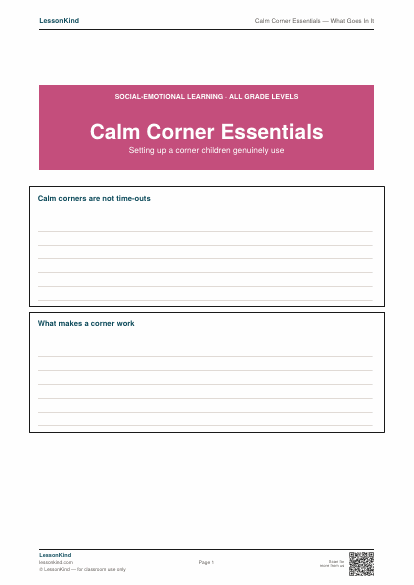
What to put in a primary classroom calm corner — soft seating, regulation tools, visual aids, calming books, quiet activities. With honest notes on what genuinely helps children self-regulate and what's just decorative.
Preview
Page count: 4. Print-ready PDF — letter / A4 friendly. Click image to see all pages.
Learning objective
Provide teachers and SENCos with a calibrated calm-corner setup list — what to include, what to avoid, and how the corner becomes a self-regulation tool rather than a 'time-out' space.
About this resource
- Subject: PSHE & SEL
- Type: Fact File
- Grade levels: Pre-Kindergarten (ages 3-4, ≈ Nursery), Kindergarten (ages 4-6, ≈ Reception / Y1), Grade 1 (ages 6-7, ≈ Year 2), Grade 2 (ages 7-8, ≈ Year 3), Grade 3 (ages 8-9, ≈ Year 4), Grade 4 (ages 9-10, ≈ Year 5), Grade 5 (ages 10-11, ≈ Year 6), Grade 6 (ages 11-12, ≈ Year 7)
- Pages: 4
- Date added: 2026-11-11
- Credit: Qualified primary teacher
What to put in a calm corner
Convenience links to Amazon. Schools often buy soft furnishings via approved suppliers, but Amazon is fine for individual classrooms.
Seating and comfort
The most important investment — children need soft seating to feel held.
-
S
Soft Cushion Set — TickiT
Two large cushions — sit, lean, hide behind -
B
Beanbag (Child-sized) — Yogibo
Cosy, hugged, comforting -
W
Weighted Lap Pad (2.5kg) — Senseez
For self-regulation through proprioceptive input -
S
Soft Throw Blanket — Various
Wrap-up, hide, settle
Regulation tools
The active tools that help children DO regulation, not just feel calm.
-
T
Time Timer 60 Minute Visual Timer — Time Timer
5-minute timer — children know how long they're staying -
S
Sensory Liquid Motion Bubbler — Soothing
Calming visual focus -
T
Tangle Junior Fidget Toys — Tom & Geo
Hand-occupying, quiet -
T
Therapy Putty — Speks
Calming, hand-strengthening
Visual aids and posters
Children regulate using visuals — the brain at high arousal can't read text well.
Books that calm
Picture books that match the calm-corner mood — gentle, slow, beautiful.
-
T
The Boy, the Mole, the Fox and the Horse — Charlie Mackesy
Reflective, slow, comforting -
R
Ruby's Worry — Tom Percival
Anxiety understood and named -
T
The Color Monster — Anna Llenas
Naming feelings -
T
The Rabbit Listened — Cori Doerrfeld
Grief, presence, calm -
T
The Owl Who Was Afraid of the Dark — Jill Tomlinson
Fear, gently
Disclosure: Links above go to Amazon. LessonKind may earn a small commission if you buy via these links — at no extra cost to you. We only link to books and items we already recommend in our resources. We are not paid by Amazon to recommend specific titles.
You might also like
Selected based on subject, grade, and type — with a free option always included.
Picture Books That Teach Big Feelings
Picture books that handle emotions, friendship, fear, anger, sadness, change, and difference well. For SEL teaching, classroom calm corners, and home reading. Carefully chosen so the books do the emotional work, not the adult.
Color the Mood — Feelings Coloring Pack
Children color faces and abstract shapes to match different feelings, then talk about how each feeling feels in their own body. Combines coloring with emotional literacy. Useful for SEL lessons, calm-down corners, and morning check-ins.
Y6 SATs Anxiety Toolkit — for Children, Parents, and Teachers
Practical strategies for managing SATs anxiety. For the children who genuinely worry. For the parents who can see it. For the teachers who want to help without making it worse. Includes specific scripts, breathing exercises, and the conversations worth having before May.
Friendship Changes in Year 6/7 — Article and Activity
An honest pack about friendship changes during transition. Some primary friendships continue; some don't. New friendships form. The pack helps children process this without shame, and helps adults talk about it without minimising. Includes a class activity, parent guide, and self-reflection prompts.
Feelings Vocabulary Poster
Beyond happy and sad — 50+ feelings words organised by intensity. Builds emotional vocabulary across KS1 and KS2.
Wellbeing Daily Check-In — Routines & Visuals
Three classroom routines for daily wellbeing check-ins — Zones of Regulation poster, How am I arriving today wheel, and a class wellbeing tracker. Print, mount, use every morning.