EAL & inclusion · 6 min read
The Stages of English Acquisition: What Teachers Need to Know
What to expect at each stage and how teaching should adapt
Published 2026-05-23
The single most common mistake teachers make with EAL pupils is treating them as a single group. 'My EAL pupils' may include: a child who arrived three weeks ago speaking no English; a child who was born here, speaks English fluently, and maintains family language at home; and everything in between. Appropriate provision is radically different for each.
The NASSEA (Northern Association of Support Services for Equality and Achievement) and Bell Foundation stages provide a useful framework:
**Stage A: New to English.** The pupil has no or minimal English. Understands little of what is said. Cannot communicate in English. May be in the silent period. Teaching response: visual support for everything; bilingual peer where possible; gesture and demonstration; home language allowed and encouraged; gentle inclusion without forced participation.
**Stage B: Early acquisition.** Beginning to communicate in English with single words or simple phrases. Understands familiar, contextualised language. Teaching response: sentence stems and frames; reduced written demand; paired work with patient English-speaking peers; vocabulary pre-teaching;
**Stage C: Developing competence.** Communicating in sentences, though with errors. Can access cognitively undemanding, contextualised tasks. Frustration common — has ideas that outrun language ability. Teaching response: maintain high cognitive challenge; reduce language demand; writing frames; oral rehearsal before writing; explicit grammar teaching through use.
**Stage D: Competent.** Can communicate effectively in most situations. Academic language still developing. May struggle with abstract, decontextualised tasks. Often invisible — mistaken for monolingual English speaker and under-supported. Teaching response: academic vocabulary development; support with subject-specific language; maintain challenge.
**Stage E: Fluent.** Appears to be at the level of a monolingual English peer. May still be developing in literacy, particularly creative and academic writing. Teaching response: continue developing academic register; celebrate bilingualism.
The BICS/CALP distinction
Jim Cummins's framework remains useful: BICS (Basic Interpersonal Communication Skills) — the conversational language used for everyday interaction — develops in 1-3 years. CALP (Cognitive Academic Language Proficiency) — the language of academic thinking, abstraction, and subject-specific discourse — takes 5-7 years to develop to native speaker level.
A child who converses confidently in English may still be 5 years from academic language parity. This is why many EAL pupils who appear 'fine' at Stage D still need support with academic writing and abstract reasoning tasks.
Free bundle for this topic
SEND Inclusion Toolkit
7 essential SEND resources covering autism, ADHD, dyslexia and emotional regulation.
Practical resources for this
Take this further
Printable, classroom-ready resources for the topics in this article.
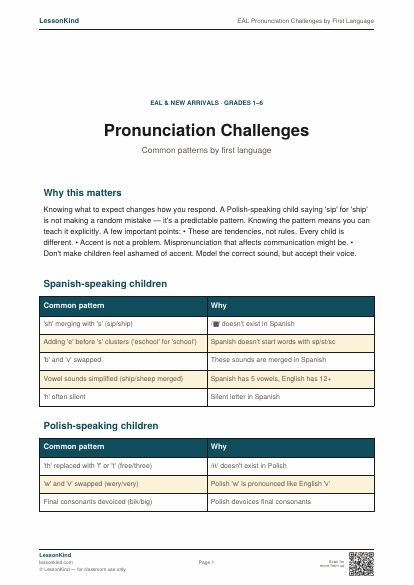
EAL Pronunciation Challenges by First Language
A practical reference: which English sounds tend to be hard for speakers of specific first languages. Covers Spanish, Polish, Arabic, Mandarin, Urdu, Somali.
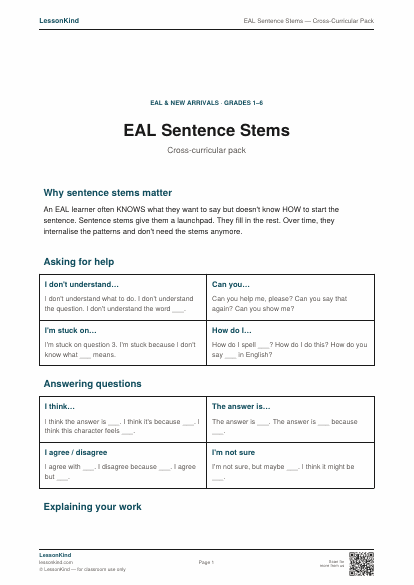
EAL Sentence Stems — Cross-Curricular Pack
Sentence starters for every part of the school day — answering questions, giving opinions, explaining work, asking for help. Print, laminate, give the child their own copy.
Going deeper
Books on EAL teaching
Books we'd recommend on the topics raised in this article.
For teachers
Convenience links to Amazon. As an Amazon Associate we earn from qualifying purchases at no extra cost to you. Read our affiliate disclosure.
Keep reading
EAL & inclusion
10 EAL Strategies Every Mainstream Teacher Should Know
Most EAL pupils spend the majority of their school day with mainstream class teachers, not specialist EAL staff. Here are ten evidence-informed strategies any teacher can use immediately.
7 min read
EAL & inclusion
What Good SEND Support Looks Like in a Mainstream Classroom
Most primary schools have solid SEND documentation. The gap is between what support plans say and what happens during lessons. Here is what effective classroom SEND support actually looks like.
7 min read