EAL & inclusion · 7 min read
10 EAL Strategies Every Mainstream Teacher Should Know
Practical approaches that help EAL pupils access learning without specialist support
Published 2026-05-22
The majority of pupils learning English as an additional language are taught primarily by mainstream class teachers — not EAL specialists. Most of those teachers received no EAL training during their initial teacher education. This is a significant gap, because EAL provision quality varies enormously depending on whether the class teacher has strategies or not.
None of the following require specialist knowledge. All can be started immediately.
**1. Don't confuse EAL with SEN.** A child who cannot yet communicate in English is not a child with a learning difficulty. EAL is not on the SEND register. The EAL profile (strong visual-spatial reasoning, good mathematical thinking, strong memory for patterns) is often masked by language acquisition. The default assumption should be normal or high ability until there is specific evidence to the contrary.
**2. Give processing time.** EAL pupils need longer to formulate responses — they are doing two cognitive tasks simultaneously: processing the language and constructing the answer. A 10-second pause after asking a question before calling for answers significantly increases EAL participation.
**3. Pre-teach key vocabulary.** Five to ten key words, taught before the lesson begins using visuals and real objects where possible, reduces the cognitive load during the lesson itself. The vocabulary mat generator can produce a set in seconds.
**4. Use visual support consistently.** Diagrams, photographs, graphic organisers, and visual timetables reduce dependence on English comprehension for basic navigation and understanding. These are good for all learners; they are essential for EAL.
**5. Pair strategically.** A bilingual peer who shares the home language is the single most effective support for a new arrival — more effective than any classroom strategy. Where this isn't possible, pair with a patient, kind pupil who speaks clearly and doesn't do the work for them.
**6. Sentence stems and writing frames.** Structured sentence starters reduce the language production demand while still requiring genuine cognitive engagement: 'I think... because...', 'The evidence shows...', 'On one hand... on the other hand...'. These are scaffolds to be gradually removed.
**7. Accept home language as thinking.** A child who thinks through a problem in their home language before translating it is not cheating — they are being cognitively efficient. Discouraging home language use in classroom contexts increases cognitive load and reduces performance.
**8. Notice the silent period.** New arrivals often pass through a silent period of weeks or even months where they are absorbing language without producing it. This is normal and healthy. Don't force verbal participation; do create low-stakes opportunities for it.
**9. Assess without language barriers.** A pupil who cannot yet explain a science concept in English may fully understand it. Assessing through drawing, sorting, matching, or labelled diagrams separates language acquisition from subject knowledge.
**10. Learn a few words of the home language.** You don't need to be fluent. Learning 'hello', 'well done', and 'don't worry' in a child's home language takes five minutes and communicates something that no classroom resource can: I see you, and I made an effort for you.
Free bundle for this topic
SEND Inclusion Toolkit
7 essential SEND resources covering autism, ADHD, dyslexia and emotional regulation.
Practical resources for this
Take this further
Printable, classroom-ready resources for the topics in this article.
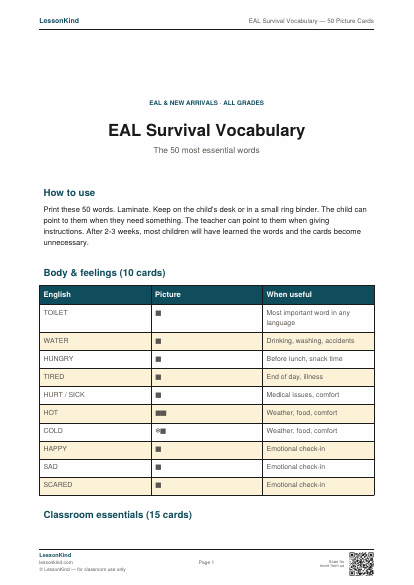
EAL Survival Vocabulary — 50 Picture Cards
The 50 most essential English words for a new arrival — toilet, water, hungry, hurt, friend, help. Picture cards to laminate and use daily.
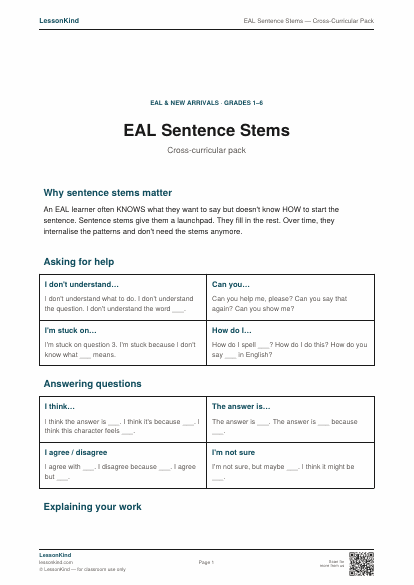
EAL Sentence Stems — Cross-Curricular Pack
Sentence starters for every part of the school day — answering questions, giving opinions, explaining work, asking for help. Print, laminate, give the child their own copy.
Keep reading
EAL & inclusion
ADHD Isn't a Lack of Attention — and Why That Matters
The label is the worst part of the diagnosis. ADHD is not 'attention deficit' — it's an attention regulation difference, and that distinction changes almost everything about how schools should respond.
8 min read
EAL & inclusion
What Good SEND Support Looks Like in a Mainstream Classroom
Most primary schools have solid SEND documentation. The gap is between what support plans say and what happens during lessons. Here is what effective classroom SEND support actually looks like.
7 min read