EAL & inclusion · 8 min read
ADHD Isn't a Lack of Attention — and Why That Matters
What ADHD actually is, what it looks like in primary, and why our default responses so often make things worse
Published 2026-08-26
The name "Attention Deficit Hyperactivity Disorder" is one of the worst things ever to happen to ADHD. Almost everything important about the condition is misrepresented by the label.
There is no deficit of attention. ADHD brains can sustain extraordinary attention on the right thing — three hours absorbed in a video game, an entire afternoon building Lego, a deep dive into a special interest. What ADHD brains struggle with is regulating attention. Choosing what to focus on. Sustaining focus on something boring. Switching between tasks at the right moment. Stopping focusing on something interesting to do something less interesting.
This sounds like a small distinction. It changes almost everything about how schools should respond.
What ADHD actually is
ADHD is a neurodevelopmental difference rooted in how the brain's executive functioning works. Executive functions are the cognitive skills that let us plan, prioritise, start tasks, hold information in mind, regulate emotion, and switch between activities. ADHD brains have structural and chemical differences (particularly involving dopamine and noradrenaline) that make these functions less reliable.
The diagnostic criteria cluster around two domains:
1. **Inattention.** Difficulty sustaining focus on boring tasks, missing details, losing things, not finishing work, struggling to follow instructions, easily distracted, forgetful in daily activities.
2. **Hyperactivity-impulsivity.** Fidgeting, leaving the seat, talking excessively, blurting out answers, interrupting, struggling to wait turns, acting without thinking.
Children may meet criteria for one cluster (inattentive presentation), the other (hyperactive presentation), or both (combined presentation). Combined is most common in clinical samples, though inattentive is probably underdiagnosed because it's quieter.
ADHD affects roughly 5-7% of children, with consistent estimates across cultures and continents. It's heavily heritable — if one parent has ADHD, the child has roughly a 50% chance of having it too. It rarely "goes away" — about two-thirds of children with ADHD continue to meet diagnostic criteria into adulthood, though presentation often shifts (less hyperactivity, more difficulty with organisation and emotional regulation).
What ADHD looks like in primary
The textbook image of ADHD is a 7-year-old boy who can't sit still and shouts out answers. This image is correct — for some children. It misses many others.
**The hyperactive boy.** Bouncing off chairs, blurting out answers, calling out "Miss!" every 30 seconds, can't get through a single instruction. Spotted from age 4 or 5. Usually diagnosed early.
**The dreamer.** Stares out the window. Misses instructions. Loses things constantly. Submits incomplete work. Smiles vaguely when you ask if she heard you. Often labelled "lazy" or "not very bright" rather than ADHD. Often female. Often missed until secondary school, sometimes never diagnosed.
**The chatterbox.** Talks endlessly. Can't quite read social cues for when to stop. Interrupts. Has lots of friends but also lots of falling-outs. Often more impulsive than truly hyperactive. May or may not get spotted.
**The emotional lightning rod.** Dysregulated emotions — small upsets become big ones, recovery takes a long time. Often labelled "behavioural" or "attachment-related" before anyone considers ADHD. Emotional dysregulation is a core feature of ADHD that's often missed because it isn't in the diagnostic criteria.
**The hyperfocuser.** Can't focus on the lesson but spends 90 minutes drawing the same dragon in the margins. Can recite every fact about ancient Egypt but didn't hear today's instruction. Hyperfocus is part of ADHD, not the opposite of it — it's still attention dysregulation, just in the other direction.
Most children with ADHD are some mix of these. Pattern recognition matters more than checklist matching.
Why our default responses make things worse
Schools have inherited a default response to "inattention and disruption" that is, for ADHD children, almost perfectly counterproductive.
**"Sit still."** ADHD children often think better while moving. Forcing stillness uses cognitive resources that should be going to learning. Wobble cushions, standing desks, errands, fidget tools — these are not indulgences, they're regulation aids.
**"Pay attention."** ADHD attention is a regulation issue, not an effort issue. Telling a child to "pay attention" is like telling someone with depression to "cheer up." They can't, by definition. Adding shame to the mix makes things worse.
**"Just try harder."** ADHD children typically ARE trying harder than peers — at least when the task is uninteresting. They're often putting massive effort into staying focused. Telling them to try harder when they've been trying harder all morning damages their self-image and rarely changes the outcome.
**Public correction.** "Sam, are you listening?" — said in front of the class — provokes either shame or defiance. Neither helps. A discreet hand on the desk, a quiet word, a private redirect — these work. Public correction doesn't.
**Removing recess.** Frequently used as an ADHD consequence. It's exactly backwards. ADHD children NEED movement to regulate. Removing recess removes their main regulatory tool, and the afternoon goes worse, not better.
**Long lectures about behaviour.** By minute 3 they've drifted off. The lecture stops being heard, and instead becomes ambient unpleasantness associated with you. They didn't learn anything; they just feel worse.
**"You did this last week too!"** ADHD includes time blindness — last week feels like ten minutes ago and like ten years ago simultaneously. Reminding them of past failures rarely improves future ones; it just adds shame to working memory load.
What works instead
A different set of responses, drawn from what actually works for these brains.
**Build movement IN.** Movement breaks every 15-20 minutes. Errands ("Sam, can you take this to the office?"). Standing or perching options at desks. Wobble cushions. Allow them to move and the rest of the lesson goes much better.
**Front-and-centre seating.** Near you. Where you can do quiet redirects. NOT at the back where you can't keep low-key contact.
**Shrink instructions.** ONE instruction at a time. Use the child's name first ("Sam — open your book"). Get attention before content. Repeat key parts in writing.
**Chunked work.** Don't put a worksheet of 30 questions in front of them. Three at a time. Check in. Three more. The attention span fits the task, not the lesson.
**Discrete redirects.** A hand on the desk. Catching their eye. A whispered "stay with me." Public correction shames; private redirect helps.
**Praise effort, not outcome.** Outcomes for ADHD children are unreliable — the same effort one day produces brilliant work, another day produces nothing. Praise the effort. They can control that.
**Make boring tasks interesting.** Their brains can't focus on boredom. Adding a timer ("can you do these 5 in 3 minutes?"), an interest ("let's do these word problems but the characters are dinosaurs"), or a genuine purpose ("this report is going to the school newsletter") often unlocks focus.
**Forgive forgetting.** Forgetting is not a moral failure — it's literally part of the disability. Don't punish lost homework, missed instructions, forgotten kit. Scaffold around it — checklists on the desk, photos of the planner, gentle reminders. Save your relationship for the things that matter.
**Repair after upset.** Emotional dysregulation means meltdowns happen. When they pass, repair. "That was hard. We're OK now. Let's try again." Don't add long debriefs in front of others.
Working with parents
ADHD is one of the most fraught areas for parent-teacher relationships, because parents have often been told (directly or indirectly) for years that their child is naughty and that they are to blame. Many are exhausted, defensive, traumatised by previous school relationships.
If you have an ADHD child whose family is open to working with you, you're lucky. If they're prickly, defensive, or absent, treat it as understandable rather than awkward. They have probably lived through a hundred difficult conversations about their child by now.
Lead with strengths. Lead with what's working. Lead with what you're doing — not what you want them to do at home. Acknowledge that parenting an ADHD child is genuinely hard. Most importantly: when something IS going well, tell them. They've had a hundred phone calls about problems. Make a few that aren't.
On medication
This is sensitive territory and not really my place to adjudicate. But a few neutral observations:
ADHD medication (most commonly stimulant medication like methylphenidate or lisdexamfetamine, sometimes non-stimulant alternatives) is one of the most effective psychiatric medications, with response rates around 70-80%. It is not a cure or a personality change — it's a regulator. For many children, it's the difference between a school day they can survive and one they can't.
That said, it's not for every child. Some children's families opt against it. Some children have side effects. Some have other conditions where stimulants aren't appropriate.
The teacher's role here is essentially neutral support: notice what's working, share observations factually, support the family in whatever path they've chosen. Don't push for or against medication. Don't comment on it without being asked. Just teach the child in front of you, with whatever support they currently have.
A final word
Children with ADHD are often funny, creative, deeply emotional, intensely loyal, and genuinely original thinkers. They are also often tired, frustrated, and ashamed by the time they reach you — because school is built for brains that are not theirs, and they've been told too many times that they're not trying hard enough.
You can be the teacher who breaks that pattern. Make the lesson fit them better. Be patient when it doesn't. Don't shame them for things they can't help. Notice when they get something right.
Their teenage and adult years are where ADHD often becomes hardest. The scaffolding you build for them now — both the practical strategies and the self-image — will outlast you.
Free bundle for this topic
SEND Inclusion Toolkit
7 essential SEND resources covering autism, ADHD, dyslexia and emotional regulation.
Practical resources for this
Take this further
Printable, classroom-ready resources for the topics in this article.
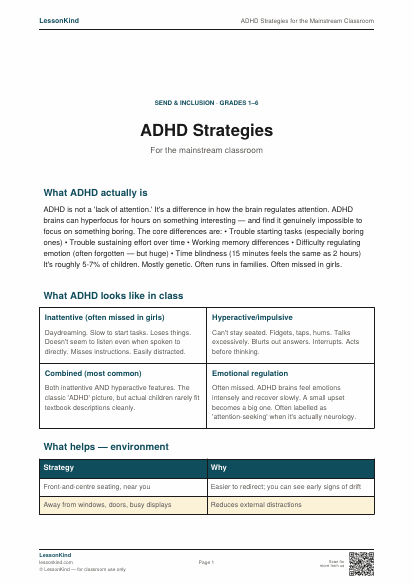
ADHD Strategies for the Mainstream Classroom
What ADHD actually looks like in primary school (it's not 'lack of focus'), and the practical strategies that consistently help in mainstream classrooms.
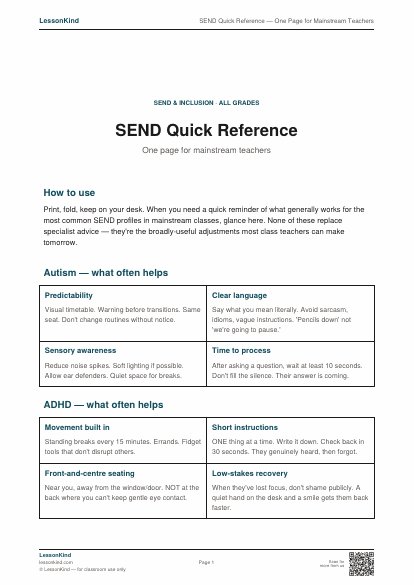
SEND Quick Reference — One Page for Mainstream Teachers
A one-page reference summarising the most useful adjustments for the four most common SEND profiles — autism, ADHD, dyslexia, anxiety. Print and stick on your desk.
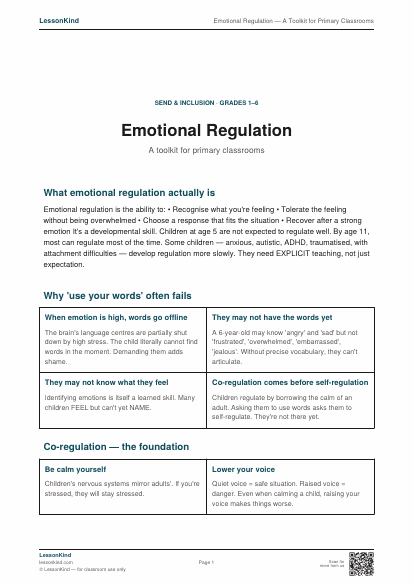
Emotional Regulation — A Toolkit for Primary Classrooms
How to teach and support emotional regulation in primary classrooms — including why 'use your words' so often fails, and what to do instead.
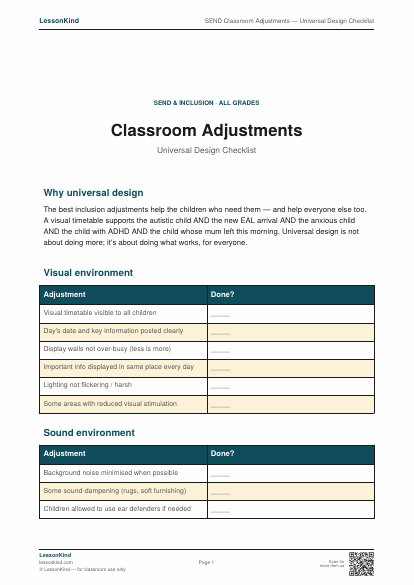
SEND Classroom Adjustments — Universal Design Checklist
A walk-through audit of adjustments that benefit children with SEND but help everyone else too. Audit your classroom in 15 minutes.
Going deeper
ADHD — recommended reading
For teachers, SENCos and parents understanding ADHD beyond the simplified 'can't focus' story.
Foundational
For UK primary practice
Convenience links to Amazon. As an Amazon Associate we earn from qualifying purchases at no extra cost to you. Read our affiliate disclosure.
Keep reading
EAL & inclusion
Understanding the Autism Spectrum in Primary School
Most teachers will have at least one autistic child in their class. Most teacher training spends maybe an hour on autism. This article fills in the gap: what the spectrum actually looks like, what helps, and the things teachers commonly get wrong.
9 min read
Behavior & classroom management
When the Kids Who Need You Most Are the Ones You Find Hardest
The marble jars and traffic lights work for the children who didn't really need them. Here's what actually moves the kids who keep blowing the system up.
8 min read
Behavior & classroom management
Anxiety in Primary Children: What's Normal and What's Not
Most primary-aged children worry. Some of them worry in ways that affect their lives. The line between these is the most consequential thing for parents to get right — and the most often blurred by anxiety culture going in both directions.
9 min read