EYFS & early years · 6 min read
Why Early Maths Experiences Matter More Than You Think
The research case for getting the first five years of maths right
Published 2026-05-20
In 2007, a major analysis of six large longitudinal studies found that early maths skills at school entry predicted later achievement more strongly than any other measured variable — including early reading, attention skills, or socio-emotional development. This finding has been replicated multiple times since.
The implication is stark: what children learn (or don't learn) about mathematics in the first five years of life has consequences that echo into secondary school and beyond.
What early maths actually involves
Contrary to a common misconception, early maths is not about recognising numerals or counting to ten. Those are surface outcomes. The underlying skills that predict later attainment are more subtle:
**Subitising** — the ability to instantly perceive small quantities without counting. Children who can subitise reliably to five by the end of Reception have a stronger number sense foundation than children who can count to fifty but must count every time.
**Number sense** — an intuitive feel for relative size, for relationships between numbers, for whether an answer makes sense. This develops through hands-on, exploratory activity — not through worksheets.
**Spatial reasoning** — understanding shape, position, pattern, and spatial relationships. Spatial reasoning in early childhood predicts maths attainment at every subsequent stage. It develops through construction play, jigsaw puzzles, physical movement, and geometry.
**Pattern recognition** — identifying, creating, and extending patterns. Pattern underpins algebraic thinking, which underpins most of upper KS2 maths.
The vocabulary gap
Children who arrive in school with strong mathematical vocabulary — more, less, same, equal, half, whole, before, after, between — outperform those without it throughout primary school. This vocabulary gap is almost entirely a home environment gap: it develops through adult-child interaction, not through formal instruction.
What this means for practice
For EYFS practitioners: prioritise exploratory, hands-on maths over formal number activities. A child who has spent forty minutes building with blocks has been doing maths. A child who fills in a number formation worksheet has been practising handwriting.
The mathematical conversations you have — 'how many more do you need?', 'can you find the same number of a different thing?', 'which one is bigger? how do you know?' — are the highest-leverage teaching you can do in the early years.
For parents: talk about numbers, quantities, shapes, and patterns in everyday life. Cooking, shopping, building, playing board games. The maths children encounter in the real world, with an attentive adult narrating it, is far more valuable than workbooks.
Free bundle for this topic
EYFS Essentials Pack
8 essentials for Reception and Kindergarten — provision, observation tools and activity cards.
Practical resources for this
Take this further
Printable, classroom-ready resources for the topics in this article.
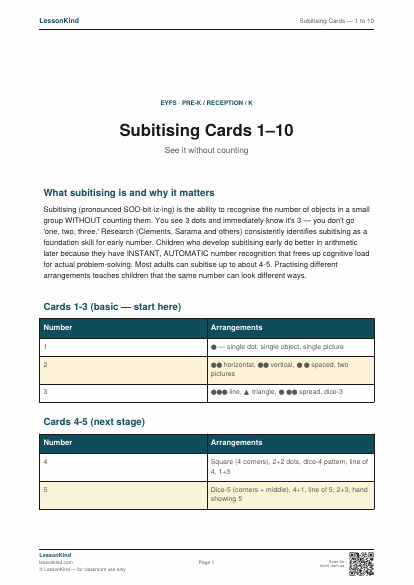
Subitising Cards — 1 to 10
Picture cards for subitising — instantly recognising small quantities without counting. The single most important early-number skill, with cards in five different arrangements per number.
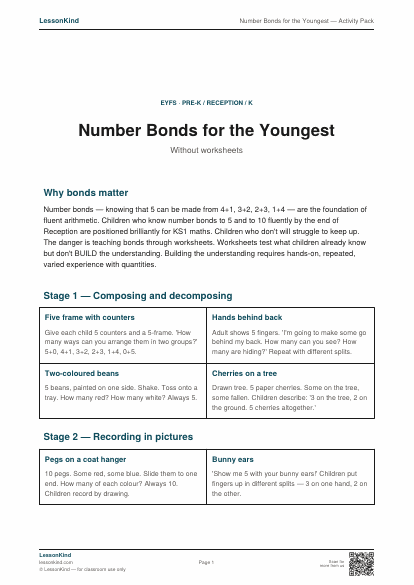
Number Bonds for the Youngest — Activity Pack
How to introduce number bonds to 5 and 10 in EYFS without worksheets — with tens-frames, real objects, story contexts and games.
Going deeper
Books on early maths development
Books we'd recommend on the topics raised in this article.
For EYFS practitioners
- M Mastering Mathematics: Teaching to Transform Achievement — Helen Drury
- M Mathematics in Nursery Education — Ann Montague-Smith
- T Teaching Mathematics 3–5: Developing Learning in the Foundation Stage — Sue Gifford
- L Learning and Teaching Early Math: The Learning Trajectories Approach — Doug Clements, Julie Sarama
Early maths equipment
Convenience links to Amazon. As an Amazon Associate we earn from qualifying purchases at no extra cost to you. Read our affiliate disclosure.
Keep reading
Math
'I'm Not a Maths Person' Is a Lie — And We Need to Stop Telling It
The belief that mathematical ability is fixed and innate is widespread, wrong, and directly harmful to children's development. Here's the evidence — and what to say instead.
6 min read
Math
'I'm Not a Maths Person' Is a Lie — And We Need to Stop Telling It
The belief that mathematical ability is fixed and innate is widespread, wrong, and directly harmful. Here's the evidence — and what to say instead.
6 min read
Parent communication
What Is EYFS? A Guide for New Parents
EYFS stands for Early Years Foundation Stage. It covers children from birth to the end of Reception. This guide explains what it is, what your child will experience, and how progress is measured.
6 min read