Parent communication · 6 min read
What Is EYFS? A Guide for New Parents
The Early Years Foundation Stage explained — what children learn, how they're assessed, and what to expect
Published 2026-05-18
EYFS stands for Early Years Foundation Stage. It is the national framework that covers the education and care of children from birth to the end of Reception year (age 5). Whether your child is in a nursery, childminder setting, or Reception class at a school, the EYFS framework applies.
What are the areas of learning?
The EYFS is organised into seven areas of learning and development:
**Prime areas (the most important foundations):** - Communication and language: talking, listening, and understanding - Physical development: gross motor skills (running, jumping, climbing) and fine motor skills (holding a pencil, using scissors) - Personal, social and emotional development: making relationships, self-confidence, managing feelings
**Specific areas (built on the prime areas):** - Literacy: early reading (phonics) and writing - Maths: number sense and shape, space and measure - Understanding the world: science, technology, history, and the wider world - Expressive arts and design: art, music, dance, drama, and imaginative play
How do children learn in EYFS?
The EYFS is explicitly play-based. This is not an accident — it reflects a large body of research showing that play is the primary vehicle through which young children learn. A child building a tower with blocks is learning about physics, spatial reasoning, and persistence. A child making a shop in the play area is learning maths, literacy, and social skills simultaneously.
What looks like play IS learning. Settings that have replaced play with formal teaching in Reception have not improved outcomes; research suggests they have made things worse.
What is the EYFS Profile?
At the end of Reception, teachers complete the EYFS Profile — a statutory assessment of whether each child has met the 'expected level of development' in each area. This is based on teacher observation over the year, not a test.
Results are sent to parents and passed to Year 1 teachers. National results are published each year.
How can you support your child at home?
Talk, talk, talk. The single most powerful thing parents can do is talk to their child — about everything. What you're cooking, where you're going, what you notice on a walk. Vocabulary gap at age 5 strongly predicts outcomes at 16. You close the gap through conversation.
Read every day. Picture books are not babyish for 4 and 5 year olds — they are cognitively rich. Read aloud even when children can read themselves. Stop and discuss the pictures, predict what happens next, notice interesting words.
Play alongside them. Children learn through play with attentive adults who extend their thinking — not through adult-directed activities. Follow their lead. Provide materials (cardboard boxes, water, sand, clay, paint) and play alongside without directing.
Don't rush phonics at home. If your child is learning phonics at school, trust the method and sequence their teacher is using. Well-intentioned but incorrect phonics teaching at home can confuse children.
Practical resources for this
Take this further
Printable, classroom-ready resources for the topics in this article.
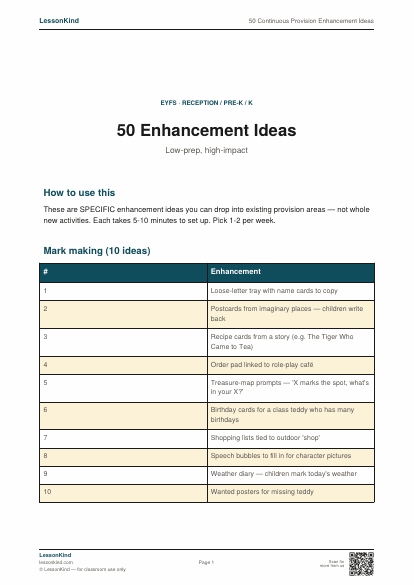
50 Continuous Provision Enhancement Ideas
50 specific, low-prep enhancements for the main provision areas — by area, by season, by skill. Useful for the Sunday-night moment when you're staring at the planning sheet.
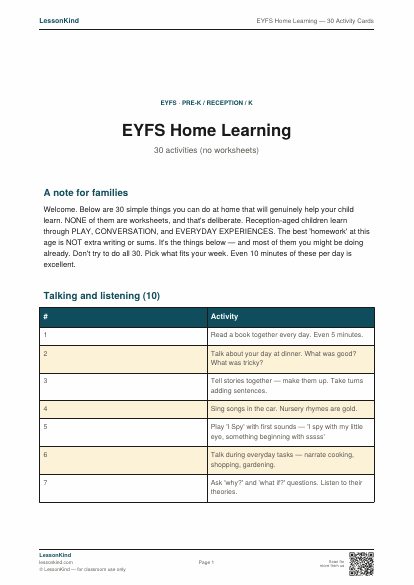
EYFS Home Learning — 30 Activity Cards
30 home-learning activities for Reception families — none of them worksheets. Cooking, walking, talking, counting, drawing — the things that actually develop young children.
Going deeper
Books for parents of Reception children
Books we'd recommend on the topics raised in this article.
For parents
Books to read with a 4-5 year old
Convenience links to Amazon. As an Amazon Associate we earn from qualifying purchases at no extra cost to you. Read our affiliate disclosure.
Keep reading
EYFS & early years
What Reception Teachers Know That the Rest of the School Should
Reception teachers operate with a different framework from the rest of primary — one that the rest of the school could learn a great deal from.
6 min read
EYFS & early years
What Reception Teachers Know That the Rest of the School Should
Reception teachers operate with a different framework from the rest of primary — one the whole school could learn from.
6 min read
Parent communication
How to Help Your Primary Child With Reading at Home
Reading at home matters, but the approach makes all the difference. Here's what the research says about how parents can genuinely support a child's reading — and what to avoid.
7 min read