EAL & inclusion · 7 min read
Five Myths About Bilingual Children (And What the Research Actually Says)
From 'speaking two languages confuses children' to 'switch to English at home'
Published 2026-08-22
Almost every primary teacher has, at some point, given parents of an EAL child advice that turned out to be the opposite of what the research recommends. This isn't because teachers are uninformed — it's because the conventional wisdom about bilingual children is decades behind the evidence, and very few teacher training programmes cover it.
Here are five common myths, and what we actually know.
Myth 1: "Speaking two languages confuses children"
The intuitive worry: a child being raised with two languages will have neither well, mixing them up, struggling to keep them separate, ending up half-fluent in both.
The research: this isn't really how it works. From early infancy, bilingual children differentiate their languages. They might do this remarkably young — research using head-turn paradigms suggests babies can distinguish languages by their rhythm at just a few days old. By preschool, bilingual children can switch between languages depending on who they're speaking to with surprising sophistication.
What CAN happen is "code-switching" — moving between languages within a single conversation, or borrowing a word from one language because it's the right word for the moment. This used to be seen as a sign of confusion. It's now seen as a sign of fluency. It requires holding both languages active and selecting between them rapidly — something only confident bilinguals can do.
What teachers see when they think a child is "confused" is often a child whose vocabulary in one language is ahead of the other in some areas, behind in others. This is normal. It evens out by adolescence in most cases.
Myth 2: "If they're going to learn English, they should drop their first language"
The intuitive worry: every minute spent on Polish, or Urdu, or Arabic, is a minute not spent on English. Switch the home language to English and the child will catch up faster.
The research: the opposite. Children with strong first languages acquire second languages BETTER, not worse. The cognitive infrastructure for language — concepts, vocabulary, grammar — transfers between languages. A child who knows what a "river" is in their first language only needs to learn the English word, not the underlying concept. A child whose first language is being eroded loses that infrastructure too.
The classic finding here is from Jim Cummins's work on "common underlying proficiency" — the idea that languages share a common cognitive base. Strengthen that base in any language and you strengthen it for all of them.
This is why advice like "stop speaking [Polish/Arabic/Urdu] at home, only English" is actively harmful. It deprives the child of: - Their main source of cognitive and linguistic stability - The relationship language they share with their family - A healthy sense of bilingual identity - The very foundation that helps L2 acquisition
What parents should do instead: read to the child in L1. Tell stories in L1. Watch films in L1. Sing songs in L1. Then let the school provide the English. Both grow together.
Myth 3: "If they speak English fluently to friends, they're fine"
The intuitive worry — actually a reverse one. If the child chats happily in English at break, surely they're fully bilingual now and don't need extra support?
The research: this is the trap that catches more EAL learners than any other. The distinction the research makes is between BICS (Basic Interpersonal Communication Skills) and CALP (Cognitive Academic Language Proficiency). BICS is the language of friendship, of asking for things, of describing what you can see. CALP is the language of textbooks, exam questions, abstract reasoning, multi-clause grammar.
Cummins's research suggests BICS typically takes 2 years to develop. CALP takes 5–7 years. A child who has been in your country for 18 months may sound fully bilingual on the playground but still struggle to access a Year 5 history lesson.
This matters because EAL children at the BICS-but-not-CALP stage are often labelled as "low ability" rather than "still acquiring academic language". They're given simpler work because they "should be fluent by now". They're written off academically when in fact they need the same kind of language scaffolding as a recent arrival, just at a higher level.
If you have an EAL child who chats fluently but struggles with multi-step worded math problems, complex written texts, or formal academic writing — they don't have a learning difficulty. They're at the BICS/CALP gap. Keep scaffolding language and they'll continue to develop for years.
Myth 4: "Children pick up languages faster than adults"
The intuitive worry — and a surprisingly common bit of folk wisdom. Children are language sponges. They'll pick up English in a few months without any special support.
The research: it's more complicated. Children DO have some advantages — they typically end up with more native-like accents, they integrate socially faster, they don't have the self-consciousness that adult learners have. But they don't actually learn vocabulary or grammar faster than adults in controlled conditions. In some areas, adult learners progress more quickly because they bring metacognitive awareness ("oh, this is the past tense, like in my own language") that children don't yet have.
The misleading thing is that children are usually IMMERSED — surrounded by the new language all day at school — while adult learners typically aren't. Five hours a day of English exposure for a child equals years of weekly classes for an adult. So children seem to learn faster, but it's mostly volume of exposure, not faster processing.
The implication for teachers: don't assume the child will pick up English by osmosis just because they're young. They need explicit teaching, structured input, and a great deal of repetition. The "they'll just pick it up" assumption is one of the most common reasons EAL learners don't get the support they need in primary schools.
Myth 5: "Bilingual children have lower IQs"
The intuitive worry: an old one, but it persists. If the child has half their attention on each language, surely both are weaker?
The research: bilingual children, on every well-controlled study, do at least as well as monolingual peers, and on certain tasks notably better. Specifically, bilingualism is associated with: - Better executive function (the brain's ability to switch tasks, suppress distractions) - Better metalinguistic awareness (understanding how language itself works) - Some evidence of delayed onset of dementia in elderly bilinguals - More flexible cognition generally
What used to make bilingual children look worse on tests was that the tests were administered in one language only — usually their weaker one. When testing was bilingual, or when the child could choose, the apparent deficit disappeared.
This doesn't mean bilingualism is a magic boost (research is more cautious about specific claims now than in the early 2000s). But the old idea that two languages dilute the mind is wrong. Two languages enrich it.
What this means for our practice
If you take five things from this article:
1. A child speaking their first language at home is doing themselves a favour, not holding themselves back. 2. Code-switching is fluency, not confusion. 3. Conversational English is not academic English. The gap between them lasts years. 4. Children don't learn languages magically. They need structured support. 5. Bilingual children's brains are not divided. They are integrated and, in some ways, more flexible.
Mostly, what teachers and schools need to do is push back against well-meaning bad advice — both their own and that of others. The grandparent who says "no Polish at home, only English." The previous teacher who said "she's fluent now, she doesn't need EAL support." The well-intentioned colleague who suggests testing the bilingual child for a learning difficulty.
The research doesn't agree with any of them. We have decades of clear evidence about how bilingual children develop. It's mostly good news. We just need to act on it.
Free bundle for this topic
SEND Inclusion Toolkit
7 essential SEND resources covering autism, ADHD, dyslexia and emotional regulation.
Practical resources for this
Take this further
Printable, classroom-ready resources for the topics in this article.
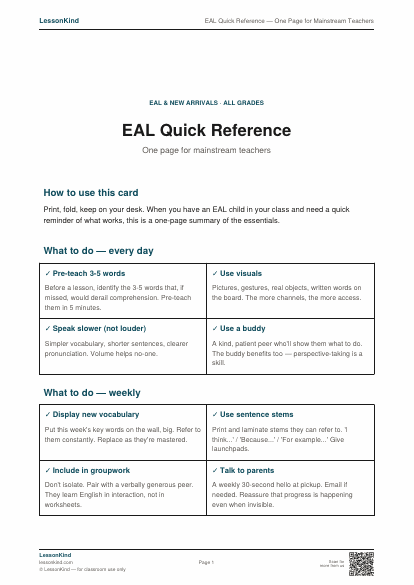
EAL Quick Reference — One Page for Mainstream Teachers
A one-page reference card summarising the most important things mainstream teachers need to know when supporting EAL learners. Print and stick on your desk.
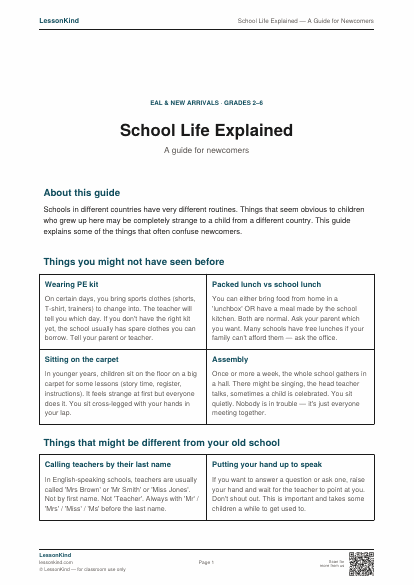
School Life Explained — A Guide for Newcomers
An illustrated guide explaining the unwritten rules of school in English-speaking countries — for children newly arrived. Covers PE kits, packed lunches, assemblies, school trips and more.
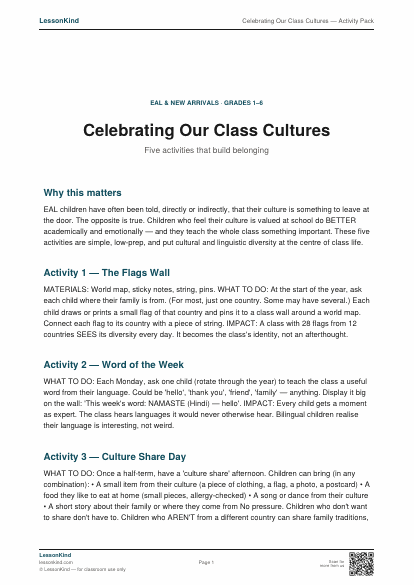
Celebrating Our Class Cultures — Activity Pack
Five activities that put EAL children's cultures at the centre — a class flags wall, a 'word of the week' from a child's language, a culture share day, and more.
Going deeper
Bilingual children — recommended reading
What the research actually says about raising and teaching bilingual children.
For teachers and parents
Convenience links to Amazon. As an Amazon Associate we earn from qualifying purchases at no extra cost to you. Read our affiliate disclosure.
Keep reading
EAL & inclusion
Teaching a Child Who Doesn't Speak Any English Yet
When a new arrival is sat at the back of your class with no English and no warning, here's what to do in the first hour, the first week and the first term.
9 min read
EAL & inclusion
The Silent Period — Why Your EAL Child Isn't Speaking
When a new EAL arrival barely speaks for weeks, teachers worry. The silent period is well-documented in the research, almost universal, and often a sign of cognitive work happening below the surface.
6 min read