EAL & inclusion · 9 min read
Teaching a Child Who Doesn't Speak Any English Yet
Practical first steps for the day a new arrival joins your class
Published 2026-08-05
You arrive on Monday morning. The office tells you a new child will be joining your class at 9 a.m. They speak no English. They arrived from Ukraine — or Syria, or Albania, or Eritrea — three weeks ago. There has been no transition meeting, no language assessment, no preparation. Their parent stands awkwardly in the corridor with paperwork. The bell goes.
This article is for that day, and the days that follow.
The first hour
You will not solve the language gap today. Your one job in the first hour is to make this child feel safe and welcome enough to come back tomorrow. That's it.
**Greet warmly.** A smile, a wave, a hand on the heart, your name. They won't understand what you're saying, but they will understand the tone.
**Pair them with the right buddy.** Not your most academically able child. Not your bossiest. The kind one. The patient one. Ideally a child who is themselves bilingual or has been new before. Tell the buddy: "This is X. They don't speak much English yet. Show them where to put their bag. Show them the toilet. Sit next to them today. If they look lost, just smile at them. That's all you need to do."
**Lower the stakes for the lesson.** Don't expect them to participate in maths today. Give them a simple drawing or copying task they can complete without language: tracing letters, copying a pattern, sorting objects, drawing themselves and their family. Let them sit and observe. Observation is learning. Children acquiring a second language often have a "silent period" of weeks or months where they take everything in but speak almost nothing. This is normal. It is not laziness or refusal.
**Use a visual timetable.** Pictures of the day's activities, in order, on their desk. Even a child with zero English can follow "literacy → snack → maths → playtime → lunch" if it's drawn.
The first week
Once the immediate panic has passed, set up the systems that will support this child for the next six months.
**Find out their first language.** This matters more than you'd think. Use Google Translate to greet them in their language for the first week. ("Welcome", "Good morning", "Are you OK?", "This is the toilet"). It signals respect, and it's often the first time they've heard their language at school.
**Get a phone-based translator working.** Google Translate's conversation mode works astonishingly well for basic exchanges. The Microsoft Translator app does similar. Don't rely on a child interpreter for emotional or sensitive conversations — that's not their job. But for "do you need water?" or "show me where it hurts?", it works.
**Use lots of pictures.** Print or laminate a small communication board for their desk: pictures of toilet, water, food, hot, cold, hurt, sad, happy, help, finished. Point and let them point back. This bridge gets them through the first month.
**Don't talk at them louder.** Speaking English LOUDLY does not make it easier to understand. Speaking SLOWER, with simpler vocabulary and fewer words at a time, does. "Sit. Here. Please." not "If you wouldn't mind taking a seat at this desk for me please darling, that would be very helpful."
The first term — the bigger picture
Children acquiring a new language tend to follow a predictable rough trajectory. Knowing this will save you panic.
**0–6 weeks: silent period.** They listen, they observe, they may say almost nothing. This is normal. They're not "behind" — they're absorbing.
**6 weeks to 6 months: survival English.** Single words and short phrases. "Toilet?" "Yes." "No." "Water." "I do." They're starting to communicate but it's basic.
**6 months to 2 years: conversational fluency.** They can chat with friends, follow most lessons, joke around. To an outside observer they might seem fully bilingual. They are not yet — academic language takes longer.
**2–7 years: academic fluency.** This is the long tail. Their playground English may be perfect, but writing essays, decoding complex worded math problems, understanding figurative language — these continue to be challenging years after they "seem fluent". This is the most misunderstood phase. Children at this stage are often expected to perform like first-language English speakers and labelled as "lazy" or "low-ability" when they fall short. They are neither. They're still acquiring.
The research consensus on this trajectory is solid; if you want the formal terms, look up "BICS vs CALP" — Basic Interpersonal Communication Skills versus Cognitive Academic Language Proficiency, terms coined by Jim Cummins in the 1980s and still standard in EAL research.
Specific things that help
A few practical strategies that genuinely help children acquiring English in your room.
**Pair speaking with doing.** Instead of explaining, demonstrate. Pour water into a cup as you say "pour water into the cup". Repeat. They'll learn the verb pour faster than from any vocabulary list.
**Repetition is your friend.** New language has to be heard many, many times before it sticks. Use the same sentence stems again and again. "Today is Monday." "Today is Tuesday." "Today is Wednesday." Don't worry about boring them — they need this.
**Let them speak in their first language at home.** Some parents are told (wrongly) that they should switch to English at home to help. The opposite is true. A strong first language is the best foundation for a strong second language. Tell parents to read with their child in their first language, talk in their first language, keep it alive. Their English will come.
**Let them write in their first language sometimes.** If they can read and write in their L1, let them do so for parts of literacy. They're still developing the cognitive habits of writing, even if not in English.
**Don't expect them to be your interpreter for new arrivals.** A common (and well-meaning) mistake is to ask the existing bilingual child to translate for new arrivals. Sometimes this is fine and they're proud to help. Often it's a burden, especially around emotional topics. Ask the child first if they want to. Don't assume.
What to expect from yourself
You will feel inadequate. Almost every teacher with an EAL new arrival does. You'll worry you're letting them down — you're not differentiating enough, you're not giving them the language input they need, you're not supporting their family well enough.
Here's the truth: a warm classroom with a kind teacher and patient children is, by itself, an enormous gift to a child new to English. They will pick up an extraordinary amount just from being there. You don't need to be a specialist EAL teacher. You need to be a kind, observant, patient one.
If your school has an EAL coordinator, use them. If not, the British Council's "Learn English" resources, the National Association for Language Development in the Curriculum (NALDIC) website, and BBC Bitesize all have free EAL-friendly material.
A small thing that helps
In the first week, find out one or two things they like — football, drawing, a particular game, a snack — and bring it into the classroom. A football pencil case. A picture of their team on the wall. The world's smallest bridge into a new place. They'll notice. Often it's the moment they decide school here might be OK.
Free bundle for this topic
SEND Inclusion Toolkit
7 essential SEND resources covering autism, ADHD, dyslexia and emotional regulation.
Practical resources for this
Take this further
Printable, classroom-ready resources for the topics in this article.
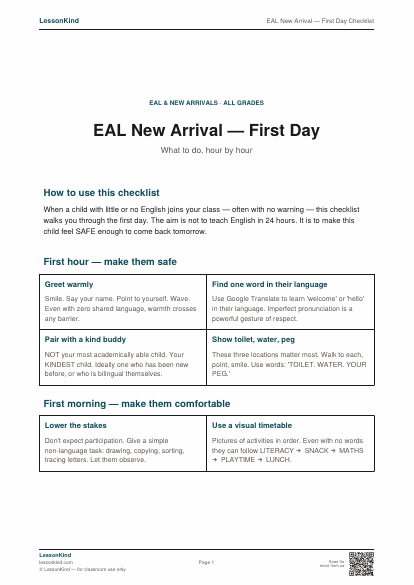
EAL New Arrival — First Day Checklist
What to do in the first hour, first morning and first afternoon when a child with no English joins your class. Practical, kind, ready to print.
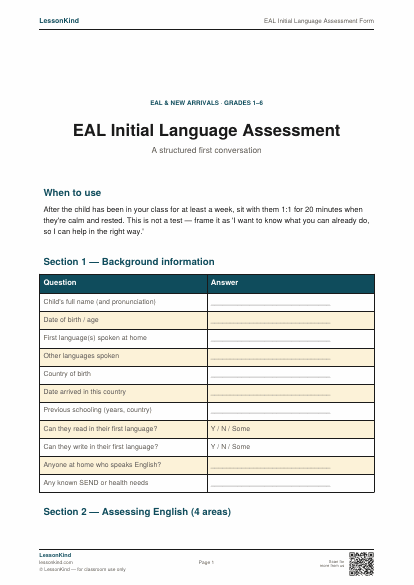
EAL Initial Language Assessment Form
A printable form for the first formal EAL assessment — based on the DfE Proficiency in English scale. Use in week 2-4 once child has settled.
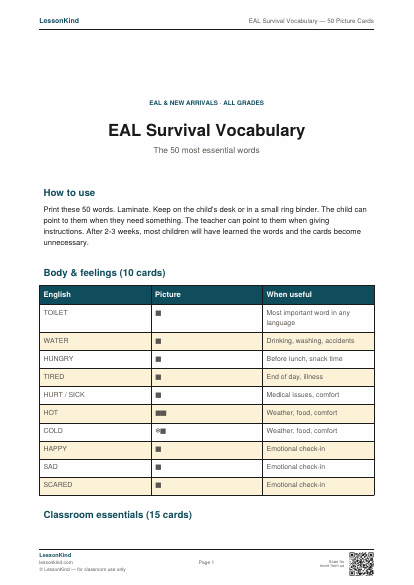
EAL Survival Vocabulary — 50 Picture Cards
The 50 most essential English words for a new arrival — toilet, water, hungry, hurt, friend, help. Picture cards to laminate and use daily.
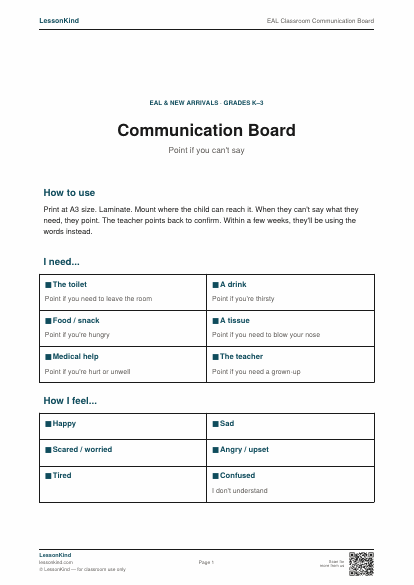
EAL Classroom Communication Board
A single-sheet visual board children can point to when they don't have the English to say what they need. Print A3, laminate, mount on the wall.
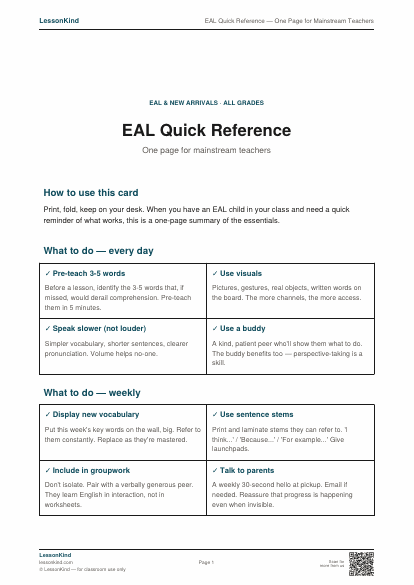
EAL Quick Reference — One Page for Mainstream Teachers
A one-page reference card summarising the most important things mainstream teachers need to know when supporting EAL learners. Print and stick on your desk.
Going deeper
EAL — recommended reading
Practitioner books for class teachers and SENCos welcoming a new arrival.
Practitioner foundational
Convenience links to Amazon. As an Amazon Associate we earn from qualifying purchases at no extra cost to you. Read our affiliate disclosure.
Keep reading
EAL & inclusion
The Silent Period — Why Your EAL Child Isn't Speaking
When a new EAL arrival barely speaks for weeks, teachers worry. The silent period is well-documented in the research, almost universal, and often a sign of cognitive work happening below the surface.
6 min read
EAL & inclusion
Five Myths About Bilingual Children (And What the Research Actually Says)
Five widely-held beliefs about bilingual children that turn out to be wrong, with the research that should replace them. Useful for teachers, parents and school leaders.
7 min read