Teaching strategy · 8 min read
How to Teach KS2 Writing: A Practical Guide
From composition through to transcription — what works and what doesn't
Published 2026-05-21
Writing is the most cognitively demanding thing we ask children to do in primary school. It requires simultaneous management of composition (what to say and how to structure it) and transcription (spelling, punctuation, handwriting or typing). These are separate skills and often compete for working memory. A child who is still working hard on spelling has less working memory available for composition — and vice versa.
Understanding this distinction is the foundation of effective writing teaching.
Composition before transcription in the teaching sequence
The most common mistake in KS2 writing is teaching transcription as if it were the same as writing. Correcting spelling and punctuation errors without engaging with whether the writing says something interesting is transcription feedback. It produces technically correct but empty writing.
Sequence matters. First: what do you want to say and why? Second: how can you structure it? Third: what language choices? Finally: transcription (spelling, punctuation, grammar). Teachers who spend most feedback time on transcription inadvertently signal that transcription is what writing is.
Immersion and reading like a writer
Before children write in any form, they need to be saturated in that form as readers. A child who has read and heard ten excellent persuasive letters will write a better persuasive letter than one who has received a list of features. This is not a nice-to-have; it is the mechanism.
Implications: read aloud every day. Study texts not just for comprehension but for craft. Ask 'why did the writer choose this word?' 'What effect does this have?' 'Could you write a sentence like this?'
Modelled writing (shared writing)
The most powerful teaching technique for writing is the teacher writing in front of the class, thinking aloud. Not showing a finished piece — composing live, making decisions visibly, crossing things out, trying alternatives.
'I'm going to start with a question. Which question would be more interesting — this one or this one? Why?' The teacher demonstrates that writing involves choice, that first attempts are provisional, and that good writing comes from deliberate decision-making.
This is different from showing a WAGOLL (What A Good One Looks Like). Both have value, but the live composition demonstrates process rather than product.
Increasing genuine choice
Children write best when they have genuine stake in the content. The genre, form, and structure can be specified; the content and voice should have room to be the child's own. A teacher who specifies 'write a setting description of a spooky house' and then corrects any setting that doesn't conform to their idea of a spooky house has reduced the child's investment to zero.
The drafting culture
Good writing is rewriting. Children who never redraft — or who only redraft to correct transcription errors — do not develop a drafting habit. They produce first drafts and hand them in as finished work.
Building genuine drafting into the process: share a piece and ask 'what would you change if you could improve it?' Show the teacher's own drafts with crossings out. Create time for revision after publication — not just before. Model changing content, not just correcting errors.
Practical resources for this
Take this further
Printable, classroom-ready resources for the topics in this article.
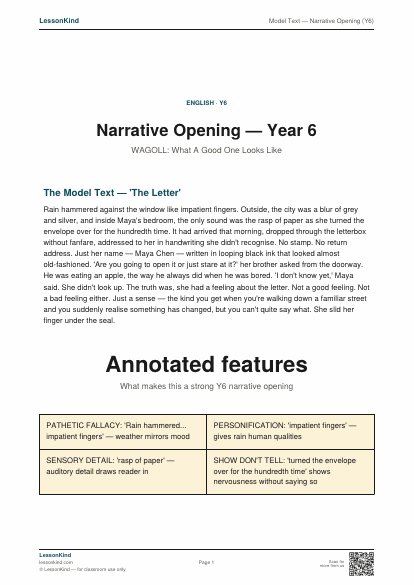
Going deeper
Books on teaching writing in primary
Books we'd recommend on the topics raised in this article.
Essential reading for teachers
Convenience links to Amazon. As an Amazon Associate we earn from qualifying purchases at no extra cost to you. Read our affiliate disclosure.
Keep reading
Teaching strategy
What Is a Knowledge Organiser — and How Should Pupils Use One?
Knowledge organisers are widely used in primary schools. The rationale is strong. But the gap between distributing them and pupils actually learning from them is often large — and almost entirely about use, not design.
6 min read
Reading & literacy
How to Run Guided Reading in a Primary Classroom
Guided reading is one of the most time-intensive elements of primary English. Done well it is highly leveraged; done badly it produces worksheets. Here is what a well-run session looks like.
7 min read