Reading & literacy · 7 min read
How to Run Guided Reading in a Primary Classroom
Structure, grouping, texts, and questioning that make guided reading work
Published 2026-05-16
Guided reading is a teacher working with a small group of pupils who are reading at a similar level, listening to them read, questioning their comprehension, and explicitly teaching reading strategies. Done well, it is one of the most high-leverage uses of teaching time in primary literacy.
What guided reading is not
Not round-robin reading. Not silent reading supervised by an adult. Not comprehension worksheets completed independently. Not listening to one child read while others wait.
Grouping
Guided reading groups are typically organised by reading level because the text needs to challenge every member appropriately. This does not mean fixed ability groups. Review groupings at least termly.
Practical structure: four to six groups, each meeting the teacher once or twice per week for twenty to twenty-five minutes. While the guided group meets with the teacher, the rest of the class works independently or with a teaching assistant on short focused tasks.
Choosing the text
Guided reading texts should be at the instructional level: slightly challenging but accessible with support. Too easy and there is nothing to teach. Too hard and the group spends all their time decoding rather than comprehending.
Vary the texts: fiction, non-fiction, and poetry across the year. Non-fiction is frequently underprioritised but uses different skills that need explicit teaching.
Session structure
**Before reading (3-5 min):** activate prior knowledge; preview the text from title, blurb, images; make a prediction.
**During reading (8-10 min):** pupils read quietly while the teacher listens to individuals and takes brief notes. Pause at key moments: what happened? What does this word mean? What do you predict next?
**After reading (7-8 min):** targeted questions across retrieval, vocabulary, inference, and summary. Discuss rather than quiz. You want to hear their thinking process.
Effective questioning
Ask pupils to locate evidence in the text for any claim. Use agree-or-disagree prompts to force engagement with interpretation. Ask why more than anything else. Why did the author choose this word? Why did the character do that? Why is this chapter called this?
The VIPERS framework organises question types: Vocabulary, Inference, Prediction, Explain, Retrieval, Sequence or Summarise. A question bank organised by VIPERS ensures coverage across groups and sessions.
The independent work problem
The practical challenge is what the rest of the class does while you work with a group. Establish independent tasks early in the year so the expectation is clear. Short focused tasks work better than long open-ended projects. Have a protocol for pupils who are stuck that does not involve interrupting the guided group.
Free bundle for this topic
EYFS Essentials Pack
8 early-literacy essentials — provision, phonics-readiness, mark-making and storytime support.
Practical resources for this
Take this further
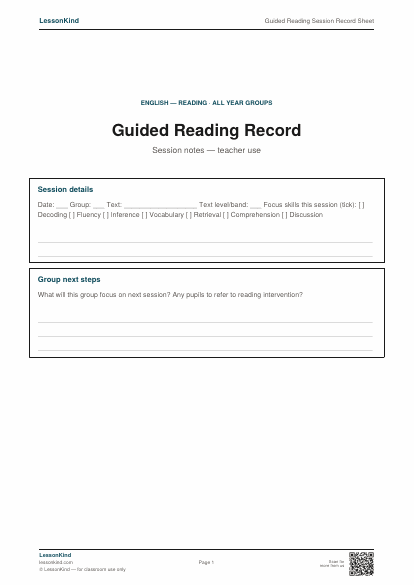
Printable, classroom-ready resources for the topics in this article.
Going deeper
Books on guided reading
Books we'd recommend on the topics raised in this article.
For teachers
Convenience links to Amazon. As an Amazon Associate we earn from qualifying purchases at no extra cost to you. Read our affiliate disclosure.
Keep reading
Parent communication
What Are Reading Levels and Book Bands? A Guide for Parents
Primary schools use book bands and reading levels to organise reading books. Here's what the colours mean, what age children should be at each level, and what actually matters.
5 min read
Parent communication
How to Help Your Primary Child With Reading at Home
Reading at home matters, but the approach makes all the difference. Here's what the research says about how parents can genuinely support a child's reading — and what to avoid.
7 min read