Parent communication · 6 min read
How to Write School Reports That Parents Actually Find Useful
The difference between reports that inform and reports that reassure
Published 2026-05-18
Report writing season typically falls in May or June and can consume weeks of teacher time. A lot of that time produces reports that contain almost no information. Here's how to do better, without spending more time.
The core problem with most reports
Most school reports fail for the same reason: they are written to reassure rather than to inform. They contain generic praise ('Harry is a kind and enthusiastic member of the class who always tries his best'), vague acknowledgement of effort, and a single imprecise target at the end. The parent learns almost nothing about what their child can do, what they can't, and what specifically should happen next.
This happens for understandable reasons: teachers write 30 reports in a short period; negative comments invite defensive responses from parents; school policy often requires a positive tone; and the word count is typically tight.
But the result is that parents whose children are significantly below expected standard often don't know until a face-to-face meeting — because the report didn't say so clearly.
What makes a good report comment
**Specific strengths.** Not 'excellent at maths' but 'explains her working clearly and checks her answers using inverse operations'. Specific = memorable = useful.
**Honest acknowledgement of difficulty.** 'Still developing fluency in times tables' is more useful than 'working on times tables'. Parents can handle honesty if it's delivered professionally.
**A concrete next step.** Not 'keep reading at home' but 'ask him to explain what he's read in his own words — this builds the inference skills we're developing in class'. The more specific the target, the more likely a parent acts on it.
**Genuine voice.** Reports that sound like every other report give no sense of the individual child. One or two specific, particular details ('her explanation of the water cycle using the whiteboard was one of the best I've seen this year') take 20 seconds to write and make the report memorable.
How to be efficient
Batch similar children. Write all the high-attaining readers in one session, all the developing writers in the next. This reduces cognitive switching and creates natural consistency.
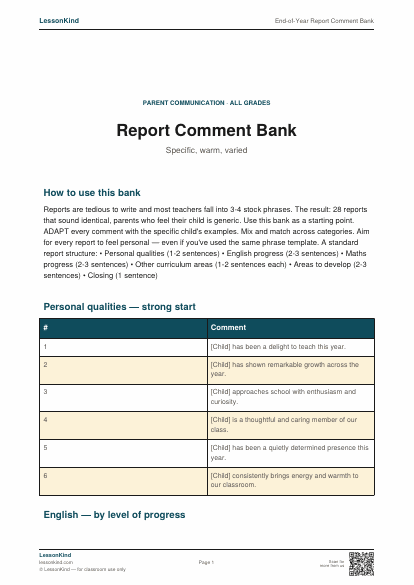
Use a comment bank strategically. A bank of subject-specific starters is a time-saver, not a shortcut, as long as you personalise the second sentence.
Write the difficult reports first. The reports for children with complex needs, those significantly below expected, or those with difficult family situations require the most thought. Do them when your brain is freshest.
The tone question
There is no requirement for school reports to be relentlessly positive. They should be professional, respectful, and honest. A parent whose child has had a difficult year deserves a report that acknowledges it and says clearly what support is in place. Pretending otherwise doesn't serve the child.
If you are uncertain whether a comment is appropriate, ask yourself: if this parent came into school tomorrow having read this report, would they be surprised by anything you told them in person? If yes, the report isn't doing its job.
Practical resources for this
Take this further
Printable, classroom-ready resources for the topics in this article.
Going deeper
Books on parent communication and school reports
Books we'd recommend on the topics raised in this article.
For teachers
Convenience links to Amazon. As an Amazon Associate we earn from qualifying purchases at no extra cost to you. Read our affiliate disclosure.
Keep reading
Parent communication
Talking to Parents About Difficult Things
Sooner or later, every elementary teacher has to tell a parent something they don't want to hear. Here's how to do it well.
6 min read
Assessment & feedback
Assessment for Learning: 7 Techniques That Actually Work
Formative assessment is one of the highest-leverage things a teacher can do. Here are seven techniques with strong evidence and clear practical application.
8 min read