Parent communication · 6 min read
Talking to Parents About Difficult Things
How to deliver hard news with care and clarity
Published 2026-06-25
At some point, every elementary teacher has to make the conversation no one wants to have. You'll need to tell a parent that their child is struggling. That their child has hurt another child. That their behavior at home is showing up at school. That their reading is well below where it should be. That you're worried about something.
Here are a few things experienced teachers have learned about doing this well.
Lead with what you've noticed, not what you've concluded
There's a big difference between "Your child is anxious" and "I've noticed that your child sometimes starts crying when we have a math test, and is sometimes reluctant to come into class on Mondays".
The second is harder to argue with — it's facts. The first is a label, and parents will (rightly) push back on labels. State what you've SEEN. Let the parent help you make sense of it.
Don't ambush
If the conversation is going to be hard, don't let the parent walk into it cold. A short note or call earlier in the day — "I'd love to talk for a few minutes after school today, nothing urgent, just want to share some things I've been noticing" — gives them time to mentally prepare. They'll show up better than if you sprung it on them.
Choose your space
Not in front of other parents. Not at the door at pickup with a child holding their hand. If it's a serious conversation, you need a quiet room and at least 15 minutes. If you don't have those, schedule. Don't squeeze a real conversation into the wrong moment.
Start with what's going well
This isn't a sandwich technique to soften bad news. It's a reminder — to YOU and to the parent — that this is a whole child, not just a problem. "She's brilliant in art, and her friendships have been really strong this term. There's something I want to share too, though, that I've been thinking about." This is honest. This is true. It earns you the right to share the harder thing.
Use "I'm wondering" instead of "I think"
"I'm wondering whether something might be happening at home, or whether this is something that's just for school" is genuinely curious. "I think there's something going on at home" is a guess presented as fact. Parents will resist the second; they'll often open up in response to the first.
Listen at least as much as you talk
Some of the most useful information in any conversation comes after you've stopped speaking. If a parent goes quiet, let the silence sit. Often that's when they say the thing that actually matters — about a divorce, an illness, a worry, a backstory you couldn't have known.
Agree what comes next, in writing
By the end, you should both know: - What I'll do at school (with timeline) - What you'll try at home (with timeline) - When we'll check back in
Send a follow-up email the same day summarizing those three things. Not because you don't trust the parent — because everyone forgets. The email becomes the document you both work from.
When to bring in your colleagues
Some conversations are too big for one teacher alone. If you're talking about possible neurodevelopmental concerns, safeguarding worries, or a deteriorating mental health picture — loop in your school's SENCO, counselor, or principal early. You don't have to handle it solo, and frankly, shouldn't.
The most important thing
Parents — even the prickly ones, even the ones who seem in denial — almost always love their children fiercely and want them to do well. They are usually NOT the enemy. If you walk into the conversation believing that, your tone will be different, and the conversation will go better.
Most difficult conversations, done well, end with the parent saying some version of "thank you for telling me" and meaning it.
That's the goal.
Practical resources for this
Take this further
Printable, classroom-ready resources for the topics in this article.
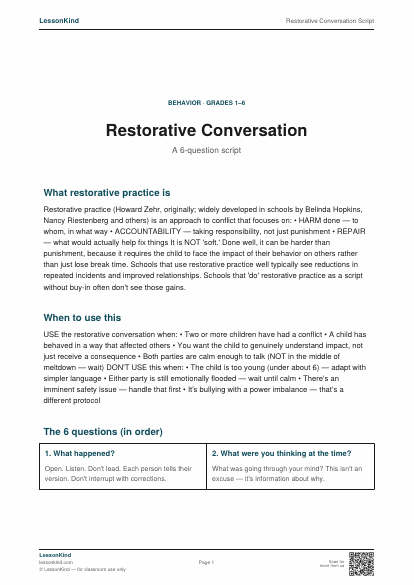
Restorative Conversation Script
A simple 6-question script for restorative conversations after a behavior incident. Follows the standard restorative practice format — focused on harm, accountability, and repair.
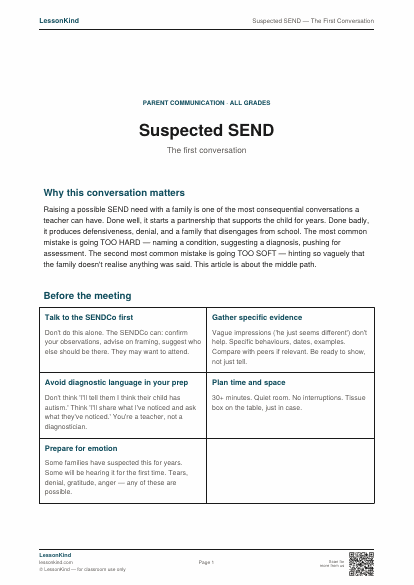
Suspected SEND — The First Conversation
How to raise the possibility of a SEND need with a family for the first time — without diagnosing, without panicking parents, and without backing off when you shouldn't.
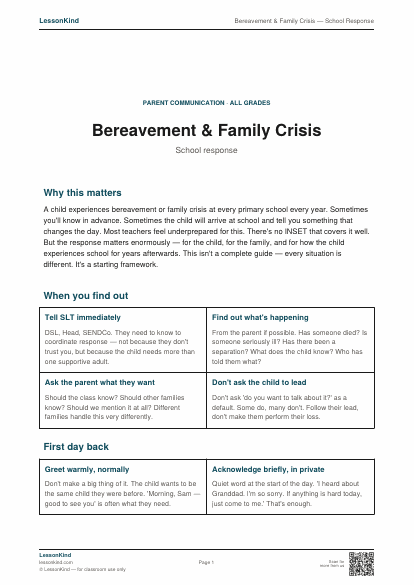
Bereavement & Family Crisis — School Response
How a primary school responds when a child experiences bereavement, illness, separation, or family crisis — the first conversation, the first day back, the longer-term support.
Going deeper
Reading on hard conversations
Books that help with the hardest conversations — with parents and beyond.
Foundational
Convenience links to Amazon. As an Amazon Associate we earn from qualifying purchases at no extra cost to you. Read our affiliate disclosure.
Keep reading
Parent communication
The Difficult Parent Meeting — A Better Approach
Telling parents something they don't want to hear is one of the hardest skills in teaching. Most teachers learn it the hard way, by getting it wrong. There's a better path.
7 min read
Parent communication
The Newsletter Nobody Reads (And How to Fix Yours)
Schools spend hours producing newsletters that most parents barely skim. The reason isn't lazy parents — it's that newsletters as a format have stopped working. Here's what works instead.
6 min read