Teaching strategy · 6 min read
Teaching Mixed-Year Groups in Primary Schools
The specific challenges and the strategies that turn them into advantages
Published 2026-05-24
Mixed-year group teaching — combining two year groups in one class — is a necessity for many smaller primary schools. It creates genuine planning challenges. It also, done well, creates learning opportunities that single-year classes cannot.
About a third of primary schools in England have mixed-year group classes, concentrated in rural areas and smaller towns where single-year groups would have fewer than 15 pupils.
The planning challenge
The curriculum pressure in mixed-year classes is real: two year groups have different National Curriculum expectations, different SATs requirements, and sometimes different prerequisite knowledge.
Three planning models are most commonly used:
**Topic cycling** — the whole class studies the same topic, with the year groups working at different levels of complexity. In Year A, the class studies the Tudors; in Year B, the Romans. Both year groups experience both topics over two years, at different curriculum stages. Works well for foundation subjects. Less well for maths and English where the National Curriculum sequence is tightly specified.
**Parallel tracking** — both year groups follow their respective curriculum simultaneously, with the teacher moving between groups. Very time-consuming to plan. Produces high levels of independent work — which can be positive or negative depending on how well children are prepared for it.
**Shared teaching with differentiated outcome** — the teacher teaches to the whole class with a shared concept, task, or stimulus, but the expectations and outputs differ by year group. Good for discussion, exploration, and creative work.
The opportunity that mixed-year teaching creates
Research consistently shows that the older children in a mixed-year group often benefit more from the arrangement than the younger ones. The act of teaching, explaining, and modelling for a younger pupil deepens understanding in ways that being taught by an adult cannot. This is not accidental — it is the 'protégé effect' (or 'learning by teaching') — and it is well documented.
Structure this deliberately: older pupils who explain a concept to a younger one, who act as a reading partner or maths support, are not losing time from their own learning — they are consolidating it.
The social benefits
Children in mixed-year classes develop stronger cross-age social skills and are less likely to exhibit the rigid age-peer social hierarchies common in large single-year groups. The younger child who is excellent at maths has the opportunity to be excellent at maths in front of the older year group. This matters for identity.
Practical resources for this
Take this further
Printable, classroom-ready resources for the topics in this article.
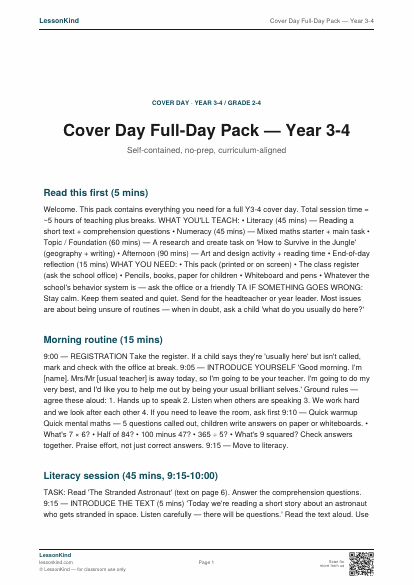
Going deeper
Books on mixed-age teaching
Books we'd recommend on the topics raised in this article.
For teachers
Convenience links to Amazon. As an Amazon Associate we earn from qualifying purchases at no extra cost to you. Read our affiliate disclosure.
Keep reading
Teaching strategy
How to Plan a Primary School Assembly
Most primary school assemblies fail for the same reason: they try to say too much. Here's how to plan an assembly that children will actually remember.
5 min read
Classroom culture
The Most Important Week of the Year
Most teachers think the first week is for getting to know the children. The teachers whose classrooms run beautifully use it for something quite different.
6 min read