Classroom culture · 6 min read
The Most Important Week of the Year
Why the first week of school is worth treating like an emergency
Published 2026-06-18
A common piece of new-teacher advice goes: spend the first week getting to know the children. Use icebreakers, light tasks, "name games" — let everyone settle in.
It's well-meaning. It's also, in the experience of most veteran teachers, a quiet disaster.
The teachers whose classrooms run smoothly all year do something quite different in the first week. They teach ROUTINES. Almost obsessively. To the exclusion of nearly anything else.
Why September matters disproportionately
Whatever you teach in week 1, the children will assume is "how this class works". If lining up is sloppy in week 1, lining up will be sloppy in week 30. If transitions are slow in week 1, they'll be slow in May.
The reverse is also true. A class that has spent the first week practising — actually practising, repeatedly, with feedback — how to walk to the carpet quietly, how to put a hand up for a question, how to settle into independent work, how to clear up at the end of a lesson, how to listen when someone else is speaking, will run on autopilot for the rest of the year. You will not have to micromanage these things ever again.
The cost of NOT doing this work in September is paid for by the rest of the year, in lost minutes per lesson — minutes which compound to entire weeks of lost teaching time.
What to teach (and re-teach)
Pick your priorities and rehearse them. You don't need fancy systems — you need 5-7 routines that get drilled to the point of automaticity. Most experienced teachers focus on:
**The morning entry.** Where they hang bags. What they do before the bell rings. How they greet you. What the silent settling task is on the board.
**The carpet.** Who sits where. How quickly they get there. How they sit. What signals you'll use to begin.
**Hand-up routines.** When you put a hand up, when you don't. What "no hands up" means. How you signal you want to ask the teacher something privately.
**Transitions.** From carpet to desks. From inside to outside. From one subject to the next. The signal you use. The expected speed.
**Voice levels.** Silent. Whisper. Indoor voice. Group voice. A different cue for each. They should never wonder which applies.
**Cleanup.** Who collects what. Where things go. The exact state the room must be in before the lesson is "over".
**The end of day.** Bags. Coats. Chairs up. Goodbyes. Next-day expectations.
How to teach a routine
Like any other concept. You explain it. You model it. The children practise it. You give feedback. They practise again. They get praised for doing it well.
The most common new-teacher mistake is to TELL the children once and assume they've got it. They haven't. They've heard you. That's not the same. They need to physically do it, several times, with you watching and adjusting. By the third or fourth practice, the routine is theirs.
The hardest week
This is unglamorous, slightly tedious work. There will be parents who wonder why the children aren't doing fractions yet. There will be a voice in your head saying "we should be teaching CONTENT". There will be days you feel like you're spending all of September on logistics.
Stay the course. Watch what happens in week 5, when the children return from the long weekend and instinctively go to their seats, get books out, settle in silence. That is what you bought with the first week's work.
What to drop
The icebreakers. The 'all about me' poster on day 1. The complicated "values discussion". The detailed academic content you feel you should be covering.
What you can keep: the names. Use day 1 to learn every child's name. Use day 2 to learn one fact about each child. Beyond that, the kindest thing you can do for the children is give them a calm, predictable, well-routined classroom. That's not boring — that's safe. Safe is what 6-year-olds are looking for. The deeper relationships will follow.
September is short. It is the most important investment you make in the year. Spend it on routines.
Free bundle for this topic
Cover Day Survival Pack
9 resources for cover days and routines, including behavior systems and morning meeting scripts.
Practical resources for this
Take this further
Printable, classroom-ready resources for the topics in this article.
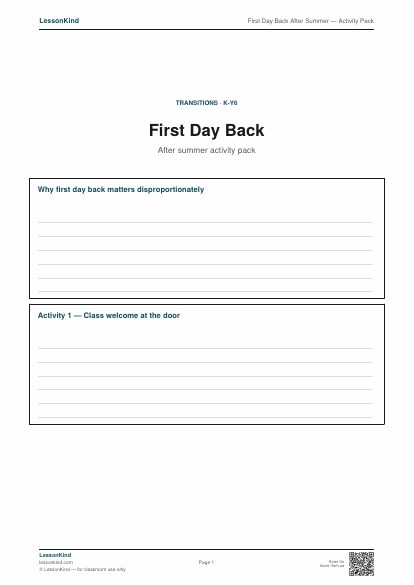
First Day Back After Summer — Activity Pack
Six activities for the first day back in September — designed to ease children in without overwhelming them, and give the new teacher useful information about their class. Low-stakes, structured, calming.
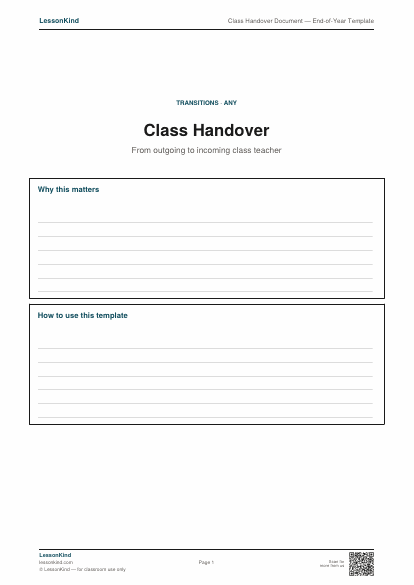
Class Handover Document — End-of-Year Template
The document the outgoing class teacher fills in for the incoming one. Captures every child's academic level, social map, vulnerabilities, family context, and the one thing the next teacher absolutely must know. Saves the new teacher a half-term of figuring it out.
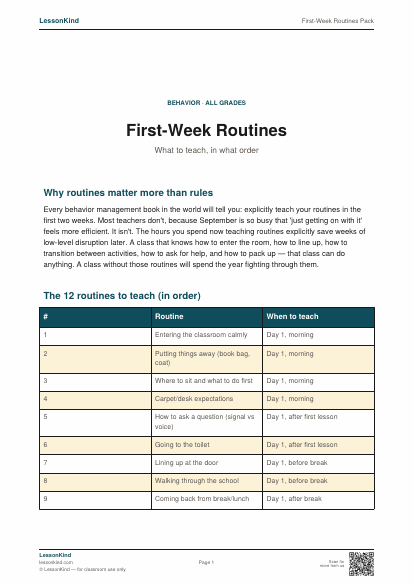
First-Week Routines Pack
The 12 routines you must establish in the first two weeks — entry, transitions, lining up, asking for help, finishing work, end of day. With explicit teaching scripts.
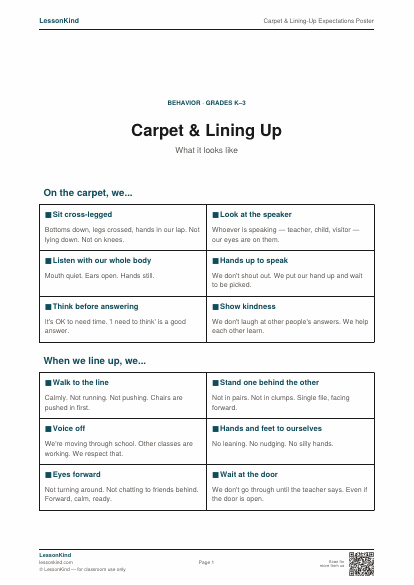
Carpet & Lining-Up Expectations Poster
A two-poster set showing exactly what 'good carpet' and 'good lining up' look like. Visual support for younger children — print A3, mount where children can see.
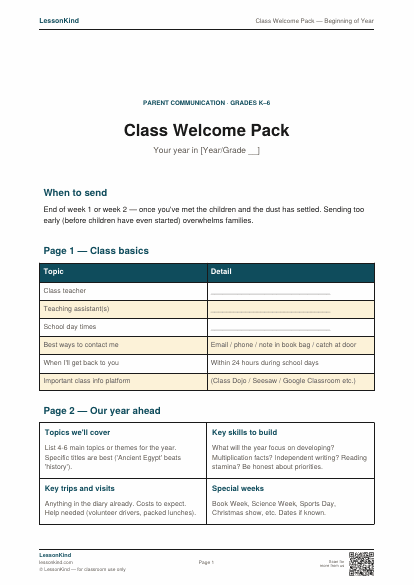
Class Welcome Pack — Beginning of Year
A 4-page pack to send home in the first week — covers the year ahead, communication, expectations, and how to support learning at home.
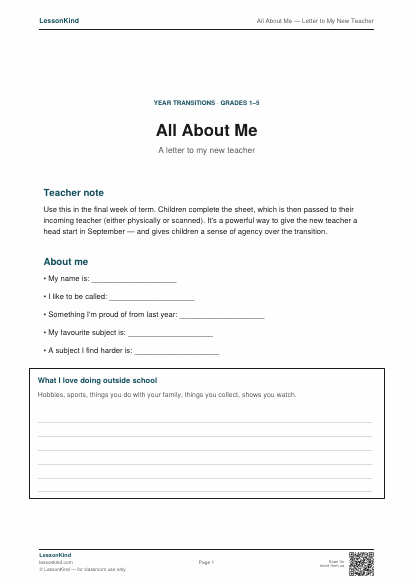
All About Me — Letter to My New Teacher
A printable sheet children fill in for their incoming teacher — interests, strengths, things they find hard, and what helps them learn.
Going deeper
Books for the start-of-year
How experienced teachers think about the first week.
Practitioner
Convenience links to Amazon. As an Amazon Associate we earn from qualifying purchases at no extra cost to you. Read our affiliate disclosure.
Keep reading
Teaching strategy
The Handover Most Schools Skip
Every July, the children move up a year. The data tracking system shows reading levels and maths attainment. The handover meeting (if it happens) lasts twenty minutes. And the new teacher spends most of the autumn term re-learning what the previous teacher already knew.
8 min read
Behavior & classroom management
The First Two Weeks: The Behavior Foundation You Can't Build Later
Most teachers know the first two weeks matter. Few know how MUCH they matter, or what to do with them. The behavior of your class in June is largely determined by what you do — or fail to do — in September.
8 min read
Classroom culture
Why Your Routines Matter More Than Your Lesson Plans
First-year teachers spend hours on lesson plans and almost no time on routines. The teachers whose classrooms run beautifully have it the other way around.
6 min read
First-year teaching
Five Mistakes I Made as a New Elementary Teacher
If I could go back and shake my first-year teacher self by the shoulders, here's what I'd say.
7 min read