Teaching strategy · 6 min read
Music in the Primary Classroom: A Guide for Non-Specialists
How to teach music with confidence when you don't have a music background
Published 2026-05-23
Music education in primary schools has a significant staffing problem. Most class teachers have no formal music training; specialist music teachers are rare outside the independent sector; and the result is that music is either delivered poorly, delegated to assemblies, or quietly dropped in favour of English and maths.
None of this is necessary. Effective primary music education does not require specialist knowledge. It requires confidence, a structured approach, and some specific resources.
Start with what everyone can do
Every teacher can lead singing. Singing is the most natural form of musical participation, requires no equipment, and is the most evidence-backed activity for developing musical understanding. Choose songs you can sing (not necessarily perfectly), sing them regularly, and teach them properly — not just playing the song and hoping children absorb it.
A singing warm-up that takes five minutes before another lesson is a contribution to music education. It also improves the lesson that follows — children who have sung together are more regulated and more cohesive.
Use high-quality recorded music
Playing recordings — not just as background but as objects of attention — is one of the highest-leverage things a non-specialist can do. 'We're going to listen to this piece for two minutes. I want you to notice: where does it feel exciting? Where does it feel sad? Does it remind you of anything?'
A teacher who doesn't know music theory can still facilitate a rich conversation about a piece of music. The questions don't require knowledge; they require curiosity.
Rhythm games require no musical knowledge
Clapping and tapping rhythms, call-and-response patterns, body percussion, rhythm ostinato — none of these require reading music or knowing theory. The Kodály method (widely used in Hungary and increasingly in the UK) builds musical understanding entirely through singing and rhythm before introducing notation.
When you need more
For notation, instruments, and composition — consider: Charanga (widely used digital music curriculum; very accessible for non-specialists); BBC Ten Pieces (free, links classical music to curriculum topics); Music Express (scheme with CD recordings and lesson plans);
Accept help when offered. A pupil who plays an instrument and wants to demonstrate it is a resource. A teaching assistant with musical experience is a resource. A parent who plays is a resource. Primary music does not have to be one teacher trying to cover everything alone.
Practical resources for this
Take this further
Printable, classroom-ready resources for the topics in this article.
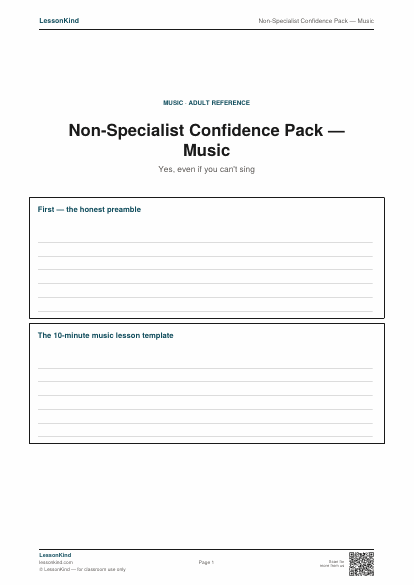
Non-Specialist Confidence Pack — Music
For class teachers who 'can't sing' or 'don't know music' but have to deliver music lessons. Practical confidence-builders, scripts for what to say, low-stakes activities that work even if you can't carry a tune. Written by people who understand the anxiety.
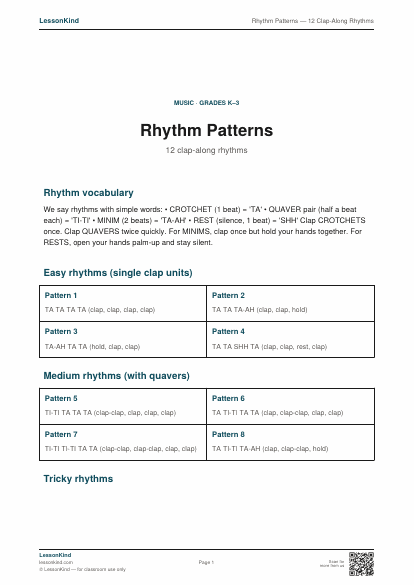
Rhythm Patterns — 12 Clap-Along Rhythms
Twelve printable rhythm patterns for clap-along practice — from very simple (4 beats) to harder (with rests and quavers).
Keep reading
Teaching strategy
How to Plan a Primary School Assembly
Most primary school assemblies fail for the same reason: they try to say too much. Here's how to plan an assembly that children will actually remember.
5 min read
Classroom culture
Building Classroom Community: Practical Strategies That Actually Work
The quality of relationships in your classroom determines how much learning is possible. Here are the specific, practical strategies that build genuine community — not just a pleasant atmosphere.
6 min read