Classroom culture · 6 min read
Building Classroom Community: Practical Strategies That Actually Work
The difference between a class that functions and one that thrives
Published 2026-05-19
A classroom with a strong sense of community produces better outcomes than one without — not just in terms of wellbeing, but in terms of attainment. Children who feel they belong take more academic risks, ask for help earlier, and recover from failure faster. This is not idealistic: it is what the research on psychological safety consistently shows.
The question is how to build it deliberately, rather than hoping it emerges.
Start with names
Nothing communicates care more efficiently than knowing someone's name and using it correctly. Learn every child's name in the first week. Learn how to pronounce them correctly — not the anglicised approximation, the actual name. Ask the child to say it to you. Ask again if you're not sure. Get it right.
This sounds small. It isn't. For a child whose name is routinely mispronounced or avoided, having a teacher get it right communicates: I took the trouble. You matter.
Create moments of genuine connection
School morning meetings, circle time, and check-ins work when they're genuine rather than performative. A question that reveals something about the teacher as well as the children ('the most embarrassing thing that happened to me this week was...') builds connection in a way that 'share one word describing your weekend' does not.
Build in regular moments where children hear each other's thinking — not just their answers. Discussion, debate, and collaborative tasks expose personality and perspective in ways that solo work cannot.
Make failure public and safe
The classroom culture around mistakes determines how much intellectual risk children will take. In classrooms where wrong answers are met with laughter, quick correction, or visible disappointment from the teacher, children learn to play it safe. They answer only when certain; they avoid challenge.
The habit to build: when a child gives a wrong answer, treat it as interesting. 'That's not what I was thinking — can you tell me more about how you got there?' models that wrong thinking is visible and discussable, not shameful.
Use the power of collective identity
Classes that have a strong shared identity ('we're the class that...' and 'in our class we...') behave differently from classes that don't. Develop this deliberately: class agreements (not rules) that children co-create; class traditions and rituals; a class name or symbol if it works for you; specific acknowledgement of class achievements as collective, not individual.
The repair culture
Every class will have conflicts. What distinguishes community-strong classes is not the absence of conflict but the presence of repair: the expectation that when something goes wrong between people, it gets addressed, apologised for, and resolved. A teacher who models this — who genuinely apologises when they make a mistake in front of the class — teaches something about relationships that no PSHE lesson can.
Free bundle for this topic
Cover Day Survival Pack
9 resources for cover days and routines, including behavior systems and morning meeting scripts.
Practical resources for this
Take this further
Printable, classroom-ready resources for the topics in this article.
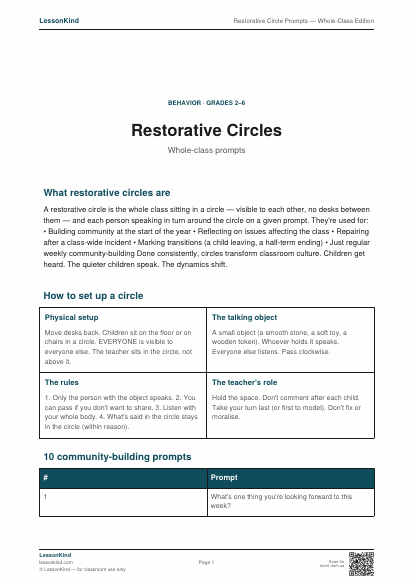
Restorative Circle Prompts — Whole-Class Edition
Whole-class restorative circle prompts for community-building and after class-wide incidents. 30 prompts across 4 categories, plus how to set up and run the circle.
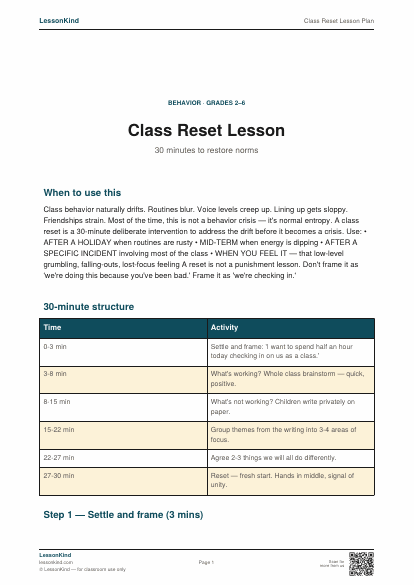
Class Reset Lesson Plan
A 30-minute lesson plan for resetting class behavior when things have drifted — without shaming, blaming, or making it feel like punishment. Use mid-term, after holidays, after big incidents.
Going deeper
Books on classroom culture and community
Books we'd recommend on the topics raised in this article.
For teachers
Convenience links to Amazon. As an Amazon Associate we earn from qualifying purchases at no extra cost to you. Read our affiliate disclosure.
Keep reading
Classroom culture
Why Your Seating Plan Matters More Than You Think
A well-designed seating plan is invisible — the room just works. A badly designed one creates low-level friction all year. Here's what the research suggests and how to approach it practically.
5 min read
Teacher wellbeing
When a Child Gets Under Your Skin
Almost every teacher has a child they find genuinely difficult to warm to. Acknowledging this is not a failure — it's the beginning of doing something about it.
6 min read
Teacher wellbeing
When a Child Gets Under Your Skin
Almost every teacher has a child they find genuinely difficult to warm to. Acknowledging this is not a failure — it's the beginning of doing something about it.
6 min read