Assessment & feedback · 5 min read
The Problem with Marking Grids — and What to Do Instead
How the tools designed to improve feedback often undermine it
Published 2026-05-20
Marking grids — structured rubrics where teachers rate specific criteria as red/amber/green, or tick boxes, or assign letters — became widespread in UK primary schools in the 2000s and 2010s. They were adopted partly for efficiency, partly to create consistency, and partly because an inspectorate asked for 'evidence of marking'.
There is a reasonable case for them. A well-designed rubric helps teachers attend to specific elements of quality. It creates a shared vocabulary between teachers marking the same year group. It can make feedback faster to produce.
There is also a strong case against them — and it is one that the profession rarely makes.
Why grids often produce worse feedback
Marking grids atomise quality. A piece of writing that is exceptional in one way — in its voice, its rhythm, its specific imagery — can score modestly across twelve tick-boxes because none of the boxes quite captures what makes it work. The teacher's professional knowledge that the writing is good is not captured by the grid; it may even be obscured by it.
They encourage description rather than diagnosis. Ticking 'not yet meeting' against 'uses a range of punctuation' tells the pupil that they aren't doing something. It doesn't tell them what to do specifically — which two punctuation marks to use, in which contexts, starting in the next piece of writing.
They invite tick-box compliance. A child who knows the grid checks for fronted adverbials will include a fronted adverbial. Whether it makes the writing better is secondary. The criteria become the goal rather than the means.
They take longer than they appear. The time saved on writing detailed comments is partly consumed by working through each criterion. The result is often similar time spent producing less useful information.
What actually works
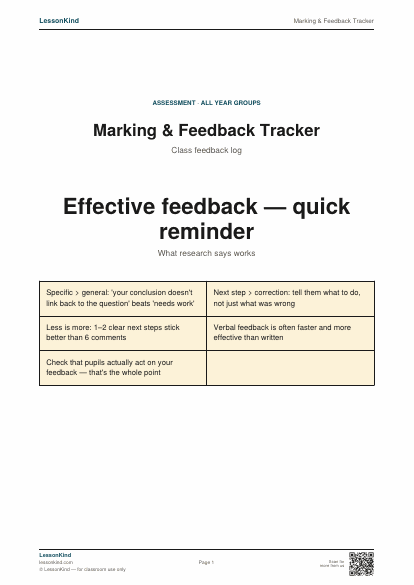
One specific strength, stated precisely. Not 'good use of vocabulary' but 'the phrase 'the silence pressed against the walls' is exactly right — it makes the silence feel physical.'
One specific actionable next step. Not 'vary your sentence length' but 'the last paragraph has five sentences of similar length — try breaking one of them into two short ones to build tension.'
Verbal feedback when possible. A 90-second conversation at a desk produces more improvement than any marking system, because the child can respond, ask questions, and clarify immediately.
If you use a grid: keep it to three to four criteria, make at least one comment specific to this particular piece of work, and build in time for children to act on it before the next piece.
Free bundle for this topic
KS2 Maths Pack
10 maths resources designed for retrieval practice and low-stakes review.
Practical resources for this
Take this further
Printable, classroom-ready resources for the topics in this article.
Going deeper
Books on feedback and marking in primary
Books we'd recommend on the topics raised in this article.
For teachers
Convenience links to Amazon. As an Amazon Associate we earn from qualifying purchases at no extra cost to you. Read our affiliate disclosure.
Keep reading
Assessment & feedback
How to Give Feedback That Actually Changes the Work
Most marking has almost no effect on student work. Here's what does — and what to stop doing immediately.
7 min read
Assessment & feedback
Feedback That Changes the Work
Decades of research on feedback in education converge on one uncomfortable finding: most feedback given in classrooms produces little or no improvement. Here's what actually works.
7 min read
Assessment & feedback
Assessment for Learning: 7 Techniques That Actually Work
Formative assessment is one of the highest-leverage things a teacher can do. Here are seven techniques with strong evidence and clear practical application.
8 min read