Parent communication · 5 min read
What Are Reading Levels and Book Bands? A Guide for Parents
What the colours and levels mean — and whether you should worry
Published 2026-05-12
If your child comes home with a red book, a gold book, or something labelled 'Stage 5', here is what it means.
What are book bands?
Book bands are a colour-coded system for organising reading books by difficulty. The standard colours roughly in order are: Pink, Red, Yellow, Blue, Green, Orange, Turquoise, Purple, Gold, White, Lime, Brown, Grey.
Each colour covers books at a similar difficulty, based on sentence length, vocabulary, plot complexity, and print size.
What age should a child be at each colour?
A rough guide: Pink/Red in Reception–Year 1 (ages 4–6), Yellow/Blue/Green in Year 1–2 (ages 5–7), Orange/Turquoise in Year 2 (ages 6–7), Purple/Gold in Year 2–3 (ages 7–8), and White and above from Year 3 onwards.
These are guides, not rigid expectations. Reading development is not linear.
Should I worry about which level my child is on?
Only if they've been on the same level for many months without moving. A child reading fluently at their current level is doing well. The level is a guide to finding books that are challenging without being dispiriting.
If your child finds their school books very easy, mention it to the teacher. If they find them very difficult and distressing, also mention it.
What actually matters
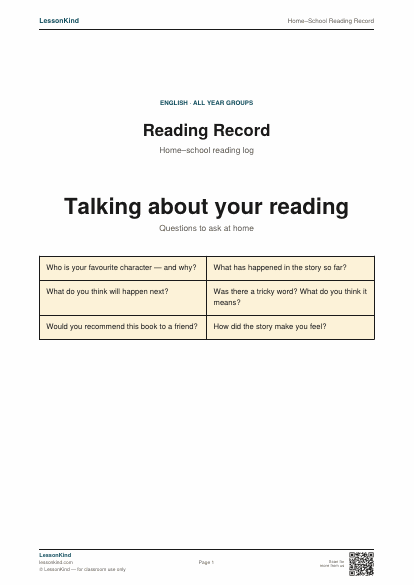
The colour on the spine is a teaching tool, not a ranking. What matters is: Is your child reading regularly? Does reading feel enjoyable? Are they making progress over a term? Are they asking questions about what they're reading?
Those questions matter far more than the band level.
The one thing that makes the biggest difference
Reading aloud to your child — even after they can read independently — accelerates vocabulary and comprehension more than almost anything else. Children can enjoy and understand books far beyond their independent reading level when they're read to. Don't stop because they've started to decode independently.
Practical resources for this
Take this further
Printable, classroom-ready resources for the topics in this article.
Going deeper
Reading scheme and phonics books
Books we'd recommend on the topics raised in this article.
Reading scheme books for KS1
For teachers: teaching reading
Convenience links to Amazon. As an Amazon Associate we earn from qualifying purchases at no extra cost to you. Read our affiliate disclosure.