Parent communication · 5 min read
What Is the SPaG Test? A Guide for Parents
The Year 6 grammar and punctuation paper explained — what it tests and how to help
Published 2026-05-18
SPaG stands for Spelling, Punctuation and Grammar. The SPaG test is one of the Year 6 SATs papers, sat in May alongside reading and maths. Many parents find it the most unfamiliar, because it uses a lot of technical grammatical terminology that many adults weren't explicitly taught.
What the test involves
The SPaG assessment has two components:
**Paper 1: Grammar and punctuation** (45 minutes, around 50 marks). Tests children's knowledge of grammatical terminology and their ability to apply correct punctuation. Question types include: identifying word classes (nouns, verbs, adjectives), correcting punctuation errors, adding missing punctuation, selecting the correct word form, explaining the effect of language features.
**Paper 2: Spelling** (approximately 20 minutes, 20 marks). The teacher reads out 20 sentences and children write a missing word in the correct spelling. The focus is on common exception words and words from the statutory Year 3-6 spelling list.
Key vocabulary children need to know
The paper uses specific grammatical terms. These are the most commonly tested:
Word classes: noun, verb, adjective, adverb, pronoun, preposition, conjunction, determiner.
Punctuation: full stop, question mark, exclamation mark, comma, semicolon, colon, apostrophe (contraction and possession), inverted commas / speech marks, brackets, dash, ellipsis.
Sentence-level: main clause, subordinate clause, relative clause, fronted adverbial, direct speech, passive voice, formal and informal register.
How to help at home
Grammar is best learned through reading and writing, not through drilling definitions. Children who read widely absorb sentence structures intuitively; the test asks them to name what they already do.
For specific revision: use the statutory word list (freely available from the DfE) for spelling practice. Work through it in 5-word batches, using the look-cover-write-check method.
For grammar: ask your child to explain a grammatical term to you. If they can teach it clearly, they know it. If they can't, look it up together.
Don't panic if you don't know the terms yourself. You almost certainly use fronted adverbials and subordinate clauses in your own speech and writing; you just might not know the names. Reassure your child that the underlying skills — clear, well-punctuated writing — are things they practise every day.
Practical resources for this
Take this further
Printable, classroom-ready resources for the topics in this article.
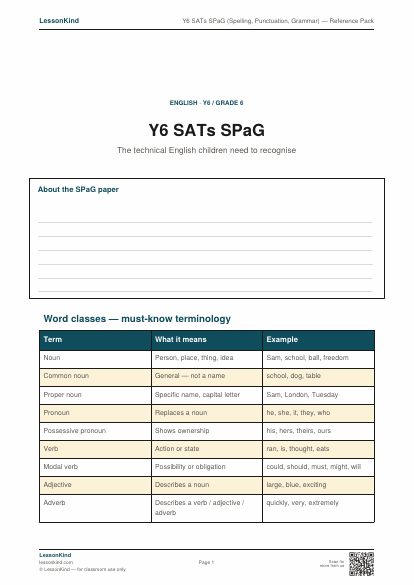
Y6 SATs SPaG (Spelling, Punctuation, Grammar) — Reference Pack
The SPaG paper tests technical English knowledge — terminology, punctuation use, grammatical structures. This pack covers the 30+ technical terms children must recognise, plus the punctuation and grammar rules that come up most often. The single revision document Y6 children should keep on their desk.
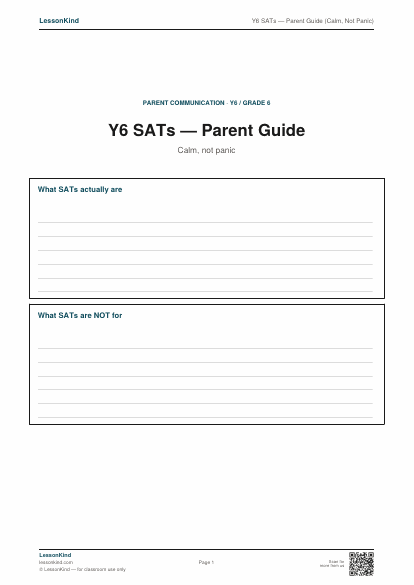
Y6 SATs — Parent Guide (Calm, Not Panic)
What SATs are, what they're for, what they're NOT for, and how parents can support their Year 6 child through SATs season without making it worse. Honest about what really helps and what doesn't. Designed to lower household anxiety about SATs week.
Going deeper
SPaG revision books for Year 6
Books we'd recommend on the topics raised in this article.
For children
Convenience links to Amazon. As an Amazon Associate we earn from qualifying purchases at no extra cost to you. Read our affiliate disclosure.
Keep reading
Parent communication
Year 6 SATs: A Complete Guide for Parents
The Year 6 SATs are the most talked-about assessments in primary school. This guide explains what they are, what they test, when they happen, and how parents can support their child without adding pressure.
8 min read
Parent communication
What Is the Multiplication Tables Check — and How Do I Prepare My Child?
The Multiplication Tables Check is a 25-question test every Year 4 pupil takes in June. Here's exactly what it involves and the most effective ways to practise at home.
5 min read