Parent communication · 8 min read
Year 6 SATs: A Complete Guide for Parents
What the tests are, when they happen, and what you can do to help
Published 2026-05-18
The Year 6 SATs (Standard Assessment Tests) happen every May in England. They are statutory national assessments taken by most children aged 10-11 in Year 6. This guide covers everything a parent needs to know.
What do the SATs test?
SATs in Year 6 cover three subjects:
**English reading** — a one-hour reading comprehension paper where children read a booklet of texts and answer questions testing retrieval, vocabulary, inference, and summary.
**English grammar, punctuation and spelling (GPaS or SPaG)** — two papers: one on grammar and punctuation (45 minutes) and one spelling test (20 words read aloud by the teacher).
**Mathematics** — three papers: an arithmetic paper (30 minutes, no calculator) and two reasoning papers (40 minutes each).
There are no SATs for writing, science, history, geography, or any other subject. Writing is teacher-assessed.
When do SATs happen?
SATs week is always in the second week of May. In 2026 it runs from Monday 11 May to Thursday 14 May. Results are sent to parents in July.
What do the scores mean?
Each paper is marked and scaled to a score between 80 and 120. The expected standard (the national benchmark) is a scaled score of 100 or above. Children who score above 110 in all areas are said to have met the higher standard.
The scaled score is NOT the same as the raw mark. A child might get 35 out of 50 on a paper and that might scale to exactly 100, depending on how hard that year's paper was.
How much do SATs matter?
For secondary schools — very little. Most secondary schools set their own assessments in September and use those to group pupils. SATs results are rarely the primary factor.
For primary schools — they contribute to school performance data and Ofsted judgements. Schools are accountable for SATs results. This is a key reason why Year 6 teachers take them seriously.
For children — they matter if the child and family treat them as mattering. The assessments themselves are straightforward for a well-prepared child. The anxiety around them is usually the bigger problem.
How can you help at home?
**Keep SATs in proportion.** One week of tests at age 11 does not determine your child's future. Children who understand this perform better because they are less anxious.
**Maintain routine.** The best preparation for SATs week is good sleep, good food, and a calm morning routine. A child who arrives tired and hungry will underperform regardless of academic preparation.
**Read together.** The single most effective thing parents can do at any age is read with and to their child. For Year 6 this means exposure to a range of text types: fiction, non-fiction, newspapers, instructions, biography.
**Practise times tables.** The arithmetic paper tests calculation fluency. Children who know their tables to 12 have a significant advantage. Five minutes of times table practice daily from January to May is more effective than two hours the week before.
**Don't over-tutor.** Private tutoring for SATs is common but the evidence that it improves outcomes significantly is mixed. Excessive tutoring can increase anxiety. Your child's teacher is preparing them all year; trust that process.
**Talk about it.** Ask your child how they're feeling about the tests. Acknowledge any worry without amplifying it: 'It's normal to feel a bit nervous. You've been working hard all year. I'm proud of you whatever the result.'
What happens if a child is absent?
If a child misses a paper due to genuine illness, there is a late-entry window. Speak to the school if this happens. Marking for late entries is delayed but results are still received in July.
Practical resources for this
Take this further
Printable, classroom-ready resources for the topics in this article.
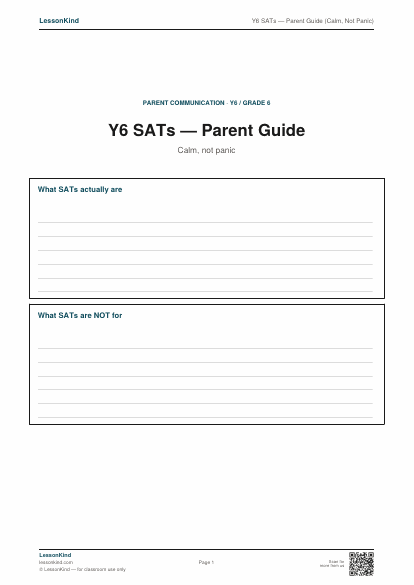
Y6 SATs — Parent Guide (Calm, Not Panic)
What SATs are, what they're for, what they're NOT for, and how parents can support their Year 6 child through SATs season without making it worse. Honest about what really helps and what doesn't. Designed to lower household anxiety about SATs week.
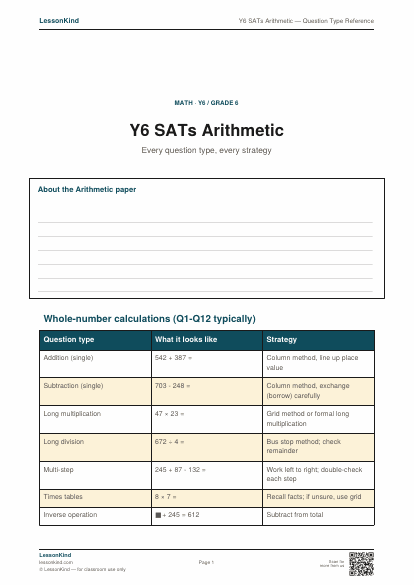
Y6 SATs Arithmetic — Question Type Reference
Every type of question that appears in the SATs Arithmetic paper, with the strategy for each. Covers all 30 question types — calculation, fractions, percentages, BIDMAS, mixed operations. The reference document Year 6 children can keep through SATs prep season.
Going deeper
SATs preparation books for Year 6
Books we'd recommend on the topics raised in this article.
For children — revision books
For parents
Convenience links to Amazon. As an Amazon Associate we earn from qualifying purchases at no extra cost to you. Read our affiliate disclosure.
Keep reading
Parent communication
What Is the Multiplication Tables Check — and How Do I Prepare My Child?
The Multiplication Tables Check is a 25-question test every Year 4 pupil takes in June. Here's exactly what it involves and the most effective ways to practise at home.
5 min read
Parent communication
How to Help Your Primary Child With Reading at Home
Reading at home matters, but the approach makes all the difference. Here's what the research says about how parents can genuinely support a child's reading — and what to avoid.
7 min read