First-year teaching · 8 min read
What Nobody Tells You About Differentiation
The honest version — what it means in practice, not the training day version
Published 2026-05-12
In teacher training, differentiation gets presented as a solved problem. You have higher, middle, and lower groups. You prepare different tasks, or different support, or different amounts of scaffolding. You target questions. You match children to ability levels. The end.
When you actually try to do this across five subjects a day, with twenty-five children who don't fit neatly into three groups, you will quickly discover that the training-day version and the classroom-reality version are quite different things.
Here's the honest version.
What differentiation is not
**It is not three sets of worksheets.** Creating a 'harder' version, a 'standard' version, and an 'easier' version of every task sounds manageable in theory. In practice it takes two to three times as long to prepare, and it has some real drawbacks: children sorted into the 'easy' pile know it. The subtle stigma of always getting the simplified version shapes how students see themselves as learners. The evidence on rigid ability grouping shows real concerns about its effect on lower-group students in particular.
**It is not the same as special educational needs provision.** Children with IEPs or formal support plans need specific provision — that's a legal and professional obligation. But differentiation is a broader concept: it's about responding to the range of needs in any class, most of which don't have labels attached.
**It is not something that must happen in every lesson in every subject.** This is a real pressure new teachers feel. It doesn't need to be that extensive. What it does need to be is responsive — not necessarily pre-prepared.
What differentiation actually looks like in working classrooms
**Responsive questioning.** Your highest-leverage differentiation tool is the question you ask to different children. A child who understands asks a follow-up question. A child who's struggling gets a question that breaks the task into a smaller step. 'Tariq, can you explain why you think that?' is more powerful than three different worksheet versions, and costs you nothing in preparation time.
**Support structures that anyone can access.** Rather than giving some children a 'support sheet' and others not, make support structures available to the whole class. A vocabulary list on the board. A word bank. A sentence starter. A worked example on the screen. Children self-select the support they need. This reduces stigma and, counterintuitively, often means more children use the support because there's no label attached to picking it up.
**Task design with natural differentiation.** The best tasks are ones where multiple entry points exist. Open-ended questions ('Describe as much as you can about...'), low-floor high-ceiling tasks in math, creative writing prompts — these naturally accommodate a range of abilities without requiring you to prepare separate versions.
**Stretch built into the main task.** Instead of a separate 'extension task,' build depth into the core task. 'Once you've finished the main question, can you explain why your answer is right?' 'What would happen if...?' This means children who move faster don't do different work — they go deeper into the same work.
**Small-group teaching.** While others are working independently, you circulate and pull a small group for targeted input. Not every lesson, not always the same group, but this direct focused teaching is some of the highest-value differentiation that exists. It costs planning time, but it works.
The differentiation that actually makes the biggest difference
The research evidence on differentiation points consistently in one direction: the quality of the whole-class teaching matters more than the quality of the differentiated tasks.
A teacher who explains clearly, who checks for understanding well, who asks targeted questions and responds to confusion in real time — this teacher is differentiating effectively without necessarily producing different materials. A teacher who produces elaborate differentiated worksheets but delivers unclear explanations is not serving their students as well as the first teacher is.
This is a useful reframe for new teachers feeling overwhelmed by differentiation demands. The highest-return investment is not building three versions of every resource. It's getting better at knowing when you've lost someone and how to re-enter.
What to say in observations and planning conversations
Observers and leaders will sometimes ask how you differentiate. Good answers include:
- Adaptive questioning during class discussion - Accessible support structures available to all (vocabulary displays, worked examples) - Small-group teaching during independent work time - Open-ended tasks with natural depth built in - Knowing which students need additional check-ins and building those in proactively
These are honest answers. They're also strong answers, because they reflect what the research says works.
The practical reality
In your first year, differentiation will sometimes mean you notice a child is lost and you stop and help them. Sometimes it means you prepare an easier version of a task on a hard night. Sometimes it means you stay a few minutes after the session to make sure a student understood something.
It doesn't have to mean something complicated or elaborate. The most important thing is that you're paying attention to individuals, not just teaching to the middle of the room and hoping it lands.
That attentiveness — noticing, responding, adjusting — is differentiation. The worksheets are just one small tool in a much larger kit.
Free bundle for this topic
The Starter Pack
18 free resources spanning every subject — the universal new-teacher starter.
Practical resources for this
Take this further
Printable, classroom-ready resources for the topics in this article.
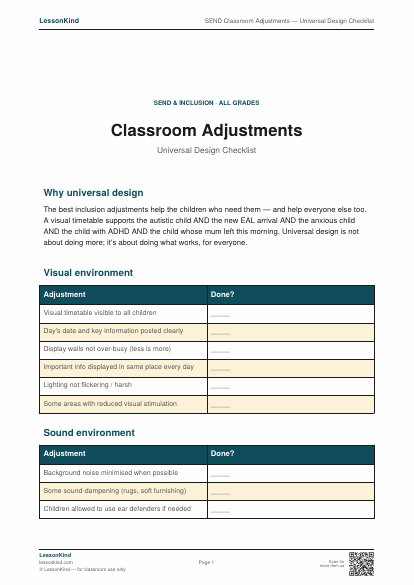
SEND Classroom Adjustments — Universal Design Checklist
A walk-through audit of adjustments that benefit children with SEND but help everyone else too. Audit your classroom in 15 minutes.
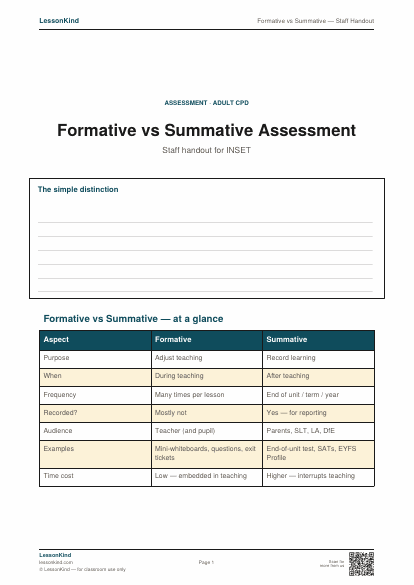
Formative vs Summative — Staff Handout
A 4-page staff handout explaining the difference between formative assessment (during learning) and summative assessment (at the end), with specific classroom techniques for each. For staff INSETs and new-teacher induction. Designed to settle the 'we test too much' / 'we don't test enough' debate.
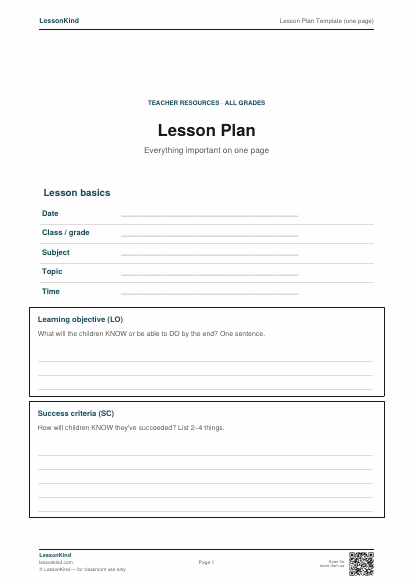
Lesson Plan Template (one page)
A one-page lesson plan template — objective, success criteria, hook, main task, assessment, plenary.
Keep reading
Assessment & feedback
Assessment FOR Learning vs Assessment OF Learning
Most schools assess constantly but don't always know why. The distinction between formative and summative assessment is one of the most useful ideas in teaching.
5 min read
Teaching strategy
Cold calling without humiliation
Cold calling — picking children to answer rather than asking for hands up — has become a fashionable technique. It works brilliantly in some classrooms and creates anxiety in others. The difference is everything in how you set it up.
7 min read
Assessment & feedback
Five-minute formative checks that actually tell you something
Exit tickets, mini-quizzes, hinge questions — formative assessment is everywhere, but a lot of it doesn't actually reveal what children know. Here are five practical end-of-lesson checks that actually tell you whether to move on or reteach.
7 min read