Behavior & classroom management · 6 min read
What to do about 'I'm bored'
It's almost never about boredom. Decoding what it really means is the first step.
Published 2026-12-03
'I'm bored.' Every primary teacher hears it. Often. The instinct is to take it at face value and respond to the surface meaning — make the lesson more interesting, give the child harder work, throw in a video.
But 'I'm bored' is almost never literally about boredom. It's a multi-purpose phrase that children use to express a lot of different things, and the right response depends on which thing this particular child means right now.
Here are the most common translations.
'I'm bored' usually means…
**'I don't understand and I'm protecting my pride.'** A child who can't access the lesson rarely says 'I don't understand.' That feels too vulnerable. 'I'm bored' is much safer — it positions the child as too sophisticated for the work rather than not sophisticated enough. If you can quietly check whether the child understands what's being asked, you'll often find the boredom evaporates once they can do it.
**'I've finished and you haven't given me anything else.'** This is the literal version. The child genuinely is bored because they've completed the task and you're still helping someone else. Easy fix: have predictable extension activities ready that don't require teacher input — a problem-of-the-day, a 'when you're done' jar, an extension question that's always available.
**'I can't focus right now.'** A tired, hungry, or dysregulated child experiences the lesson as boring even when it's perfectly pitched, because they don't have the cognitive resources to engage with it. The fix isn't more interesting content. It's a brain break, water, or — if you can spot it — addressing what's making them dysregulated.
**'I'm anxious about something else and this isn't engaging enough to crowd it out.'** Sometimes a worried child seeks distraction in lessons. When the lesson doesn't fully grip them, the worry surfaces. 'I'm bored' here means 'my brain has space to feel my problem.' This is harder to fix in the lesson — usually you'll need a quiet check-in.
**'I don't see why this matters.'** Older primary children especially can sense when content feels disconnected from anything they care about. 'I'm bored' here is an honest critique. They're not wrong; sometimes the content IS disconnected from anything they'll find meaningful. Reconnecting the topic to a real-world question or a future application can help.
**'I'm winding you up.'** Sometimes — especially in upper KS2 — 'I'm bored' is a low-grade provocation, a test to see if you'll get rattled. The right response isn't a lesson redesign. It's a calm 'okay, what part?' that takes the bait off the hook.
The trap is treating all six the same way.
How to figure out which one you're dealing with
Don't ask 'why are you bored?' That's a closed question with no good answer for the child. They'll shrug.
Better questions:
- 'What part are you finding tricky?' (Tests for the understanding-protection version.) - 'What have you already done?' (Tests for the genuinely-finished version.) - 'How are you feeling generally today?' (Tests for the dysregulation/anxiety versions.) - 'Where do you think you might use this?' (Tests for the meaning-disconnect version.)
Often the answer to one of these reveals what's going on. The child who says 'I don't really know how to start' is in the protection-mode version. The child who says 'I had toast at 7 and I'm hungry' is in the dysregulation version. Different child, different fix.
What NOT to do
A few well-meaning responses that backfire:
**'Bored people are boring people.'** This is folk wisdom and possibly true in adult life, but used at a child it's dismissive. The child who said 'I'm bored' is now ALSO mocked. You haven't made them less bored; you've made them less likely to tell you anything else this term.
**Make the next lesson more entertaining.** Tempting, but you'll exhaust yourself. You can't compete with TikTok. Lessons don't need to be entertaining; they need to be productive. Trying to entertain bored children produces a class that becomes increasingly hard to satisfy — they've trained you to keep performing.
**Send them to the 'extension' table.** If 'I'm bored' meant 'I've finished and need more,' fine. But it usually doesn't. Sending the misunderstanding-protected child to the extension table makes things worse — they're now in even harder territory with even more pride at stake.
**Take it personally.** Most teachers, when a child says 'I'm bored,' feel a small sting. Their lesson — the one they planned and prepared — is being judged. The instinct is to defend the lesson or to feel hurt. Resist. The child usually isn't critiquing you. They're communicating something else, badly. Take it as data, not insult.
What to do for the 'always bored' child
Some children say 'I'm bored' or 'this is boring' as a near-constant background commentary. They aren't always meaning it; it's become a habit. A few moves help.
**Don't reinforce the role.** Children who get attention for being 'the bored one' will keep doing it. Stop responding emotionally. 'Okay' and a continuation often deflates the role within a few weeks.
**Make the boredom precise.** 'Tell me which part specifically is boring you.' Children can rarely answer this — boredom is felt, not analysed. Forcing the precision exposes that the boredom isn't really the issue.
**Give them ownership.** Sometimes a chronically-bored child needs more control. 'You can pick which question you do first.' 'You can choose how you show your working.' Tiny choices, but they restore some agency.
**Look for the pattern.** Are they only bored in certain subjects? Certain lesson formats? Certain times of day? The pattern usually reveals the real issue. A child only bored in writing lessons is probably struggling with writing. A child only bored after lunch is probably regulating poorly. Address THAT, not the boredom.
When 'I'm bored' is fair criticism
Sometimes 'I'm bored' is not a code for anything. The lesson genuinely is boring. Maybe you're explaining something the class already understands. Maybe the worksheet is busywork. Maybe you're tired and just running content.
It's worth being honest with yourself about this. If multiple children say the same thing on the same day, the issue might be the lesson, not the children.
Good response: 'You might be right, actually. Let's move on / make this more interesting / try a different approach.' Children appreciate the honesty. It teaches them that 'this is boring' is something adults can hear without becoming defensive — which, ironically, makes them less likely to say it disruptively in future.
The takeaway
'I'm bored' is rarely about boredom. It's a child's general-purpose code for one of half a dozen different things, ranging from confusion to anxiety to genuine over-completion. The right response depends on which one — and you can usually find out with one or two careful questions.
Don't take it personally. Don't try to entertain. Decode. Respond to what's actually there. Most of the time, the bored child wasn't really bored, and what they really needed wasn't a more interesting lesson — it was you to notice them.
Free bundle for this topic
Cover Day Survival Pack
9 resources for any cover day, including behavior strategies and morning meeting scripts.
Practical resources for this
Take this further
Printable, classroom-ready resources for the topics in this article.
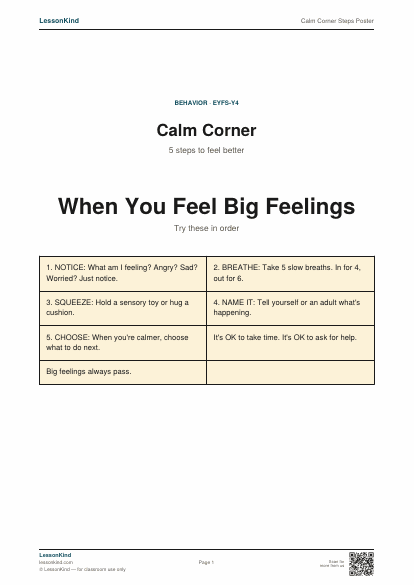
Calm Corner Steps Poster
5-step regulation poster for the calm corner — what children can do when they feel overwhelmed. Based on trauma-informed practice.
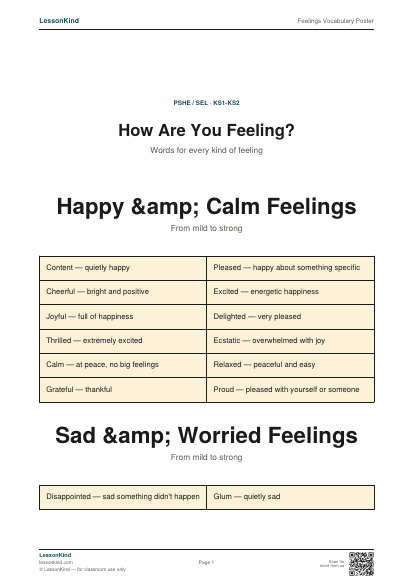
Feelings Vocabulary Poster
Beyond happy and sad — 50+ feelings words organised by intensity. Builds emotional vocabulary across KS1 and KS2.
Going deeper
On engagement, regulation and reading children
Books we'd recommend on the topics raised in this article.
Understanding children's behaviour
- W When the Adults Change, Everything Changes — Paul Dix
- T The Whole-Brain Child: 12 revolutionary strategies to nurture your child's developing mind — Daniel J. Siegel, Tina Payne Bryson
- A A Therapeutic Treasure Box for Working with Children and Adolescents with Developmental Trauma — Karen Treisman
- B Behaviour Management: A Whole-school Approach — Bill Rogers
Convenience links to Amazon. As an Amazon Associate we earn from qualifying purchases at no extra cost to you. Read our affiliate disclosure.