Behavior & classroom management · 7 min read
The problem with sticker charts
They work in the moment and quietly damage long-term motivation.
Published 2026-12-02
Almost every primary classroom has a sticker chart. Or a marble jar. Or Class Dojo points. Or table-of-the-week. The mechanics vary; the underlying logic is the same. Children do the things we want, they get a reward. They learn to do those things more.
It works. In the short term. That's why it's everywhere.
But the underlying psychology of extrinsic reward systems has been studied for fifty years, and the results are clear and uncomfortable. Sticker charts produce short-term compliance and quietly damage long-term motivation. Many of the things they're supposed to teach, they actually teach the opposite of.
This isn't a fringe view. It's the consensus across decades of research, including high-profile studies by Edward Deci, Richard Ryan, Alfie Kohn, and many others. Most primary teachers haven't read this research. The school cultures they were trained in took stickers as obviously sensible.
So let's lay out what the research actually shows, and what to do about it.
What sticker charts actually do
Three things, all well-documented.
**They reduce intrinsic motivation for the rewarded activity.** This is the famous finding. When children are rewarded for doing something they were already enjoying, they enjoy it less. The classic study had children who liked drawing rewarded for drawing. Within weeks, the rewarded children drew less in their own time than unrewarded controls — even though the rewards had stopped.
The mechanism: rewards reframe the activity. The brain notices 'I am being paid to do this' and concludes 'this must not be intrinsically valuable.' Once an activity has been moved from 'something I want to do' to 'something I do to get a reward,' the activity becomes contingent on the reward. Take the reward away, and the behaviour collapses.
In a classroom, this means: if you reward a child for reading, they will read less when you stop. The internal motivation has been replaced.
**They narrow what children attend to.** Reward systems make children focus on the reward, not the activity. A child working towards a sticker for 'good listening' is monitoring the teacher for sticker cues, not actually listening to the content. The behaviour gets performed in a way that gets noticed — which isn't the same as being a good listener.
**They damage cooperation and risk-taking.** When rewards are scarce (only one 'star of the week,' table-of-the-week competition), children compete instead of cooperating. They learn to do what's safe enough to be rewarded, rather than try things that might fail. This is exactly the opposite of the learning culture most schools say they want.
What about behavioural sticker charts?
Some teachers concede the point about academic rewards but defend behavioural rewards. 'Sure, don't reward reading. But what about a child who's hitting other children? A sticker chart for keeping hands and feet to themselves — surely that's worth it?'
It's a fair question. The honest answer is: short-term yes, long-term no.
A sticker chart for not hitting can work in the short term because the child gets a clear, visible target and feedback. They feel successful when they earn the sticker. The behaviour decreases.
But what's been taught? The child has learned 'I get stickers for not hitting.' They haven't learned why hitting is wrong, what to do with the impulses that lead to hitting, or how to repair after hurting someone. Take the sticker away — or move them to a class without one — and the behaviour returns.
Compare this to a child who has learned to recognise their anger building, has practised a calming strategy, and has internalised that hitting hurts other children. That child's improvement is durable. They don't need a chart.
The sticker chart was a behavioural patch. The actual teaching — emotional literacy, regulation strategies, repair after rupture — is harder, slower, and produces children who don't need the chart.
The 'but it works' argument
Most teachers using sticker charts will say 'I see them work every week.' And they do.
What they're seeing is short-term compliance. The behaviours they want do increase, in the moment, while the chart is in operation. That's real.
What they're not seeing is the counterfactual. They have no comparison classroom where the same children, same teacher, same content, didn't have a sticker chart. They don't see the children's behaviour in adulthood. They don't see what those children do at home, or in the next teacher's room, or when they're 14.
The research evidence — which DOES have those comparisons — finds that the immediate compliance is real and the long-term costs are real too. Both are true. Whether the immediate gain is worth the long-term cost depends on what you're optimising for.
When are rewards actually fine?
Some rewards aren't damaging. The research distinguishes between:
- **Verbal recognition that's specific and true.** 'You really thought about that answer — I noticed how you looked back at the text first.' This isn't a reward in the technical sense — it's information. It tells the child what specifically they did well. It doesn't produce the dependency effect. - **Celebration that's communal, not contingent.** A whole-class 'we did it!' for finishing a topic doesn't pit children against each other or make individual behaviour contingent on individual rewards. - **Recognition that's earned, not promised.** 'I noticed yesterday that you helped Maya. That was kind.' Said spontaneously, not as a transaction. The child wasn't doing it for the recognition — the recognition came after.
What's damaging is contingent, individual, advertised reward systems: 'If you do X you will earn Y.' Those produce the dependency effects.
What to do instead
Replacing sticker charts isn't quick — they're embedded in many schools. But teachers can shift gradually.
**Replace contingent rewards with specific feedback.** Instead of 'great work, have a sticker,' say 'I noticed you used three of the techniques we practised yesterday — you've really built that into your writing.' This gives information without creating contingency.
**Talk about the WHY of behaviour, not the reward.** Instead of 'sit nicely so you can earn a sticker,' say 'when we sit and listen, everyone can hear and we get to do more interesting things.' This gives the child a reason that lives outside the reward system.
**Build communal celebration without individual rewards.** Friday class meetings where children share something they're proud of. End-of-term whole-class celebrations for whole-class achievements. These don't pit individuals against each other.
**Don't replace sticker charts with point systems.** Class Dojo, marble jars, table points — they have the same psychological mechanism as stickers, just dressed differently. If you take down the chart, take down the principle, not the format.
The harder conversation
Schools are often reluctant to give up reward systems because the visible compliance is reassuring to leadership and inspectors. A classroom with a clear behaviour chart looks well-managed. A classroom doing emotional-literacy work and quiet recognition is harder to evidence.
This is a real institutional pressure. Individual teachers can't unilaterally fix it. But individual teachers can run their classrooms with less reliance on sticker mechanics, and over time the children they teach develop more durable self-regulation.
Ten years from now, the children you taught won't remember the stickers they earned. They might remember being told why something they did mattered. That's the durable lesson. The sticker is just a wrapper.
Free bundle for this topic
Cover Day Survival Pack
9 resources for any cover day, including behavior strategies and morning meeting scripts.
Practical resources for this
Take this further
Printable, classroom-ready resources for the topics in this article.
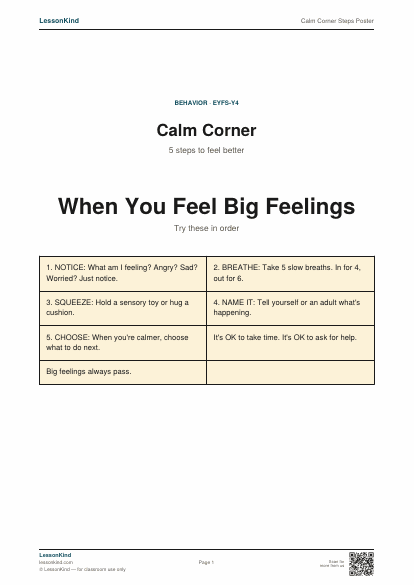
Calm Corner Steps Poster
5-step regulation poster for the calm corner — what children can do when they feel overwhelmed. Based on trauma-informed practice.
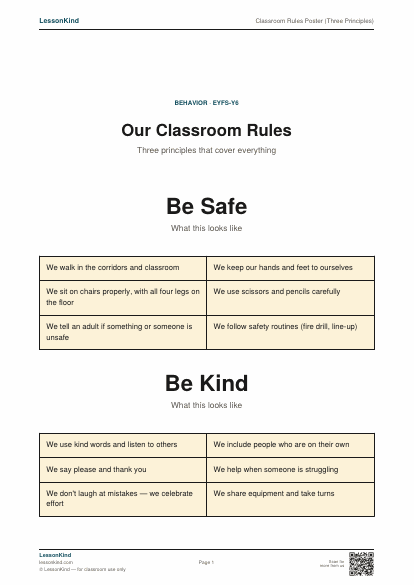
Classroom Rules Poster (Three Principles)
Principle-based classroom rules — Be Safe, Be Kind, Be Ready to Learn — with concrete examples for each. Based on the article 'The Classroom Rules Paradox'.
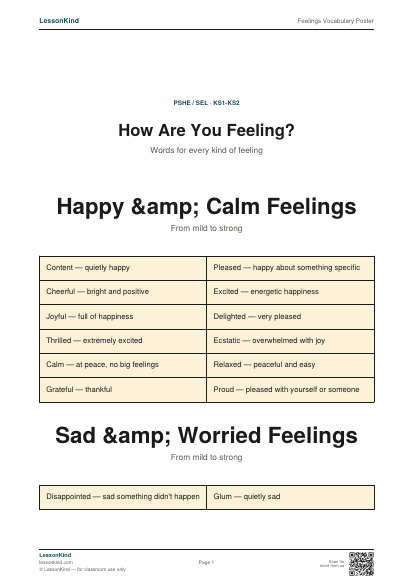
Feelings Vocabulary Poster
Beyond happy and sad — 50+ feelings words organised by intensity. Builds emotional vocabulary across KS1 and KS2.
Going deeper
On rewards, motivation and what actually works
Books we'd recommend on the topics raised in this article.
The research on rewards
-
P
Punished by Rewards: The Trouble with Gold Stars, Incentive Plans, A's, Praise and Other Bribes — Alfie Kohn
The seminal book on this topic - W Why We Do What We Do: Understanding Self-Motivation — Edward L. Deci, Richard Flaste
- D Drive: The Surprising Truth About What Motivates Us — Daniel H. Pink
- M Mindset: Changing The Way You Think To Fulfil Your Potential — Carol S. Dweck
What to do instead in primary
Convenience links to Amazon. As an Amazon Associate we earn from qualifying purchases at no extra cost to you. Read our affiliate disclosure.
Keep reading
Behavior & classroom management
When the Kids Who Need You Most Are the Ones You Find Hardest
The marble jars and traffic lights work for the children who didn't really need them. Here's what actually moves the kids who keep blowing the system up.
8 min read
Behavior & classroom management
The First Two Weeks: The Behavior Foundation You Can't Build Later
Most teachers know the first two weeks matter. Few know how MUCH they matter, or what to do with them. The behavior of your class in June is largely determined by what you do — or fail to do — in September.
8 min read
Behavior & classroom management
What 'Restorative Practice' Actually Means in Year 3
Restorative practice is the trendy approach in primary behavior. It works brilliantly when implemented well and disastrously when implemented as a cover for inaction. Here's what it actually is, what it isn't, and how to get it right.
9 min read