Math · 7 min read
Why kids hate maths (and what actually changes their mind)
It's almost never the maths.
Published 2026-11-23
'I hate maths.' If you've taught Year 4 or above, you've heard it. Often it's loud — a deliberate performance for the rest of the table. Sometimes it's quiet — a child slumping further into their chair, refusing to pick up a pencil. Almost always, it gets dismissed: 'You don't hate maths, come on, give it a go.'
But the child isn't lying. They genuinely do hate it. The mistake is assuming they hate the maths. They almost never do. They hate how maths makes them feel.
What 'I hate maths' usually means
Sit with a child who says it and ask gentle follow-ups. The answer is rarely 'I find ratios conceptually unsatisfying.' It's almost always one of:
- 'I always get it wrong.' - 'Other kids finish before me.' - 'I don't understand what the question is asking.' - 'My mum says she was bad at maths too.' - 'It's boring.'
Notice what these have in common. None of them are about the mathematics. They're about confusion, embarrassment, comparison, identity, or engagement. Maths just happens to be the subject in which the child experiences those feelings most frequently.
The shame loop
Maths is uniquely good at producing public failure. Reading mistakes can be quiet — a misread word in your head. Writing mistakes can be private — a sentence the teacher fixes in red. Maths mistakes happen on whiteboards, in mental-arithmetic starters, on the carpet during shared problems. Other children see them. The child knows the other children see.
So a quiet pattern starts. The child gets a question wrong. The teacher (well-meaningly) explains. Other children finish faster. The child internalises 'I'm slow.' Next lesson, they hesitate. The hesitation makes them slower. Slower confirms the identity. By Year 5, they have a story about themselves: 'I'm not a maths person.'
This is the shame loop. And it gets bedded in for life. Half the adults you know who say 'I'm bad at maths' are running on a story they accepted when they were 9.
What actually breaks the loop
Three things help. None of them involve more maths.
**One: stop praising speed.** Speed is a terrible proxy for maths ability. The fastest kids in your class are the ones with the strongest recall of basic facts — that's it. Speed of basic-fact recall predicts very little about mathematical thinking. By praising the children who finish first, you tell the slower thinkers (often the deeper ones) that they're losing. The reframe: 'I love watching you check your work.' 'I noticed you tried two different methods.' Those land. They tell children that thinking is the goal, not racing.
**Two: separate effort from getting the right answer.** A child who tried hard and got it wrong has done something important. They've found out what doesn't work. The Japanese maths-classroom culture has a phrase for this: 'gakushū' — productive struggle. The struggle IS the learning. If we only celebrate right answers, we punish the children who are doing the actual cognitive work.
**Three: tell them when they were right.** This sounds obvious, but most maths-anxious children genuinely don't know when they've understood something. They see ticks, they see crosses, but they don't internalise the wins. Verbalise it. 'You used the formula correctly there.' 'You spotted that pattern faster than I did.' 'That's exactly the right method, well done.' Maths-anxious children are running on a story of failure. You have to actively rewrite it with specific, observed wins.
What doesn't help
A few well-intentioned things that make it worse.
**Telling them maths is fun.** It's not, all the time. Sometimes it's hard. The child who is struggling can hear 'maths is fun' as proof that there's something wrong with them — everyone else thinks it's fun and they don't.
**Maths is everywhere posters.** Cooking. Sports. Music. Yes, fine. But the child who hates fractions does not feel better knowing that the recipe for shortbread involves them.
**Sticker charts for getting answers right.** This re-cements the idea that what matters is the right answer. A child working hard on something they don't yet understand gets fewer stickers than a child coasting on what they already know. The wrong incentive.
**Praising 'natural ability' or 'being clever.'** Carol Dweck's research on mindset is misused as much as it's used, but on this point it's clear: telling children they're 'naturally good at maths' makes them MORE afraid of failure (it's a fixed identity that hard problems threaten). Praise the strategies, not the talent.
What parents need to hear
If you're talking to parents about a maths-anxious child, the most useful single sentence is: 'Please never say you were bad at maths.'
A parent who casually says 'oh, I was rubbish at maths too, don't worry' is giving their child permission — and a model — for giving up. Parents don't realise this lands. They think they're being sympathetic. They're really transmitting a generational story.
The other useful thing parents can do: stop quizzing at home. Drilling times tables in the car when the child is already wobbly produces tears, not fluency. If a child is in the shame loop, the home should be a maths-anxiety-free zone for a while. Bring it back gently, and only with high-success activities — board games, cooking, building.
The slow rebuild
If a child has been hating maths for two years, you won't fix it in a week. The rebuild is slow. Look for tiny wins. Praise specifically. Stop the speed comparisons. Pull the child aside privately and tell them, before a tricky lesson, 'You've been working really hard on this. I'm going to look out for what you do well today.' That kind of sentence — banked privately, not performed for the class — is what turns 'I hate maths' into 'I'm okay at maths actually.'
It takes a term. Sometimes a year. But it works. And the child you helped will remember the teacher who pulled them out of the loop, decades later — long after they've forgotten what fractions are.
Free bundle for this topic
KS2 Maths Pack
10 favourite maths resources — times tables, fact families, mental maths, fractions.
Practical resources for this
Take this further
Printable, classroom-ready resources for the topics in this article.
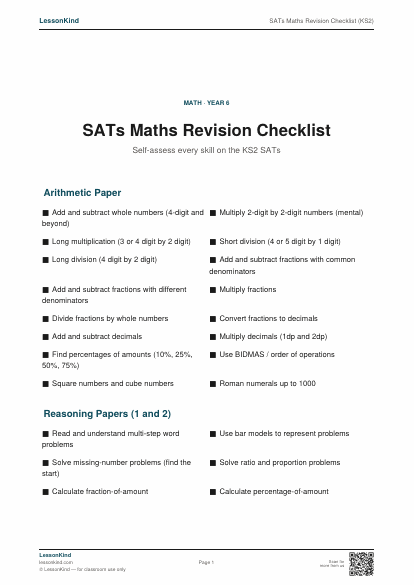
SATs Maths Revision Checklist (KS2)
A printable self-assessment checklist of every maths skill on the KS2 SATs Arithmetic and Reasoning papers. Y6 children tick off what they're confident with and what needs more practice.
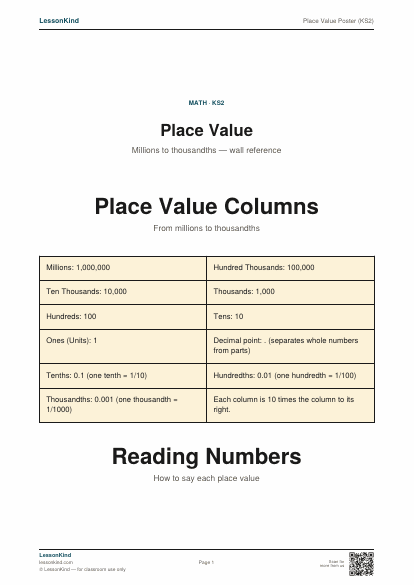
Place Value Poster (KS2)
Wall poster showing place value from millions through to thousandths. Reference for every KS2 maths lesson involving large numbers, decimals or rounding.
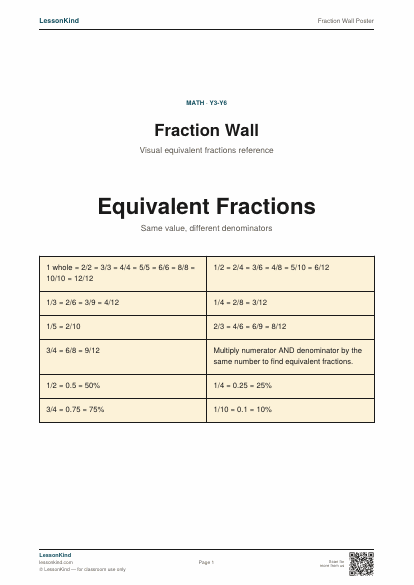
Fraction Wall Poster
Visual fraction wall showing equivalences from wholes to twelfths. The fastest way for KS2 children to grasp equivalent fractions.
Going deeper
On maths anxiety and rebuilding confidence
If a child you teach (or parent) is in the shame loop, these books help adults understand it and act differently.
On maths anxiety and identity
-
M
Mathematical Mindsets: Unleashing Students' Potential through Creative Math — Jo Boaler
The single most-cited book on maths confidence and growth - W What's Math Got to Do with It?: How Parents and Teachers Can Help Children Learn to Love Their Least Favorite Subject — Jo Boaler
-
M
Mindset: Changing The Way You Think To Fulfil Your Potential — Carol S. Dweck
The original mindset research -
O
Overcoming Math Anxiety — Sheila Tobias
Adult-focused but the patterns apply to children
For maths-anxious children themselves
Convenience links to Amazon. As an Amazon Associate we earn from qualifying purchases at no extra cost to you. Read our affiliate disclosure.