Teaching strategy · 6 min read
Differentiating Math Without Burning Out
Three pragmatic strategies for mixed-ability classrooms
Published 2026-04-02
Differentiation is one of those words that everyone agrees is important and almost no one defines the same way. For most elementary teachers, it boils down to a single hard problem: how do you keep the strugglers afloat AND keep the high-flyers from being bored AND not stay at school until 7 p.m. planning?
Here are three strategies that genuinely work without doubling your prep.
1. Differentiate by depth, not by sheet
The biggest time sink in differentiation is producing three versions of the same worksheet. Don't. Use one worksheet, but build it so it gets harder as students go down the page. The first 60% of questions should be reachable for almost everyone in the room; the last 40% should stretch your top quartile. Tell the class explicitly: "Aim for question 12 by the end of the lesson. If you finish that, the questions below are challenges. If you're not there yet, that's fine — quality over speed."
This works because it removes the pressure to label children as "low" or "high". Every child works on the same task; only the depth they reach differs. And it cuts your prep to one sheet, not three.
2. Differentiate by support, not by content
Instead of giving struggling students a different problem, give them the same problem with more scaffolding. A multiplication grid for the child who isn't fluent in tables yet. A sentence opener for the child who freezes on a blank page. A worked example pinned to the desk for the child who can't quite remember the column-addition method.
The advantage here is huge: every child is working on grade-level content. They aren't being given easier work; they're being given the SAME work with the supports they need to access it. This matters for confidence and for what they take into the next year.
3. Use ten minutes of conferencing as your real differentiation
In a 45-minute lesson, the most powerful intervention is rarely a worksheet. It's you, sitting next to a child, asking them to talk through what they're doing. Plan for a 10-minute window each lesson where you pull two or three students for a short, targeted conference. One day it's the kids who are stuck on regrouping. Next day it's the kids who are racing ahead and need stretching with a richer problem.
You won't get to every child every lesson. That's fine. Over a week, you'll have spoken individually with every child — and that's when real differentiation happens.
What to drop
Stop doing the things that LOOK like differentiation but don't help much: - Color-coded worksheets where the only difference is the font size - Three "challenge" questions tacked on the end of an easy sheet (the kids who finish first will skip them) - Different homework for different children (you'll spend the weekend chasing it)
Differentiation is real, important, and tiring. Make sure the energy you spend on it is going into the things that actually move children forward — not into producing more paper.
Practical resources for this
Take this further
Printable, classroom-ready resources for the topics in this article.
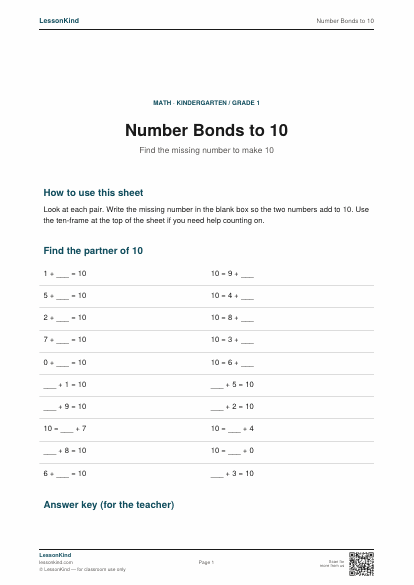
Number Bonds to 10
20 number-bond questions with a ten-frame visual support panel. Ideal for early addition fluency.
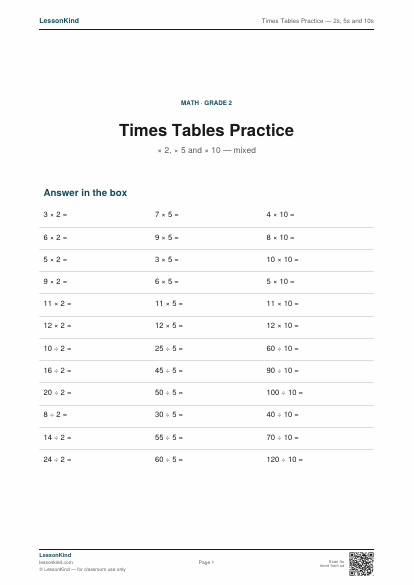
Times Tables Practice — 2s, 5s and 10s
Mixed-up times tables practice with 36 questions. Builds rapid recall of the 2, 5 and 10 tables.
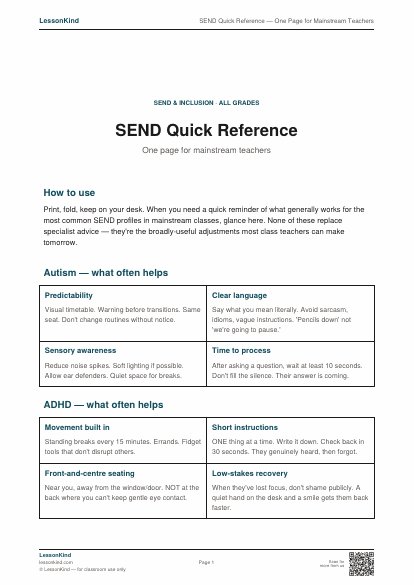
SEND Quick Reference — One Page for Mainstream Teachers
A one-page reference summarising the most useful adjustments for the four most common SEND profiles — autism, ADHD, dyslexia, anxiety. Print and stick on your desk.
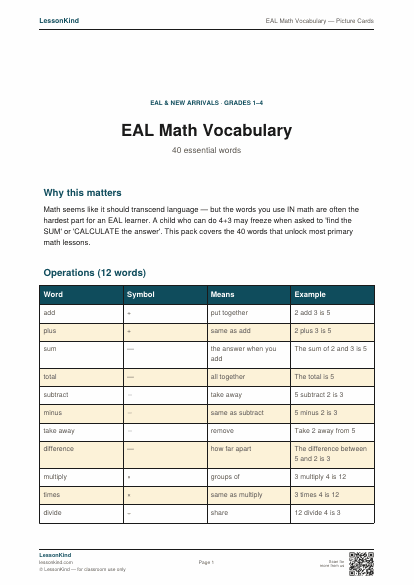
EAL Math Vocabulary — Picture Cards
40 essential math words for EAL learners — add, subtract, equals, more, less, half. Each with a visual cue and example sentence.
Going deeper
Books on maths teaching and differentiation
For teachers wanting to deepen their maths pedagogy without exhausting themselves.
Foundational
Convenience links to Amazon. As an Amazon Associate we earn from qualifying purchases at no extra cost to you. Read our affiliate disclosure.
Keep reading
Teaching strategy
Ability Grouping in Primary: What the Evidence Actually Shows
Most primary classrooms still group children by 'ability' for maths and English. The evidence on this is unusually clear — and unusually ignored. Here's what the research says, why schools keep doing it anyway, and what good mixed-attainment teaching actually looks like.
9 min read
Teaching strategy
Ability Grouping in Primary: What the Evidence Shows
The debate about ability grouping is often ideological. The evidence is more nuanced and more actionable than either side usually acknowledges.
6 min read
Math
When a Child Says 'I'm Bad at Math'
Almost every adult who hates math can name the year it started. By age eight, many children have already decided they're 'not a math person'. Here's how that happens and how to push back.
7 min read
Teaching strategy
The Myth of Learning Styles — and What to Do Instead
Learning-styles theory has been one of the most popular ideas in education and one of the most thoroughly debunked. Here's why — and what genuinely helps children learn.
7 min read