Classroom culture · 5 min read
Why Your Seating Plan Matters More Than You Think
And how to design one that actually works for your class
Published 2026-05-14
The seating plan is one of the most powerful interventions a teacher makes — and one of the least analysed. Most teachers design their first plan on instinct, adjust it twice in September, and live with it until Christmas. The research suggests we should be more deliberate.
What seating plans affect
Proximity to the teacher is consistently associated with higher engagement and attainment — not because brilliant children sit at the front, but because sitting at the front changes behaviour. Students at the front answer more questions, receive more teacher attention, and are more visually accountable. Moving a lower-attaining pupil towards the front often produces measurable improvement without any other change.
Proximity to specific peers affects both academic performance and behaviour. Children talk in class, they distract each other, they help each other. A child who sits next to someone who asks lots of questions tends to ask more questions. A child who sits next to a consistent low-level disrupter tends to produce less work.
This doesn't mean you should sort by attainment. It means seating placement matters and should be intentional.
What research suggests
The available evidence (sparse, but consistent) points to a few findings:
**Rows and columns outperform clusters for focused independent work.** When children sit in groups of four facing each other, they talk more — which is sometimes good (collaborative tasks) and sometimes not (independent writing). Clusters suit discussion-heavy lessons; rows suit focused individual work.
**Mixed-attainment pairing tends to benefit lower-attaining pupils more than it harms higher-attaining ones.** When a more confident pupil explains something to a less confident one, both tend to consolidate understanding. This doesn't mean always pair-mixed — variety matters — but don't avoid it.
**Seating instability — frequent changes — correlates with poorer outcomes.** Constant rearrangement prevents children from building working relationships with their table partners. Stability for at least half a term seems to matter.
How to design a seating plan
Think about three things:
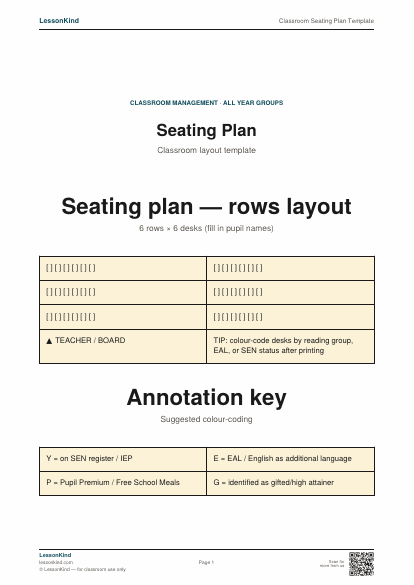
1. **Who needs to be near you?** SEND pupils, EAL pupils, and any pupil who frequently needs quiet individual support should be placed where you can reach them easily, where they can hear clearly, and where you can redirect subtly without crossing the room.
2. **Who should not sit together?** Be honest about this. Two friends who consistently distract each other is not a discipline problem — it's a seating problem. Separate them early, briefly explain why, don't make it a punishment.
3. **Visibility.** Can everyone see the board clearly? Are there positions where the light creates glare? Does the layout let you move freely to every pupil within a few steps?
A practical approach: seat pupils strategically for September, review after four weeks, and make targeted adjustments. Not a wholesale reshuffle — one or two deliberate moves where something specific isn't working.
The conversation with the class
Pupils often feel strongly about seating. They'll ask why. A direct, honest answer is always better than evasion.
"I've put you there because I want to make sure I can support you easily" is honest and kind. "Because you talk too much next to Sam" is also honest — but the phrasing matters. "I think you'll both work better with a bit of space from each other" makes the same point without accusation.
Never imply that the seating plan is punishment. Even if it is, in part. The moment it becomes punitive, you've given the seating plan emotional weight it doesn't need.
Free bundle for this topic
Cover Day Survival Pack
9 resources for cover days and routines, including behavior systems and morning meeting scripts.
Practical resources for this
Take this further
Printable, classroom-ready resources for the topics in this article.
Keep reading
Classroom culture
The Most Important Week of the Year
Most teachers think the first week is for getting to know the children. The teachers whose classrooms run beautifully use it for something quite different.
6 min read
Behavior & classroom management
The First Two Weeks: The Behavior Foundation You Can't Build Later
Most teachers know the first two weeks matter. Few know how MUCH they matter, or what to do with them. The behavior of your class in June is largely determined by what you do — or fail to do — in September.
8 min read