Teacher wellbeing · 6 min read
When a Child Gets Under Your Skin
On the professional and human reality of finding some children harder to like
Published 2026-05-15
Almost every teacher has a child they find genuinely difficult to like. Not difficult to teach — difficult to like. The child whose name produces a specific internal clench. The child you find yourself hoping will be absent.
This is more common than the profession acknowledges. And it matters — because disliking a child, if unaddressed, affects how you teach them.
Why it happens
Sometimes it's because the child triggers something personal. Sometimes it's a response to genuinely difficult behaviour over a long period. Sometimes it's a personality mismatch.
None of these are shameful. They're human responses. The professional obligation isn't to feel differently — it's to act equitably regardless.
What the research says
Teacher-student relationships are one of the strongest predictors of academic outcomes. Children who feel liked engage more, take risks, and recover from failure faster. Children who feel disliked often withdraw — or act out.
The difficult part: children know. Not always consciously, but they sense it. A teacher who doesn't enjoy their company will be imperceptibly colder. The child often responds by becoming more difficult — a self-reinforcing loop.
The 2-by-10 strategy
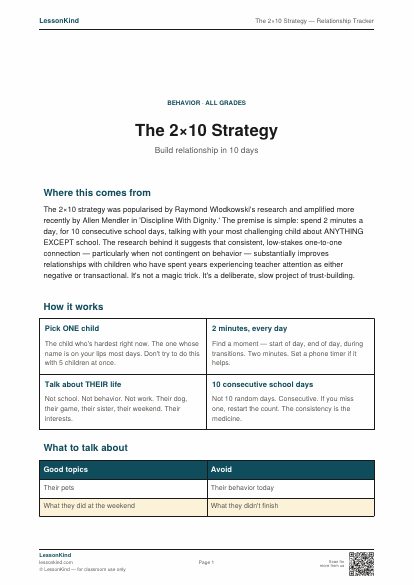
One evidence-supported intervention: for ten consecutive days, spend two minutes in purely personal, non-academic conversation with the child you find most difficult. No behaviour discussion. Just: what did you do at the weekend, what's your dog called.
Teachers report that feelings about the child shift — not dramatically, but enough. The child becomes more specific, more human. The relationship improves because you've invested in it.
The larger point
Primary teachers are expected to love all children equally. This isn't realistic. What is realistic — and what professional ethics requires — is equitable treatment regardless of feeling. Noticing the gap between what you feel and what you do is how equitability is maintained.
Free bundle for this topic
The Starter Pack
18 of our best free resources — a way to spend less time prepping and more time recovering.
Practical resources for this
Take this further
Printable, classroom-ready resources for the topics in this article.
Going deeper
Books on relationships and difficult behaviour
Books we'd recommend on the topics raised in this article.
For teachers
- I Inside I'm Hurting: Practical Strategies for Supporting Children with Attachment Difficulties in Schools — Louise Bomber
- B Building the Bonds of Attachment — Dan Hughes
- W When the Adults Change, Everything Changes — Paul Dix
- L Lost at School: Why Our Kids with Behavioral Challenges Are Falling Through the Cracks — Ross Greene
Convenience links to Amazon. As an Amazon Associate we earn from qualifying purchases at no extra cost to you. Read our affiliate disclosure.