EYFS & early years · 6 min read
The Reception to Year 1 Transition: What Children Need
Why this transition is harder than it looks — and how to make it work for every child
Published 2026-05-22
The transition from Reception to Year 1 is the sharpest in the English school system. In Reception, children learn primarily through play, in a provision-based environment, with high adult-child interaction and significant child choice. In Year 1, the expectation is often a formal, teacher-directed classroom with curriculum targets and assessment-driven practice.
This shift is well documented as a source of difficulty for many children, particularly those who were thriving in Reception but struggle to adapt to more formal approaches. The research suggests that the sharpness of this transition is a policy choice, not a developmental inevitability — and that schools can significantly smooth it with deliberate practice.
What makes the transition hard
The primary challenge is not academic readiness but regulatory readiness. Children who have developed their executive function, self-regulation, and independence in a play-based environment are often less prepared for sustained table-based sitting and teacher-directed tasks than their test scores suggest.
Children who are summer-born, those with August birthdays specifically, are chronologically younger by nearly a full year at this transition — a gap that has measurable effects on school readiness and which persists well into secondary school.
What helps
**Bridging the gap in both directions.** Year 1 teachers who incorporate elements of continuous provision — at least for the first half-term — see significantly better outcomes than those who begin immediately with a formal KS1 model. Equally, Reception teachers who gradually introduce more structured tasks in the summer term ease the shock of the transition.
**Excellent information transfer.** The Reception class teacher has detailed knowledge of each child's strengths, needs, learning style, and home context. This information should reach the Year 1 teacher in a form that is actually usable — not just scores, but narrative profiles.
**A focus on relationships.** Children who know their Year 1 teacher before they arrive — through transition visits, books, videos, or letters — show less anxiety. The quality of the Year 1 teacher's relationship with the class in the first few weeks is the strongest predictor of how well the transition goes.
**Patience with regression.** Children who were toileting independently may need more support. Children who seemed emotionally regulated in Reception may become less so. Temporary regression is a normal transition response, not a sign of difficulty requiring intervention.
A note on summer-born children
Parents of summer-born children have the legal right to request that their child starts Reception a full year later than usual (i.e., in the September after their fifth birthday rather than the September before). This right was clarified in DfE guidance. Schools must have a transparent process for considering these requests.
Free bundle for this topic
EYFS Essentials Pack
8 essentials for Reception and Kindergarten — provision, observation tools and activity cards.
Practical resources for this
Take this further
Printable, classroom-ready resources for the topics in this article.
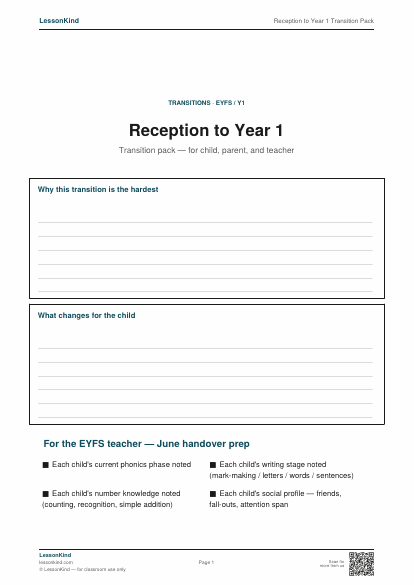
Reception to Year 1 Transition Pack
The single biggest transition in primary — from play-based EYFS to a more structured Year 1 classroom. Activities, parent letter, classroom routines, and EYFS-to-KS1 staff handover sheet for the gentlest possible move.
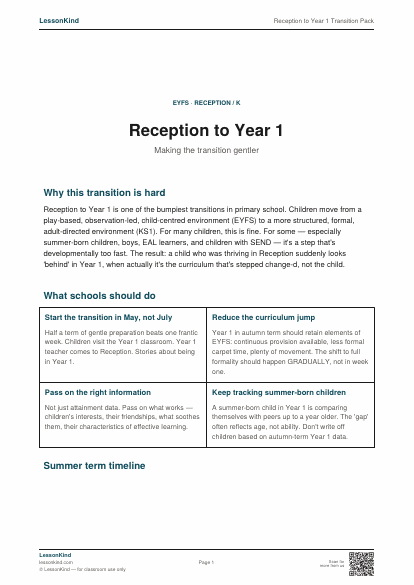
Reception to Year 1 Transition Pack
How to make the Reception-to-Year-1 transition gentler — when to start preparing, what to talk about with parents, what to pass to the next teacher, what to actually do in the last half-term.
Keep reading
Parent communication
What Is EYFS? A Guide for New Parents
EYFS stands for Early Years Foundation Stage. It covers children from birth to the end of Reception. This guide explains what it is, what your child will experience, and how progress is measured.
6 min read
EYFS & early years
How to Set Up Continuous Provision: A Beginner's Guide
Continuous provision — the system of self-directed learning activities that children access independently — is central to good EYFS practice. Here's how to set it up, what to put in each area, and how to make it work.
7 min read