EYFS & early years · 7 min read
How to Set Up Continuous Provision: A Beginner's Guide
What it is, why it works, and how to make it happen in a real classroom
Published 2026-05-20
Continuous provision is the system of carefully planned learning areas that children in Reception and nursery can access independently — without needing the adult to set up or lead an activity. It's not free play (though it includes elements of choice). It's structured, purposeful, and carefully resourced. Done well, it is the engine of EYFS learning.
What continuous provision actually is
A well-set-up continuous provision environment has eight to twelve distinct areas, each resourced to support specific aspects of learning. Children move between areas independently, choosing activities that interest them — while the teacher moves around observing, extending, and occasionally modelling.
The adult's role shifts from instructor to facilitator. This is uncomfortable for many teachers trained in more didactic models. It feels less controlled. But the research is consistent: children in high-quality continuous provision environments develop stronger executive function, better self-regulation, higher levels of creativity, and comparable or superior academic outcomes to children in more direct instruction settings.
The core provision areas
Most EYFS classrooms have some version of these areas:
**Construction** — blocks, duplo, loose parts, simple tools. Children develop spatial reasoning, engineering thinking, and mathematical language.
**Mark-making / writing** — pens, pencils, chalk, whiteboards, clipboards, stamps, paper of all kinds. This is not 'the writing table' — it is an invitation to make marks for a reason.
**Reading** — comfortable, well-lit, with books at child height. Familiar texts, information books, and books linked to current themes. Regular refreshing keeps engagement high.
**Maths** — sorting materials, counting objects, shape sets, rulers, money, dice. Materials should invite investigation rather than directing children to a specific task.
**Creative / art** — paint, collage, clay, junk modelling. Open-ended access to materials produces better outcomes than directed craft activities.
**Small world** — miniature figures, vehicles, natural materials, maps. Supports narrative development, social skills, and imaginative play.
**Role play / home corner** — changes with themes and children's interests. A shop, a hospital, a café — but the specific theme is less important than the quality of props and the adult's involvement when appropriate.
**Sand and water** — messy, essential. Children who handle sand and water develop mathematical and scientific thinking (volume, capacity, comparison) and fine motor skills.
**Outdoor provision** — ideally accessible freely throughout the session. The outdoor area is not PE and not break time — it is another learning environment with its own distinctive possibilities.
Getting it right
The most common mistake in setting up continuous provision is over-directing it. If every activity in the maths area has an instruction card, you've turned it into a worksheet on a table. The value of continuous provision lies in its openness: children choose, investigate, self-direct. The resources create the invitation; the child creates the learning.
The second most common mistake is not refreshing it. If the construction area has the same blocks in the same order for twelve weeks, engagement will drop. Small additions — a ramp, a collection of cardboard tubes, a set of mirrors — renew interest without requiring new resources.
The third is not being present in it. Continuous provision is not 'children playing while the teacher does something else'. The adult's role — observing, narrating, wondering aloud, extending, noting — is what transforms activity into learning.
Free bundle for this topic
EYFS Essentials Pack
8 essentials for Reception and Kindergarten — provision, observation tools and activity cards.
Practical resources for this
Take this further
Printable, classroom-ready resources for the topics in this article.
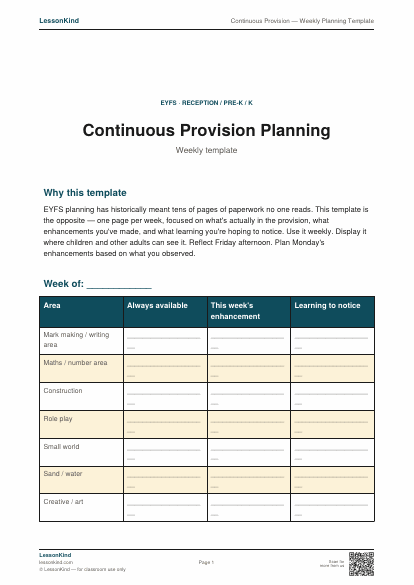
Continuous Provision — Weekly Planning Template
A simple weekly planning template for continuous provision — what's available where, what's been enhanced, what learning is being noticed. Replaces 30-page planning documents with one page that actually gets used.
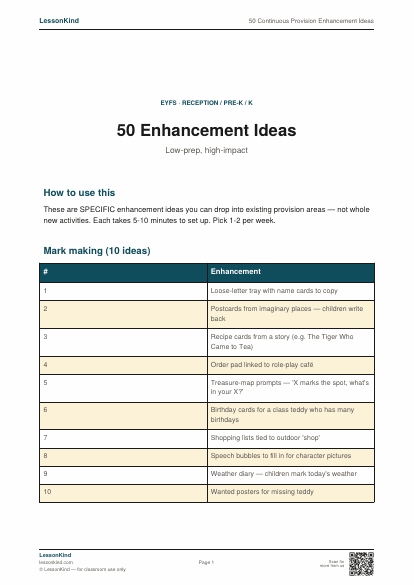
50 Continuous Provision Enhancement Ideas
50 specific, low-prep enhancements for the main provision areas — by area, by season, by skill. Useful for the Sunday-night moment when you're staring at the planning sheet.
Going deeper
Books on continuous provision and EYFS environments
Books we'd recommend on the topics raised in this article.
Essential reading for EYFS practitioners
Loose parts and continuous provision resources
Convenience links to Amazon. As an Amazon Associate we earn from qualifying purchases at no extra cost to you. Read our affiliate disclosure.
Keep reading
EYFS & early years
What Reception Teachers Know That the Rest of the School Should
Reception teachers operate with a different framework from the rest of primary — one that the rest of the school could learn a great deal from.
6 min read
EYFS & early years
What Reception Teachers Know That the Rest of the School Should
Reception teachers operate with a different framework from the rest of primary — one the whole school could learn from.
6 min read
Parent communication
What Is EYFS? A Guide for New Parents
EYFS stands for Early Years Foundation Stage. It covers children from birth to the end of Reception. This guide explains what it is, what your child will experience, and how progress is measured.
6 min read