Parent communication · 5 min read
Helping With Primary Science Homework
The concepts, the vocabulary, and how to support without giving away answers
Published 2026-05-12
Primary science covers a lot of ground. By the end of Year 6, children have studied forces, light, sound, electricity, states of matter, rocks and fossils, plants, animals, habitats, evolution, and more. Science homework can look like anything from labelling a diagram to writing up an experiment.
Here's how to support your child's science learning at home.
What primary science is actually trying to do
Primary science has two goals running at the same time. The first is knowledge — the facts and concepts that children need to understand the physical and living world. The second is scientific thinking — observing, questioning, predicting, testing, concluding.
The best homework supports both. A question like 'why does a block of wood float?' isn't just asking for a fact — it's asking a child to reason about what they know.
How to help with science homework
**Read the question together first.** Many science homework errors come from misunderading the question. Is it asking for a fact? An explanation? A comparison? A prediction? Getting clear on what type of answer is needed before starting saves a lot of frustration.
**Talk about what they already know.** Before looking anything up: 'What do you think? Why do you think that?' Getting children to commit to a prediction or explanation before checking the answer is good scientific practice — it's how scientists work.
**Use household examples.** Science is full of everyday phenomena. Condensation on a cold glass is the water cycle. A spinning bicycle wheel is inertia. A burnt piece of toast is a chemical change. Making the connection between the lesson content and things your child has seen makes the concepts stick.
**Let them be wrong.** If your child gives a wrong answer in their homework and you know it, don't immediately correct it — ask a question instead: 'Are you sure? What about...?' Let them reason their way to the right answer. This is far more valuable than being told the answer.
**Look things up together.** When neither of you knows the answer, model how to find out: search together, read together, discuss what you find. This models intellectual curiosity — the thing that makes children better at science in the long run.
Vocabulary
Science homework often trips up on vocabulary. Here are some common terms that confuse children (and parents):
**Reversible vs irreversible change**: melting ice is reversible (it can freeze again); burning wood is irreversible (it can't unburn).
**Transparent, translucent, opaque**: transparent = lets all light through (clear glass); translucent = lets some light through but not clear (tissue paper); opaque = lets no light through (wood).
**Carnivore, herbivore, omnivore**: meat-eater, plant-eater, both.
**Predator and prey**: predator hunts; prey is hunted. One animal can be both (a fox is a predator of rabbits but prey for larger predators).
**Fair test**: in an experiment, changing only ONE variable at a time to make the test fair.
When science homework involves an experiment
If your child has been asked to do an experiment at home — even a simple one — resist the urge to do it for them or to make it 'work' when it doesn't. A failed experiment that a child investigates ('why didn't it work? what could we change?') is more scientifically valuable than a tidy result that was set up by an adult.
The messy, honest result is the point.
Practical resources for this
Take this further
Printable, classroom-ready resources for the topics in this article.
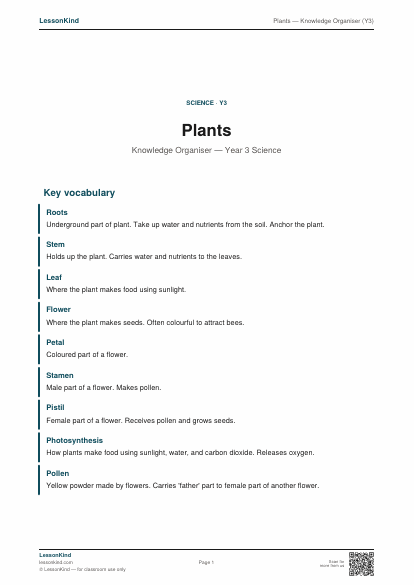
Plants — Knowledge Organiser (Y3)
Single-page reference for KS2 plants unit — parts of a plant, photosynthesis, what plants need, life cycle, pollination. Aligns with Year 3 NC science.
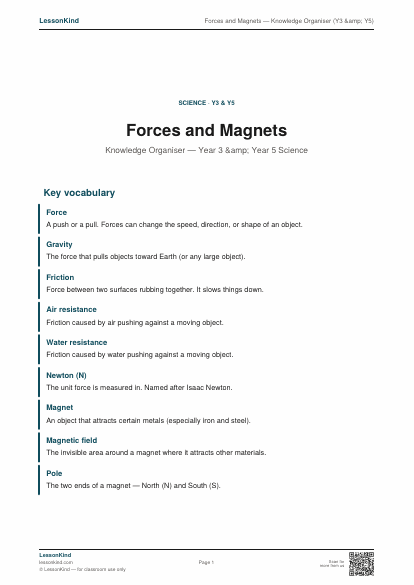
Forces and Magnets — Knowledge Organiser (Y3 & Y5)
Single-page reference for KS2 forces and magnets unit — gravity, friction, push/pull, magnetism, magnetic poles. Covers Year 3 (forces and magnets) and Year 5 (forces in detail) NC requirements.
Keep reading
First-year teaching
What They Don't Tell You in Teacher Training
Teacher training prepares you for lesson planning. It does not prepare you for what your first term as a class teacher actually feels like. Here's the honest version.
7 min read
Teaching strategy
The Purpose of Homework (And Why Most Schools Get It Wrong)
Homework is one of the most contentious parts of primary education. The research is clearer than schools admit. Here's what works, what doesn't, and why.
5 min read