First-year teaching · 7 min read
What They Don't Tell You in Teacher Training
The seven realities that hit you in your first term — and how to survive them
Published 2026-10-17
Teacher training is a strange beast. It's intellectually rigorous, professionally respectable, and almost entirely silent on what your first term as a real class teacher actually feels like.
This isn't anyone's fault — there are some things you can only learn by doing. But it does mean a lot of NQTs and ECTs spend their first October convinced they're failing at the job. Mostly, they're not. They're just experiencing what every first-year teacher experiences. Here's the honest version.
1. You will be exhausted in a way you've never been exhausted before
Standing up for six hours a day, talking continuously, making approximately 800 micro-decisions per hour, and being watched by 30 small humans is more tiring than anything most adults do. Add planning, marking, and meetings, and you'll regularly hit Friday in a state of near-collapse.
This is normal. It does ease — by January, your stamina is noticeably better. By the second year, the exhaustion is half what it was. But the first term is genuinely brutal. Plan accordingly: don't book a wedding, a house move, or a major life event in your first October half-term.
2. The behaviour will get worse before it gets better
Most NQTs spend the first few weeks being extremely nice, hoping the children will reciprocate. They don't. They test. By weeks 3-5 the class is, frankly, harder than it was on day one.
This isn't a sign you're a bad teacher. It's a sign the children are checking what your boundaries actually are. If you hold the line — calmly, consistently, predictably — the testing peaks around week 5 and then subsides. If you don't, it gets worse.
The single biggest predictor of behaviour in February is what you did in September. Not what you did in October. Front-load the boundary-setting.
3. You will be a worse teacher in October than in March
In October you're still using bandwidth on basic logistics: where the photocopier is, how to take dinner numbers, what the IT login is. By March that's all automatic and you can finally focus on the *teaching*.
This means your October observations will not be your best work. Don't be devastated by an "ECT requires more support" feedback — it's not a reflection of your potential. Most teachers are operating at 60% of their second-year level by Christmas of year one.
4. Marking will eat your evenings unless you change something
Marking 30 books five times a week, in detail, with next-step comments, is mathematically impossible to sustain. Senior leaders who tell you to do this are setting you up to fail.
Three things help:
- **Live marking** during lessons (a tick-and-flick as you walk around) replaces a lot of after-school marking - **Whole-class feedback sheets** instead of individual comments for most subjects - **Verbal feedback codes** — a tiny "VF" stamp says "I gave this child verbal feedback in the lesson"
Find your school's actual policy and follow it strictly. Don't gold-plate. The teachers who burn out fastest in year 1 are the ones who exceed the marking policy because they think they should.
5. The other staff will assess you fast
By half term, your colleagues have made up their minds about you. The judgments are usually based on three small things:
- **Are you reliable?** Do you do what you said you'd do? - **Are you punctual?** Are you in the staffroom when you said you'd be? - **Do you complain too much?** A bit of moaning is fine; constant complaining is exhausting.
Get those three right and you'll have a positive reputation that protects you when you make actual professional mistakes (which everyone does). Get them wrong and you'll find your colleagues less forgiving.
6. You will say something you regret
Sometime in your first term, you'll say something to a child that you will replay in your head that night and feel awful about. It might be a sarcastic comment that landed wrong, an unfair telling-off, or just a tired snap.
Here's the truth: every teacher does this. The children don't remember it as much as you do. The fix is simple — go to the child the next day and say "I was sharp with you yesterday and I shouldn't have been. Sorry about that. Fresh start." Children are remarkably forgiving when adults model that.
7. Your subject knowledge will get exposed
You'll teach a phonics lesson and realise you don't actually know the difference between split digraphs and trigraphs. You'll teach a maths lesson and not be able to explain why the column method works. This is humbling.
The good news: these gaps are obvious to you because you're noticing them, which means you'll fix them. The teachers in trouble are the ones who don't notice. Keep a list of "things I need to look up". Spend 15 minutes a week on it. By the end of year one, you'll be a substantively more knowledgeable teacher.
The thing that gets you through
Almost no first-year teacher succeeds alone. The thing that pulls you through October is the colleague (often in your year group, sometimes a TA, occasionally a deputy) who notices you're struggling and quietly helps — by sharing planning, listening at break, telling you that what you're feeling is normal.
Find that person. Be that person for someone next year. That's how the profession actually sustains itself.
Free bundle for this topic
The Starter Pack
18 free resources spanning every subject — the universal new-teacher starter.
Practical resources for this
Take this further
Printable, classroom-ready resources for the topics in this article.
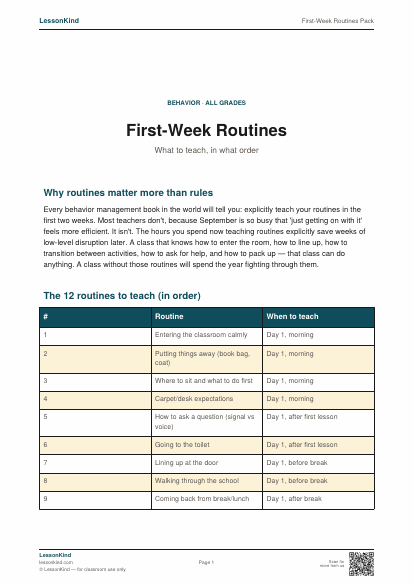
First-Week Routines Pack
The 12 routines you must establish in the first two weeks — entry, transitions, lining up, asking for help, finishing work, end of day. With explicit teaching scripts.
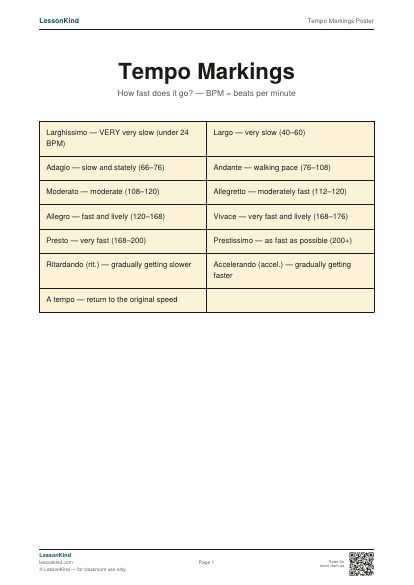
Tempo Markings Poster
Italian tempo terms with BPM ranges. Useful for music reading and ensemble work.
Going deeper
Essential reading for new teachers
Books we'd recommend on the topics raised in this article.
Survival reading
Convenience links to Amazon. As an Amazon Associate we earn from qualifying purchases at no extra cost to you. Read our affiliate disclosure.
Keep reading
First-year teaching
Five Mistakes I Made as a New Elementary Teacher
If I could go back and shake my first-year teacher self by the shoulders, here's what I'd say.
7 min read
Classroom culture
The Most Important Week of the Year
Most teachers think the first week is for getting to know the children. The teachers whose classrooms run beautifully use it for something quite different.
6 min read
Teacher wellbeing
Why September Feels So Hard (And Why That's Normal)
Every teacher knows September is hard. Fewer know that October is harder, that November is the lowest point, and that the system more or less requires you to push through. Here's what to expect and how to survive it.
7 min read