Teaching strategy · 5 min read
The Purpose of Homework (And Why Most Schools Get It Wrong)
What homework is for in primary, and what it shouldn't be
Published 2026-11-01
Few topics generate more parent emails, staff debate, and school policy revision than primary homework. Schools set it because parents demand it. Parents demand it because they want children to be learning. Children resent it because it cuts into play. Teachers set it because policy requires it, mark it under duress, and quietly suspect it doesn't help.
Underneath all this is a research literature that's surprisingly clear, and a policy practice that often ignores it.
What the research actually says
The Education Endowment Foundation summarises the evidence well:
- For *primary-age children*, homework has a small positive effect on attainment — about 2 months of progress per year, on average. - The effect varies enormously by *type* of homework. Some types help significantly; others don't help at all. - The effect is much smaller in primary than in secondary. - Quality matters more than quantity. - Engagement (whether children actually do it well) matters more than setting it.
The research does not support the position "more homework = more learning". It supports "the right kind of homework, set sparingly, helps".
What primary homework is actually for
Three legitimate purposes:
**1. Practice and consolidation.**
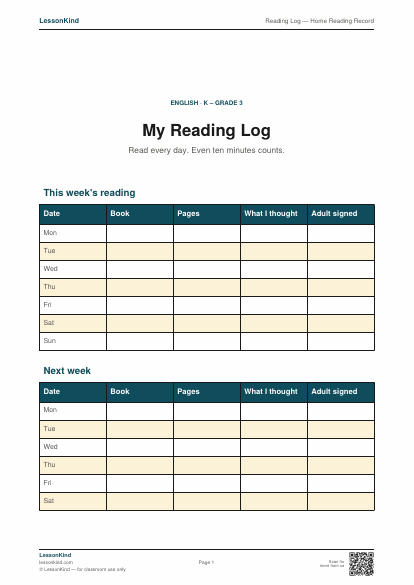
Daily reading, times tables, spelling — areas where consolidation through repetition matters. This is the strongest case for homework. Children who read 20 minutes a day at home dramatically out-pace children who don't. Children who practise times tables daily develop fluency far faster than those who only practise at school.
**2. Connection between school and home.**
Homework that involves a child telling a parent about their learning, or doing a small task with a parent, builds the home-school relationship. "Tell a grown-up about the Romans, then together write three things you've learned." The conversation matters more than the writing.
**3. Building independence.**
By Year 5 and 6, homework starts preparing children for the volume and self-management secondary will demand. Setting weekly homework with a Friday deadline teaches planning skills. This becomes more important as children approach Year 7.
What primary homework shouldn't be
Several common practices have weak or no evidence:
**1. Worksheets that test things children haven't been taught well in school.**
If the maths concept wasn't fully understood in class, sending it home as homework just transfers the teaching to the parent. Some parents teach it (well or badly). Some don't. The class arrives next day with mixed and incoherent understanding.
**2. Long projects requiring parent involvement.**
The "make a model of an Egyptian pyramid" homework is a recurring example. The parents who help build elaborate ones are often middle-class with time and craft supplies. The children whose parents can't help feel ashamed. The educational value is minimal.
**3. Spelling lists detached from school teaching.**
If the school is teaching a spelling pattern, homework practising that pattern is fine. If homework spelling is "10 random words to memorise", it's probably not building anything.
**4. Anything graded that creates anxiety.**
Homework that's marked, recorded, and reported back to parents creates a particular kind of stress for some families. The child who consistently doesn't return homework often has a reason — chaotic home, no quiet space, parent who can't help. Punishing or shaming them makes it worse.
What good primary homework looks like
A reasonable primary homework expectation:
**Years 1-2:** - Daily reading (10 minutes, with a parent if possible) - 5-10 spelling/phonics words to practice - A times tables app for 5 minutes (Y2 only) - That's it.
**Years 3-4:** - Daily reading (15-20 minutes, increasingly independent) - Weekly spelling practice (related to the school's pattern teaching) - Times tables practice 3x weekly - Occasional optional projects related to current topic
**Years 5-6:** - Daily reading (20 minutes) - Weekly maths task (consolidation, not new content) - Weekly English task (writing or comprehension) - Times tables fluency until secure - Occasional extended pieces for transition preparation
Total weekly homework: under an hour for KS1, under 90 minutes for KS2. More than this is rarely beneficial.
The reading non-negotiable
If primary schools could only set one piece of homework, it should be reading. The evidence is overwhelming: 20 minutes of daily reading at home predicts academic outcome at 16 better than almost any other variable.
For children whose parents read with them, this is easy. For children whose parents can't, schools need to compensate during school time — but schools should also keep emphasising the home reading habit, because the cumulative effect is enormous.
The conversation with parents
Schools that explain homework clearly to parents have fewer conflicts than schools that just assign it. Parents want to understand:
- What's the purpose of this homework? - How long should it take? - What if my child can't do it? - What happens if it's not handed in?
A clear homework policy that answers these questions, communicated at the start of the year and reiterated termly, prevents 90% of parent issues.
What to do as a class teacher
If your school's homework policy is reasonable, follow it but focus your effort on the highest-leverage parts (reading, times tables, spelling).
If your school's policy is excessive — daily worksheets, large projects — minimise the burden you add to children's lives. Set the worksheets, but don't gold-plate. The 30-minute optional reading you encourage is doing more for your class than the 60-minute weekly maths sheet.
If you have any influence on policy, the EEF's homework summary is your friend. Make the case for less, but better.
The honest reckoning
Primary homework is more about parent expectation and school culture than about evidence-based education. The research suggests we'd be roughly as well off setting half what we set, as long as the half we set was the right things.
But changing this requires the rare combination of leadership conviction, parent communication, and willingness to break with norms. Most schools find it easier to keep setting homework that doesn't really help than to explain to parents why they're stopping.
That doesn't make it right. It makes it familiar.
Practical resources for this
Take this further
Printable, classroom-ready resources for the topics in this article.
Going deeper
Reading on homework and parent partnership
Books we'd recommend on the topics raised in this article.
Practitioner
Convenience links to Amazon. As an Amazon Associate we earn from qualifying purchases at no extra cost to you. Read our affiliate disclosure.
Keep reading
Behavior & classroom management
Homework Battles: What Actually Works
Most homework battles aren't about homework. They're about tiredness, autonomy, executive function, or the child's relationship with the subject. The standard parental response — sit with them, push through, enforce — usually entrenches the problem. Here's what actually works.
8 min read
Teaching strategy
Homework: What the Evidence Actually Says
Homework is one of the most-debated and least-evidence-based parts of elementary education. Here's a straight-talking summary of what we know.
7 min read
Assessment & feedback
The Marking Trap
Most teachers spend hours every week on marking that produces almost no learning gain. Here's what the evidence says about feedback that actually works.
5 min read