Teaching strategy · 7 min read
Homework: What the Evidence Actually Says
How much should elementary kids do — and what kind?
Published 2026-06-04
Few things in education generate more strong opinions and fewer evidence-based practices than homework. Some parents want more of it; some want none. Schools agonize over policy. Teachers spend hours setting and chasing it. Children, in many cases, hate it.
Here's what we actually know.
The evidence in one paragraph
Homework has SMALL but POSITIVE effects on learning in middle and high school — and almost NO measurable effect on academic achievement in elementary school. This is the consistent finding across decades of meta-analyses. The main figure cited is from Harris Cooper's research: homework's effect on elementary achievement is essentially zero, while in high school it's modest but real. This doesn't mean elementary homework is BAD. It means the case for it has to be made on grounds OTHER than test scores.
Three reasons elementary homework can still be worth setting
**Building habit and routine.** A child who, age 6, can sit down and read aloud to a parent for 10 minutes a day is building a habit that will pay off for the next decade. The reading itself matters less than the routine.
**Reading at home.** This is the single homework type where evidence DOES support a positive impact, especially when an adult is reading WITH the child. 15 minutes a day of being read to (or reading aloud) is one of the strongest predictors of later reading achievement.
**Practice of fluency skills.** Things like times tables, spelling and basic number bonds become automatic only with repetition. Five minutes of times-tables practice three times a week beats 30 minutes once.
Three kinds of elementary homework that don't work
**Long, complex projects.** Children either get help from a parent (in which case the parent did it) or they don't (in which case they probably didn't finish or learn). Either way, the gap between confident and less-confident families widens — and you've spent twenty minutes per child marking it.
**Worksheets that recap today's lesson.** If they understood it, the worksheet is busywork. If they didn't, doing it wrong 25 times reinforces the misunderstanding. Better to assess understanding tomorrow and reteach.
**Anything that depends on materials at home.** "Find an interesting leaf and bring it in" sounds lovely, but children whose families don't have a garden or who live above a fast-food shop will be quietly excluded. Make any home task possible with a pencil and a piece of paper.
A rough rule of thumb
Many education researchers suggest a "10-minute rule": maximum 10 minutes per night per grade level. So Grade 2 = 20 minutes, Grade 5 = 50 minutes. That includes reading.
If your elementary school is asking children for more than that, ask why. The evidence does not support it. The evidence DOES support: a child being read to / reading aloud most nights, brief practice of fluency skills, and the rest of the time spent playing, sleeping, or being a child.
What to send home
If you're going to set homework — and many schools require some — here's what evidence-aligned elementary homework looks like:
- 10–20 minutes of reading (with an adult where possible) - A short fluency practice — times tables, spellings, number bonds - A retrieval quiz from earlier in the year (low-stakes, self-marked the next day) - Optionally: a creative or curiosity-driven prompt that doesn't depend on materials, like "tell three people in your home a fact you learned today"
Don't send: long projects, glue-stick worksheets, anything that needs a printer at home.
The bigger picture
Homework, in elementary, is not the place to expect achievement gains. The place is the actual lesson. If you want the children in your class to learn more, the highest-impact place to invest is your TEACHING — clearer explanations, better questioning, retrieval practice in lesson time. Homework is at best a small supplement. At worst, it's a wedge driven between school and family time, with little to show for it.
Set less. Demand less. Ask children to read. The evidence is on your side.
Practical resources for this
Take this further
Printable, classroom-ready resources for the topics in this article.
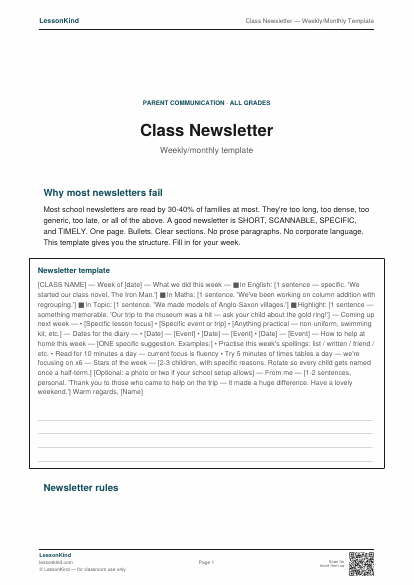
Class Newsletter — Weekly/Monthly Template
A simple, scannable class newsletter template — what we did, what's coming up, important dates, how to help. Designed to actually get read.
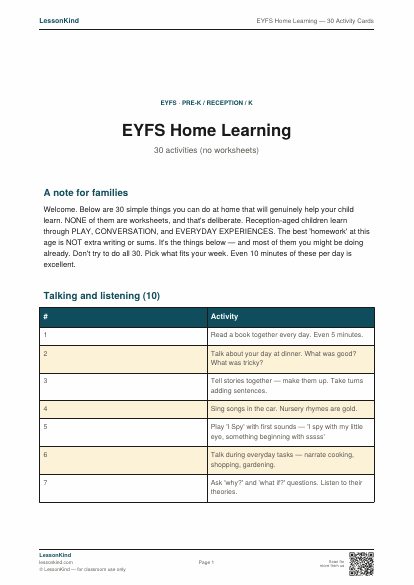
EYFS Home Learning — 30 Activity Cards
30 home-learning activities for Reception families — none of them worksheets. Cooking, walking, talking, counting, drawing — the things that actually develop young children.
Going deeper
Homework — what the evidence shows
Books that summarise the (genuinely complex) evidence on homework.
For teachers and senior leaders
Convenience links to Amazon. As an Amazon Associate we earn from qualifying purchases at no extra cost to you. Read our affiliate disclosure.
Keep reading
Teaching strategy
Ability Grouping in Primary: What the Evidence Actually Shows
Most primary classrooms still group children by 'ability' for maths and English. The evidence on this is unusually clear — and unusually ignored. Here's what the research says, why schools keep doing it anyway, and what good mixed-attainment teaching actually looks like.
9 min read
Teaching strategy
Ability Grouping in Primary: What the Evidence Shows
The debate about ability grouping is often ideological. The evidence is more nuanced and more actionable than either side usually acknowledges.
6 min read
Teaching strategy
The Myth of Learning Styles — and What to Do Instead
Learning-styles theory has been one of the most popular ideas in education and one of the most thoroughly debunked. Here's why — and what genuinely helps children learn.
7 min read
EYFS & early years
What 'School Readiness' Actually Means (And What It Doesn't)
Every year, parents worry about whether their 4-year-old is 'ready for school.' Schools advertise 'school readiness' programmes. Politicians make speeches about it. Most of what gets said about school readiness is wrong.
7 min read