EYFS & early years · 7 min read
What 'School Readiness' Actually Means (And What It Doesn't)
The phrase used by parents, schools, and policy — and how often it gets it wrong
Published 2026-09-12
"Is my child ready for school?" is one of the most common questions Reception teachers get from parents in the months before September. It's also one of the questions where the answer most often given is wrong.
The standard answer — given in parenting magazines, on school websites, in well-meaning conversations — is some version of: "they should be able to write their name, count to 20, recognise the alphabet, and sit still for a few minutes."
This is a checklist of academic skills. And while a child who can do all those things will probably have a smoother first term, none of those skills predict school success in the long run. The actual predictors are different.
This article is about what school readiness ACTUALLY is, and why we keep mistaking it for something else.
The real predictors
Decades of longitudinal research — tracking children from Reception through to secondary school and beyond — has identified what at age 4 actually predicts academic and social success at age 11.
The big ones, in approximate order of strength:
**Self-regulation.** Can the child wait? Can they shift attention? Can they tolerate frustration without melting down? Can they hold an instruction in mind? Self-regulation at age 4 predicts adolescent academic outcomes more strongly than IQ does. The Marshmallow Test made this famous; subsequent more rigorous research has confirmed the underlying finding. (Mischel, then Watts, Duncan and Quan in 2018 — though their replication suggested the marshmallow correlation was weaker than originally claimed, and that family factors mediated much of it.)
**Oral language.** What's the child's vocabulary? Can they tell a story? Can they listen to a story and understand it? Children's oral language at age 5 predicts reading comprehension at age 11 better than their early reading skills do. (Bercow review and subsequent research.)
**Executive function.** The umbrella term for self-regulation plus working memory plus cognitive flexibility plus inhibitory control. Strongly predictive across academic, social and economic outcomes throughout life. (Diamond, much work since 2000.)
**Social skills.** Can the child play with others? Take turns? Recover from disagreements? Show empathy? Children with strong social skills at school entry do better academically — not despite being social, but because of it. Learning is a social act.
**Curiosity and engagement.** Does the child want to find things out? Do they sustain interest in tasks? Do they ask questions? This is the closest cognitive marker to "the love of learning."
**Resilience.** What does the child do when something is hard? Do they try again? Walk away? Melt down? Resilience patterns in early childhood persist surprisingly strongly into adolescence.
Notice what isn't on this list:
- Knowing the alphabet - Counting to 20 - Writing their name - Reading any words
These academic skills are NICE to have at school entry. They are not necessary, and they are not predictive of long-term outcomes. A child who arrives in Reception not knowing letters but with strong self-regulation will overtake a child who arrives knowing letters but with weak self-regulation, by the end of KS1.
Why we get this wrong
If the predictors are clear, why does the public conversation about school readiness focus on the wrong things?
A few reasons.
**Academic skills are visible. Self-regulation isn't.** A parent can see whether their 4-year-old can write their name. They can't see whether their 4-year-old has good executive function. Visible things become things we worry about. Invisible things get ignored — until they become a problem.
**Academic skills can be drilled. Self-regulation can't be.** A parent who's worried their child can't write their name can buy a workbook and drill it for two weeks. A parent who realises their child has weak self-regulation can't fix that with a workbook. So the things you can address get more parent attention, even though they matter less.
**Schools sometimes ask for the wrong things.** Some Reception schools send "starting school" booklets full of academic tick-lists. Parents take this as the formal definition of school readiness. The schools usually mean these as a help; parents read them as a benchmark.
**Policy uses the language wrongly.** Government rhetoric about "school readiness" often equates it with academic readiness — phonics knowledge, ability to recognise letters, etc. This shapes funding, training, and parent expectations.
**Comparisons are corrosive.** Parents see other 4-year-olds reading and panic that their own child isn't. The other 4-year-old is probably an outlier. Most 4-year-olds aren't reading. The few who are will not have a long-term advantage.
What actually helps before school
If you have a 3- or 4-year-old, here is what genuinely helps prepare them for school. None of it requires worksheets or flashcards.
**Read to them. Every day.** This is the single most evidence-supported pre-school intervention there is. It builds vocabulary, narrative thinking, attention, and a love of stories. 15 minutes a day is plenty.
**Talk with them. A lot.** Have conversations. Explain things. Ask their opinions. Listen to their answers. The amount of conversation children have at home is one of the strongest predictors of vocabulary at age 5.
**Let them play.** Especially imaginative play, social play with other children, outdoor unstructured play. Play IS their cognitive development at this age.
**Build routines.** Bedtime, mealtimes, daily rhythms. Children who arrive at school with established routines self-regulate better than children whose lives have been more chaotic.
**Practice waiting.** Quietly, without making a big deal of it. Wait for dinner. Wait their turn. Wait for the next page of the story. Tolerance of waiting is a foundation of self-regulation.
**Encourage independence.** Putting on their own coat. Tidying their toys. Carrying their own bag. Not because they need to be self-sufficient, but because the small successes build confidence.
**Don't drill academics.** Don't teach reading early unless your child is asking for it. Don't drill counting beyond what comes up naturally. Don't make them write before they're physically ready (most aren't, at age 3-4). Pushing academic skills early often produces shallow gains and creates aversion later.
**Spend time outside.** Open air, physical exertion, nature, weather. Connects to physical health, sensory development, and (for older children) attention restoration.
**Manage their screen time.** This is the unromantic one. Heavy screen use in 3-4 year olds is associated with worse outcomes across self-regulation, attention, social skills, and language. Less is more. (Note: not zero — that's neither realistic nor necessary. But moderation matters.)
What schools should do
If you're a school reading this, a few things would help families understand school readiness more accurately.
**Talk about it. Explicitly.** In your starting-school information, talk about self-regulation, oral language, social skills. Not just "can they write their name."
**Show parents what good looks like.** Open days, transition events, parent meetings — show parents what children actually do in Reception. The play. The conversation. The small social moments. The skills you're aiming to build.
**Give specific, achievable suggestions.** "Read to your child every day" beats "promote a love of reading." "Practise turn-taking with simple games" beats "build social skills."
**Don't shame parents who haven't done the academic work.** Children arrive in Reception with vastly different experiences. Some have been to nursery for two years. Some are coming straight from home. Some have been read to thousands of times. Some have rarely been read to. The Reception year is for ALL of them. Pushing parental guilt about "school readiness" doesn't help anyone.
**Reassure about academic skills.** "If your child doesn't yet know letter sounds, that's fine. They'll learn that here." This single sentence calms a lot of parent anxiety and lets families focus on what matters.
A final word
The most "ready" children for school are not necessarily the ones who can already do school things. They're the ones who can regulate themselves, talk and listen, play with others, recover from setbacks, and stay curious about the world.
These are harder to build than the alphabet. They take years of relationships, conversations, routines and play. They can't be fixed with a workbook in August.
But they can be supported, gradually, by families who know to focus on them — and by schools that know to expect and develop them, rather than chasing the more visible academic skills that ultimately matter less.
If your child can talk, listen, play, wait, recover from upsets, and ask "why?" — they're ready. The rest will come.
Free bundle for this topic
EYFS Essentials Pack
8 essentials for Reception and Kindergarten — provision, observation tools and activity cards.
Practical resources for this
Take this further
Printable, classroom-ready resources for the topics in this article.
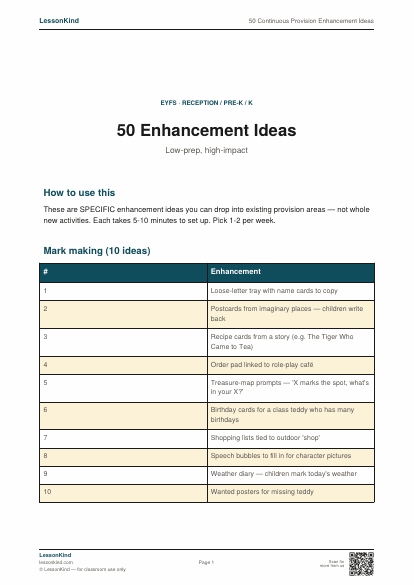
50 Continuous Provision Enhancement Ideas
50 specific, low-prep enhancements for the main provision areas — by area, by season, by skill. Useful for the Sunday-night moment when you're staring at the planning sheet.
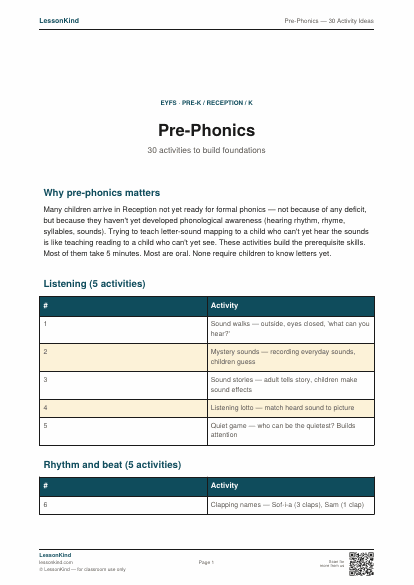
Pre-Phonics — 30 Activity Ideas
30 activities to develop the foundations BEFORE introducing letters — listening, rhythm, rhyme, alliteration, oral blending. The skills that determine how well phonics will land later.
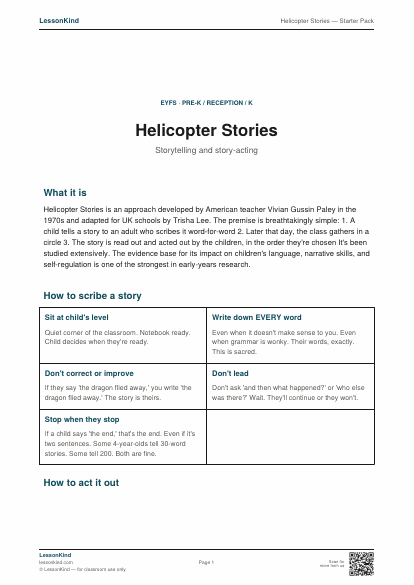
Helicopter Stories — Starter Pack
An introduction to Helicopter Stories — Vivian Gussin Paley's storytelling-and-story-acting approach. One of the most evidence-informed early-language interventions there is.
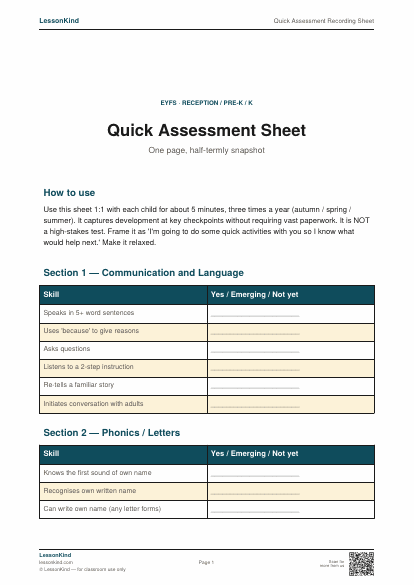
Quick Assessment Recording Sheet
A one-page recording sheet for quick formative assessments — phonics, number, fine motor, name writing. Use as a snapshot every half-term.
Reception Classroom — Essential Picture Books
The 30 picture books every Reception classroom should have — read-aloud favourites, repeat-read classics, and the books that build the foundational vocabulary, rhythm, and story-sense Reception children need.
Going deeper
School readiness — recommended reading
Books for parents wondering what their pre-school child needs (and what they don't).
For parents
For practitioners
Convenience links to Amazon. As an Amazon Associate we earn from qualifying purchases at no extra cost to you. Read our affiliate disclosure.
Keep reading
EYFS & early years
Play-Based Learning Isn't Lower Expectations — It's Different Expectations
Walk into a Reception classroom and you'll see children playing. Walk into a Year 3 classroom and you'll see children working. The mistake most adults make is assuming the second is more rigorous than the first.
8 min read
Reading & literacy
When to Worry About a Five-Year-Old Who's Not Reading Yet
Reception and Year 1 parents worry constantly about their child's reading. Most of the worry isn't warranted. Some of it is. Here's how to tell the difference — and what to do about both.
8 min read