Teaching strategy · 7 min read
The Myth of Learning Styles — and What to Do Instead
Why 'visual learner' and 'kinesthetic learner' don't hold up — and what does
Published 2026-04-30
For decades, an idea has dominated teacher training: that every student has a preferred 'learning style' — visual, auditory, kinesthetic — and that teaching should match that style for the child to learn well. It has spawned posters, surveys, training modules, even commercial products. It is also, by the weight of available research, almost certainly wrong.
What the research found
Multiple large reviews — including a much-cited 2008 review in the journal Psychological Science in the Public Interest — looked for evidence that matching teaching to a student's preferred style produces better outcomes. They found, in essence, none. Children who say they prefer visual learning don't learn more from visual teaching than from any other kind. The same holds for auditory and kinesthetic.
This doesn't mean students are imagining their preferences. They aren't. Many children genuinely prefer one mode over another. It just means those preferences don't predict what works to teach them.
Why teachers latched on to the idea
Three reasons stand out. First, it sounds humane: the idea that every child is unique and deserves teaching tailored to them. Second, it gives a satisfyingly concrete answer to "why isn't this child learning?" — they're a kinesthetic learner in a verbal classroom. Third, it sells well: surveys, training, posters, books.
But none of those reasons mean it works.
What actually does work
The good news is that we know quite a lot about what helps children learn. Almost all of it is content-led, not style-led.
**Match the mode to the material, not to the child.** Some content is genuinely visual — geography, geometry, anatomy. Diagrams help everyone. Other content is genuinely verbal — poetry, language, reasoning. Talking and listening help everyone. Other content is genuinely physical — drumming a rhythm, shaping a clay pot, doing a long jump. Demonstration and practice help everyone. Use whichever mode fits the content, not the child.
**Multiple representations help everyone.** A new concept lands harder when children meet it multiple ways: hear it, see it, do it, talk about it. Not because some children "are" auditory and others "are" kinesthetic, but because every brain forms more durable knowledge when it's encoded in multiple forms.
**Retrieval practice beats restudy.** Asking children to recall what they learned (a low-stakes quiz, a quick discussion, write three things you remember) does more for memory than re-reading the same notes.
**Spacing beats massing.** Three short practices over three days beats one long practice in a single day. This is brutal for end-of-unit cramming and brilliant for retention.
**Worked examples for novices, problem-solving for the more advanced.** When something is brand new, copying a worked example is more effective than wrestling with the problem from scratch. Once children have a foundation, then the problem-solving stretches them.
What you can let go of
Teachers carry enough cognitive load. Here's what learning-styles theory says you need to do, and what you can drop:
- Surveying every child to identify their style — drop it - Designing three versions of every lesson for V/A/K — drop it - Worrying that a verbal explanation is "wasted" on kinesthetic learners — drop it - Labeling children with a learning style at all — drop it
Keep instead: variety in how content is presented, plenty of retrieval practice, and the discipline to ask "what does this content need?" rather than "what does this child need?". The data say children will be better off — and you'll have your evenings back.
Practical resources for this
Take this further
Printable, classroom-ready resources for the topics in this article.
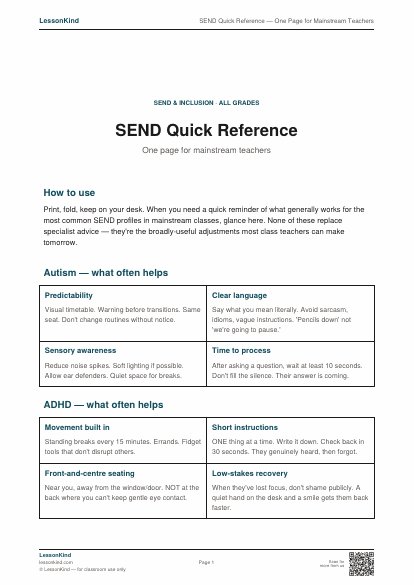
SEND Quick Reference — One Page for Mainstream Teachers
A one-page reference summarising the most useful adjustments for the four most common SEND profiles — autism, ADHD, dyslexia, anxiety. Print and stick on your desk.
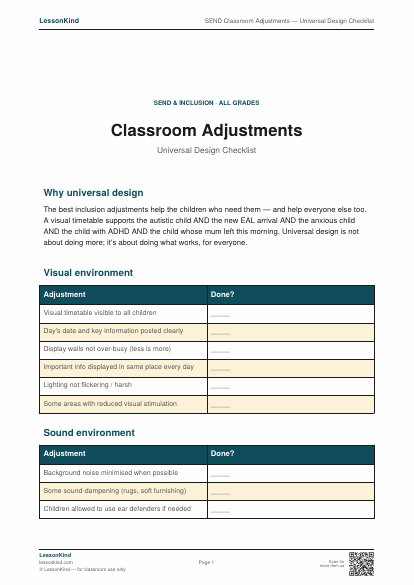
SEND Classroom Adjustments — Universal Design Checklist
A walk-through audit of adjustments that benefit children with SEND but help everyone else too. Audit your classroom in 15 minutes.
Going deeper
Cognitive science for teachers
The books that demolished learning styles and replaced them with something more useful.
Foundational
Convenience links to Amazon. As an Amazon Associate we earn from qualifying purchases at no extra cost to you. Read our affiliate disclosure.
Keep reading
Teaching strategy
Ability Grouping in Primary: What the Evidence Actually Shows
Most primary classrooms still group children by 'ability' for maths and English. The evidence on this is unusually clear — and unusually ignored. Here's what the research says, why schools keep doing it anyway, and what good mixed-attainment teaching actually looks like.
9 min read
Teaching strategy
Ability Grouping in Primary: What the Evidence Shows
The debate about ability grouping is often ideological. The evidence is more nuanced and more actionable than either side usually acknowledges.
6 min read
Teaching strategy
Homework: What the Evidence Actually Says
Homework is one of the most-debated and least-evidence-based parts of elementary education. Here's a straight-talking summary of what we know.
7 min read
Assessment & feedback
How to Give Feedback That Actually Changes the Work
Most marking has almost no effect on student work. Here's what does — and what to stop doing immediately.
7 min read
Assessment & feedback
Feedback That Changes the Work
Decades of research on feedback in education converge on one uncomfortable finding: most feedback given in classrooms produces little or no improvement. Here's what actually works.
7 min read