Parent communication · 6 min read
How to Help With Year 4 Maths Homework
What's actually on the curriculum — and how to support it at home
Published 2026-05-12
Maths homework can be a source of real tension at home — especially if the methods your child is using look different from the ones you were taught. Year 4 in particular is a significant year: it's when children take the Multiplication Tables Check and when formal methods of addition, subtraction, multiplication, and division begin to be embedded.
Here is what your child is working on in Year 4 maths, and how you can help without accidentally making things harder.
What Year 4 maths actually covers
Year 4 pupils work on:
**Times tables.** All tables up to 12×12. The government test (the Multiplication Tables Check, or MTC) happens in Year 4, so rapid recall of all times tables is a significant focus. If your child doesn't know their 6, 7, and 8 times tables confidently, that's the priority.
**Place value.** Numbers up to 10,000 — understanding what each digit represents. What does the 3 in 3,462 mean? The answer is 3,000, and children should be able to answer this quickly.
**Written methods.** Column addition and subtraction (carrying and borrowing), short multiplication (multiplying a 3-digit number by a 1-digit number), and the beginnings of short division.
**Fractions.** Equivalent fractions, comparing fractions, adding and subtracting fractions with the same denominator, and beginning to convert between mixed numbers and improper fractions.
**Decimals.** Tenths and hundredths. Decimal notation for tenths (0.3 = three tenths) and connecting decimals to fractions.
**Measurement and geometry.** Converting units (km/m, kg/g, l/ml), area and perimeter, properties of 2D shapes, and reading a 12- and 24-hour clock.
How to actually help
**On times tables:** The single most useful thing you can do is test them orally, randomly, quickly. Not in order — any table, any number, any order. Apps (the free ones that replicate the MTC format) work well for this. Five minutes a day is more effective than thirty minutes once a week.
**On written methods:** If your child's method looks different from yours, don't teach them your way. Ask the school how they teach it. Modern methods — like the 'grid method' for multiplication — are different from the long multiplication many adults learned, but they're designed to build understanding of place value. Conflicting methods confuse children.
**On fractions:** The common sticking point is equivalent fractions. If your child is struggling, use visual representations — cutting pizza, folding paper — before worrying about the abstract numbers. One half is the same as two quarters. Showing this with a physical object is much more powerful than drilling the calculation.
**On all topics:** Ask your child to explain what they're doing, not just do it. If they can explain why 47 + 25 = 72 (not just write the answer), they understand it. If they can only write the answer, they might be following a procedure they don't fully understand — and that will catch up with them.
What not to do
Don't tell your child the answer. It solves the immediate problem and creates a larger one.
Don't express your own anxieties about maths in front of them. 'I was terrible at maths at school' is a message that children often absorb as permission to be terrible too.
Don't reteach in a different way if they're already using a method from school — this creates confusion and frustration for both of you. If something isn't making sense, contact the teacher.
When to contact the teacher
If your child is consistently unable to complete maths homework without significant distress, that's useful information for the teacher. It might mean the work is too hard, that a concept hasn't been secured in class, or that your child is experiencing maths anxiety. All of these are things a teacher can address — but they need to know.
A quick email — 'Tom struggled a lot with fractions this week — is there anything we should focus on at home?' — is always welcome.
Practical resources for this
Take this further
Printable, classroom-ready resources for the topics in this article.
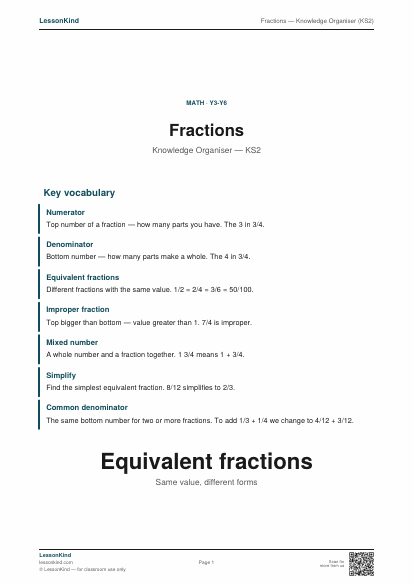
Fractions — Knowledge Organiser (KS2)
One-page reference for all KS2 fractions: equivalent fractions, comparing, ordering, adding/subtracting, multiplying, fractions of amounts, mixed numbers and improper fractions.
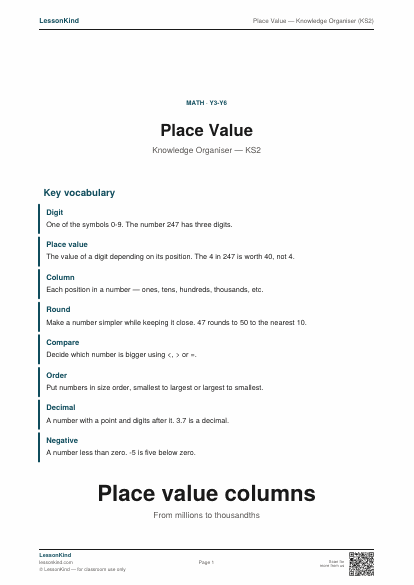
Place Value — Knowledge Organiser (KS2)
One-page reference for all KS2 place value: digits, columns, rounding, comparing, ordering, and decimals. Aligns with Autumn Block 1 in most primary maths schemes.
Going deeper
Maths support books for primary
Books we'd recommend on the topics raised in this article.
For children (home support)
For parents (understanding the methods)
Convenience links to Amazon. As an Amazon Associate we earn from qualifying purchases at no extra cost to you. Read our affiliate disclosure.
Keep reading
Math
Maths Anxiety in Primary Children
By Year 3, some children have already decided maths isn't for them. By Year 6, it's hard to shift. Maths anxiety is real, measurable, and largely preventable — but it requires understanding what actually causes it, which is rarely what parents assume.
8 min read
Math
Why Times Tables Still Matter (Even in 2026)
Times tables aren't old-fashioned drudgery. They're the cognitive scaffolding for everything from long multiplication to algebra. Here's why automatic recall matters and how to actually build it.
6 min read
Math
Mental Math Strategies That Actually Work
Mental maths isn't a mysterious gift. It's a small set of strategies that confident calculators use without thinking. Teach them explicitly and watch the gap close.
5 min read