Math · 6 min read
Why Times Tables Still Matter (Even in 2026)
The cognitive science behind automatic recall — and why apps alone won't get children there
Published 2026-10-15
There's a familiar parental complaint at parents' evening: "Why are you still making them learn times tables? Surely they can just use a calculator?"
It's a reasonable question. And the honest answer is: yes, calculators exist. But the children who can't recall 7 × 8 instantly aren't being held back at multiplication — they're being held back at every problem that *contains* multiplication. Long division. Fractions. Percentages. Algebra. Area and volume. Ratio. The cognitive cost of stopping mid-problem to work out 7 × 8 from scratch is what stops children from ever getting good at the bigger problem.
This is what cognitive scientists call "working memory load". Your brain has a small, finite amount of attention available at any moment — roughly 4-7 items. When children solve 246 × 38, they need that attention for the *method* (carrying tens, lining up columns, understanding place value). If they're also using up working memory calculating 6 × 8 from scratch, they have nothing left for the structure of the problem.
What "automatic recall" actually means
Automatic recall isn't the same as knowing. It means the answer comes back faster than you can think. Ask a confident Y4 child "What's 6 × 7?" and they say "42" without any visible processing — the same way you'd answer "What's your name?". That speed matters because it frees the brain for harder thinking.
Children who *work out* 6 × 7 (by counting up in 7s, or doubling 21) are not doing the same thing as children who *recall* it. The first group will struggle in long multiplication. The second group will fly.
Why apps alone don't get children there
Most times tables apps gamify the experience: get the answer right, win points, unlock a level. Children enjoy them. And used regularly, they do help.
But they have a hidden weakness: most apps move children to the next question the moment they answer correctly. That's perfect for testing recall, but it's poor for *building* it. Building automatic recall requires what psychologists call "spaced retrieval practice" — being asked the same fact at carefully timed intervals (immediately, then a minute later, then ten minutes later, then a day later). Almost no consumer app does this properly.
What does work
The most effective approach combines several modes:
**1. Daily oral chants** (3 minutes per day). Not a worksheet — a whole-class call-and-response. The 6 times table, then the 7, then the 8. Children chanting in unison, then individual children answering on the spot. This builds the verbal-auditory pathway, which is most resistant to forgetting.
**2. Mixed-table testing** (twice a week, 5 minutes). Not "today is 6× day". Mix all the tables they've supposedly learned. This catches the children who only "know" tables in order.
**3. Practical application** (woven through every math lesson). When measuring, calculating area, dealing with money, working with time — point out the times tables hidden in the problem.
**4. Apps in moderation** (10 minutes, twice a week — not more). Useful as warm-up or fluency check, but not the main method.
The Y3-Y4 window
The UK curriculum expects times tables 1-12 secure by end of Year 4 — that's the Multiplication Tables Check. Children who arrive at Y5 without secure tables struggle visibly. By Y6, the gap between confident and shaky multipliers is enormous: it shows up in SATs reasoning papers and in classroom maths confidence.
If you're a Year 3 or 4 teacher and only one thing in your day is non-negotiable, make it 5 minutes of times tables practice. The children who leave your class with automatic recall will thank you in Year 11.
What to tell parents
Some parents will still resist. The honest pitch: "Times tables are like sight words for reading. Yes, technically you could sound out every word — but fluent readers don't, and that's why they can read for meaning. Your child needs times tables to become fluent at maths."
Free bundle for this topic
KS2 Maths Pack
10 favourite maths resources — times tables, fact families, mental maths, fractions.
Practical resources for this
Take this further
Printable, classroom-ready resources for the topics in this article.
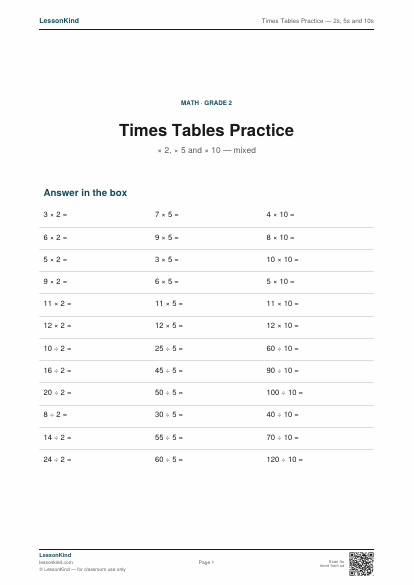
Times Tables Practice — 2s, 5s and 10s
Mixed-up times tables practice with 36 questions. Builds rapid recall of the 2, 5 and 10 tables.
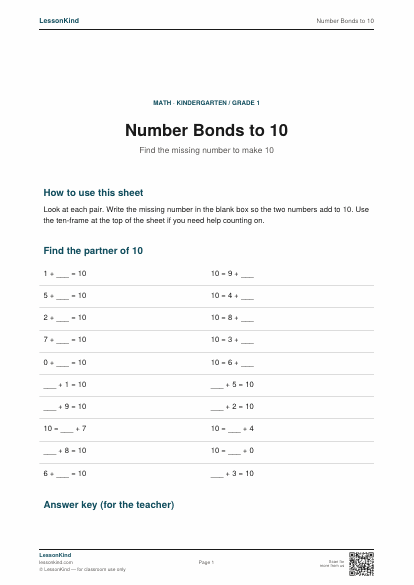
Number Bonds to 10
20 number-bond questions with a ten-frame visual support panel. Ideal for early addition fluency.
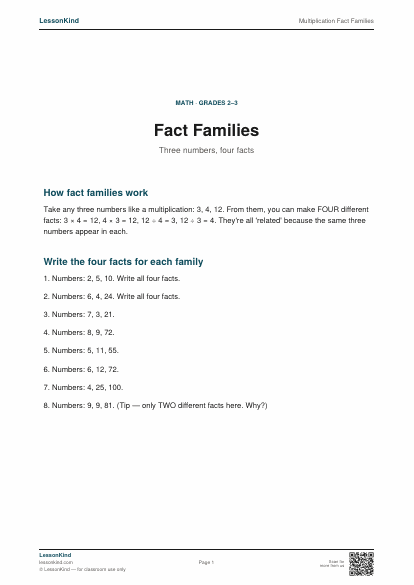
Multiplication Fact Families
From three numbers, write four related facts (2 multiplication, 2 division). Builds inverse-operation fluency.
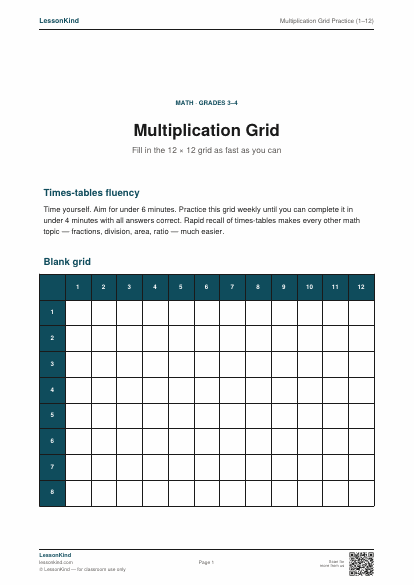
Multiplication Grid Practice (1–12)
Two blank 12×12 grids for timed times-tables practice.
Going deeper
Books on math fluency
Books we'd recommend on the topics raised in this article.
Practitioner
For pupils
Convenience links to Amazon. As an Amazon Associate we earn from qualifying purchases at no extra cost to you. Read our affiliate disclosure.
Keep reading
Teaching strategy
Differentiating Math Without Burning Out
You don't need three separate lesson plans every day. Here's how to differentiate math meaningfully without doubling your prep.
6 min read
Math
Maths Anxiety in Primary Children
By Year 3, some children have already decided maths isn't for them. By Year 6, it's hard to shift. Maths anxiety is real, measurable, and largely preventable — but it requires understanding what actually causes it, which is rarely what parents assume.
8 min read
Math
When a Child Says 'I'm Bad at Math'
Almost every adult who hates math can name the year it started. By age eight, many children have already decided they're 'not a math person'. Here's how that happens and how to push back.
7 min read