Math · 5 min read
Mental Math Strategies That Actually Work
The five strategies confident mental mathematicians use — and how to teach them explicitly
Published 2026-10-16
Ask 30 adults what 47 + 28 is and most will get it right within 5 seconds. But ask them *how* they did it and you'll get an interesting variety:
- "I added 50 + 28 = 78, then took away 3 to get 75." - "47 + 30 = 77, take 2 off, 75." - "40 + 20 = 60, then 7 + 8 = 15, so 75." - "47 plus 3 is 50, then plus 25 more, 75."
What's striking is that none of them did "the column method in their head". Mental maths isn't doing written maths invisibly. It's a different set of strategies entirely — and the children who are good at it have absorbed those strategies, often by accident.
The five strategies that matter
**1. Round and adjust.** For 47 + 28, round one number up to a friendly number (50), then adjust. 47 + 28 → 50 + 28 = 78, take 3 off = 75.
This is the single most useful mental strategy. Make sure every child can articulate it.
**2. Partition.** Break numbers into tens and ones. 47 + 28 → (40+20) + (7+8) → 60 + 15 = 75.
Useful for two-digit additions, but slower than rounding for most children. Worth knowing.
**3. Compensation in subtraction.** For 73 - 29, change it to 73 - 30 = 43, then add 1 back to get 44.
This eliminates the need for "borrowing" mentally, which is where most errors happen.
**4. Doubles and near-doubles.** Memorise doubles to 20, then use them. 7 + 8 = 7 + 7 + 1 = 15. 6 + 7 = 6 + 6 + 1 = 13.
Doubles are easier to recall than other facts, so children should leverage them.
**5. Use known facts.** If you know 7 × 5 = 35, you also know 7 × 50 = 350, 70 × 5 = 350, 7 × 500 = 3500, and 14 × 5 = 70. Confident calculators use one fact to derive twenty.
The strategy children almost always need but never get taught
Counting on. For "What's 8 + 5?" the slow child counts: 8, 9, 10, 11, 12, 13. The fast child *starts at 8 and counts up 5*. Same answer, but the slow child counts every number from 1.
Many Year 1 and 2 children count from 1 every time. They need to be explicitly taught: "Put the bigger number in your head and count on." This is a *skill*, not an instinct. Without it, every addition takes 4 times longer than it should.
What 'mental maths' practice should look like
If your daily mental maths warm-up is "calculate these in your head", you're testing — not teaching. Children who can already do mental maths get faster; children who can't continue not to.
Better:
- **Tell them which strategy to use.** "I'm going to ask 5 questions. For each one, use round-and-adjust." Then run through them. - **Compare strategies for the same question.** "How did you do 47 + 28? Anyone do it differently?" Three children share three approaches. The class sees that there isn't one right way. - **Call out the strategy by name.** "That's compensation in subtraction. Excellent." Children remember named strategies far better than unnamed ones.
The connection to exam performance
In SATs reasoning papers, the children who do best aren't necessarily the strongest at written methods — they're the ones who can quickly mental-calculate the simple parts. If a problem requires you to work out 200 - 158 as part of a bigger question, you can't afford to set out written subtraction. You need 200 - 160 = 40, plus 2 = 42, in two seconds.
Mental maths fluency is what frees children to focus on the *reasoning*. That's why it matters even in an age of calculators.
Free bundle for this topic
KS2 Maths Pack
10 favourite maths resources — times tables, fact families, mental maths, fractions.
Practical resources for this
Take this further
Printable, classroom-ready resources for the topics in this article.
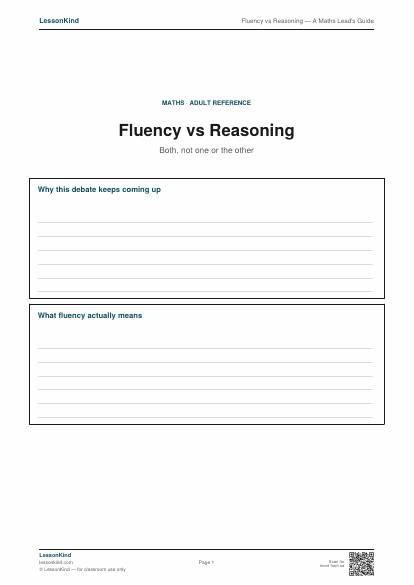
Fluency vs Reasoning — A Maths Lead's Guide
Why fluency and reasoning are both essential, what they actually mean, and how to build each across the school. Includes specific routines for each (e.g. number talks, fluency starters, reasoning prompts). Settles the staffroom debate about 'spending too much time on times tables' vs 'not doing enough word problems'.
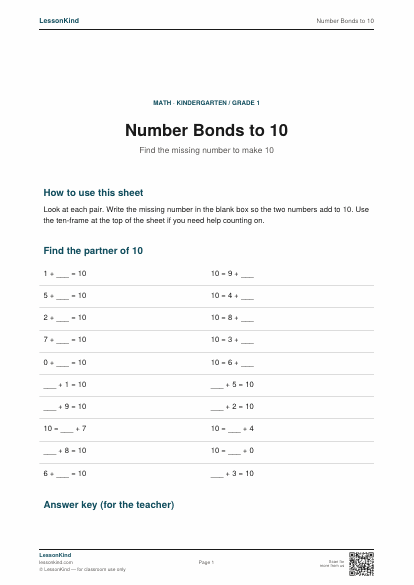
Number Bonds to 10
20 number-bond questions with a ten-frame visual support panel. Ideal for early addition fluency.
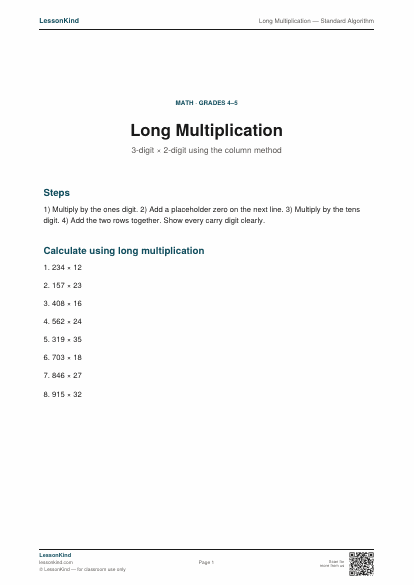
Long Multiplication — Standard Algorithm
Step-by-step long multiplication (3-digit × 2-digit) using the column method.
Going deeper
Books on mental maths and number sense
Books we'd recommend on the topics raised in this article.
Practitioner
Convenience links to Amazon. As an Amazon Associate we earn from qualifying purchases at no extra cost to you. Read our affiliate disclosure.
Keep reading
Teaching strategy
Differentiating Math Without Burning Out
You don't need three separate lesson plans every day. Here's how to differentiate math meaningfully without doubling your prep.
6 min read
Math
Why Times Tables Still Matter (Even in 2026)
Times tables aren't old-fashioned drudgery. They're the cognitive scaffolding for everything from long multiplication to algebra. Here's why automatic recall matters and how to actually build it.
6 min read
Math
When a Child Says 'I'm Bad at Math'
Almost every adult who hates math can name the year it started. By age eight, many children have already decided they're 'not a math person'. Here's how that happens and how to push back.
7 min read