🎁 Instant access to 532+ free resources β€” no sign-up needed. Or grab our 5 free bundles.

Parent communication  Β·  6 min read

How to Make Parents' Evening Actually Useful

Ten-minute appointments, difficult conversations, and getting parents to leave with something actionable

Parents' evening is one of the most important communication opportunities of the school year, and one of the most poorly used. Here's how to run appointments that parents leave feeling informed and supported.

Published 2026-05-19

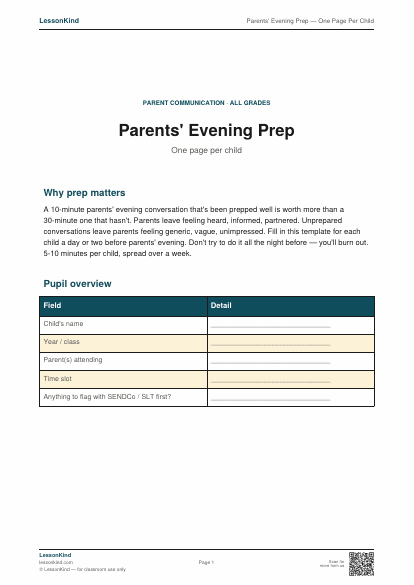
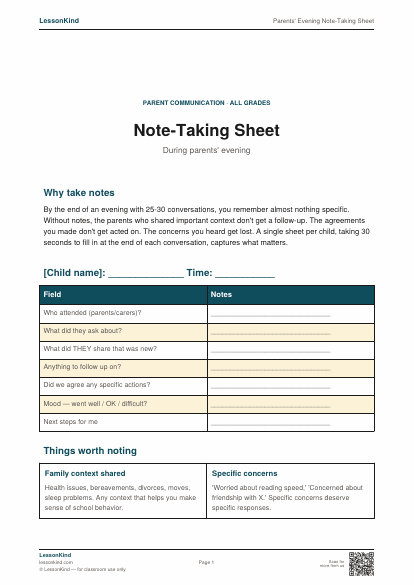
<p>Ten-minute appointments. Seven seconds of transition time. A waiting list of parents who may be anxious, defensive, or carrying concerns from earlier in the year. Parents' evening is one of the most demanding professional environments a teacher navigates β€” and the stakes are high. The parent sitting opposite you may leave with a completely new understanding of their child's school life, or with exactly the same misconceptions they arrived with.</p> <h2 class="article-section-heading">Prepare differently for different parents</h2> <p>Most parents' evenings fail because every appointment gets the same treatment. The ten minutes with a parent whose child is thriving needs a different approach from the ten minutes with a parent who is worried, or a parent whose child is significantly behind.</p> <p>For the majority: three specific things (one strength, one area for growth, one action). This is achievable in ten minutes and leaves the parent with something concrete.</p> <p>For concerned parents: acknowledge the concern first, before doing anything else. 'I know you've been worried about how she's settled' before 'let me tell you about her progress'. This changes the emotional register of the whole appointment.</p> <p>For adversarial parents: stay factual. Stick to evidence. Avoid defensiveness. 'Here's what I've observed' is more robust than 'I think...'. Have a piece of the child's work to show if needed.</p> <h2 class="article-section-heading">The structure that works</h2> <p>Open with something specific and genuine about the child. Not 'she's lovely' (every parent wants to believe this already) but 'she asked a brilliant question in science last week that I'm still thinking about'. This signals: I notice your specific child, not just the class.</p> <p>State clearly how the child is doing. 'She is working at the expected level for this point in Year 4' is a sentence many parents never receive β€” because teachers soften it into incomprehensibility. Clarity is kind.</p> <p>Give one specific action for home. Not 'read more' β€” 'ask her to tell you what happens in each chapter in her own words, rather than just reading'. Specific, actionable, and achievable.</p> <h2 class="article-section-heading">What to do with the five minutes that run over</h2> <p>Some appointments will run over. Have a phrase ready: 'I can see there's more to discuss β€” can we arrange a separate meeting so I can give this the time it deserves?' This gives the parent a pathway without derailing the rest of the evening.</p> <h2 class="article-section-heading">The conversation you don't want to have</h2> <p>Every parents' evening has at least one conversation the teacher has been dreading β€” a parent whose child has been struggling, a parent who has complained, a parent who is consistently hostile. For these: prepare specifically, have evidence ready, stay calm, and remember that most parental defensiveness is anxious love in disguise.</p>

Going deeper

Books on parent communication

Books we'd recommend on the topics raised in this article.

Convenience links to Amazon. As an Amazon Associate we earn from qualifying purchases at no extra cost to you. Read our affiliate disclosure.