First-year teaching · 5 min read
How to Plan When You're Running on Empty
The minimum viable lesson plan for week eight of a long term
Published 2026-05-12
There's a version of teaching advice that assumes you're always operating at full capacity. This isn't that.
This is for the Thursday night in week eight of a long term, when you're behind on planning, you have an early morning, and you genuinely cannot face building elaborate lessons from scratch. This happens to every teacher. It happens to experienced teachers and new teachers alike. The question isn't whether it happens — it's what to do when it does.
The minimum viable lesson
A lesson needs five things to work:
1. A clear task that students know how to begin 2. Enough material to last the time 3. A way for you to see who's getting it and who isn't 4. Anything you need to gather or print beforehand 5. A way to end it that feels deliberate
That's it. Everything else — elaborate starters, beautiful slides, clever hooks, multiple differentiated tasks — is above the minimum viable line. Good teaching does more than this. But *working* teaching needs only this.
When you're running on empty, plan to the minimum viable line and stop.
Practical approaches for each subject
**Reading and English:** A sustained reading task with a response task usually requires very little planning energy. Take a high-quality text — something from your class reader, an article, a poem — and build three questions around it: one retrieval, one inference, one personal response. That's a lesson. If you need writing, a prompt with a clear structure ('Write a diary entry from the perspective of...') can run for thirty minutes with minimal input from you.
**Math:** Revisit a skill you've already taught. Practice problems are low-prep and high-value. If your school has a standard resource bank, use it. There is nothing wrong with a consolidation lesson — children need more practice time than they usually get, and you planning a brand-new task when there are twenty unfinished workbook pages is probably wrong anyway.
**Science / Social studies:** Retrieval practice. A simple quiz on what you've covered so far. Write ten questions. This is good pedagogy — regular low-stakes retrieval strengthens long-term memory — and it takes about fifteen minutes to prepare.
**Art / DT / PE:** Continued work on a project they're already in the middle of. 'Today we're going to keep working on our...' is a legitimate and often excellent lesson. Children need sustained time to make things.
The five-minute planning session
If you've genuinely got almost nothing left, here's a five-minute planning approach:
1. Write the one thing children are supposed to do or learn. (1 minute) 2. Write what they'll actually be doing — the main task. (1 minute) 3. Write what you need to gather or print. (1 minute) 4. Write how you'll know if it's worked. (1 minute) 5. Write your backup if they finish early. (1 minute)
That's a plan. It fits on a sticky note. It will get you through the lesson.
What you should *not* do
Don't stay up until midnight planning something elaborate when you're already exhausted. A tired teacher delivering a simple lesson well beats an exhausted teacher delivering a complicated lesson badly. You will be a worse teacher tomorrow morning if you don't sleep. This is not a metaphor — sleep-deprived adults have measurably worse attention, decision-making, and emotional regulation. Your lesson plan matters less than your state when you deliver it.
Don't use a lesson as dead time. 'Free choice' or 'finish off anything you haven't done' is not a plan; it's a slow chaos generator. Children without clear tasks generate noise and problems. A simple structured task is always better than no task.
The longer game
If you're regularly running on empty by the middle of the term, the planning load is probably unsustainable. That's worth looking at directly: are you planning more elaborately than you need to? Are you recreating resources that already exist somewhere in your school? Are you planning units from scratch when a decent framework would take 80% of the work away?
Experienced teachers plan less elaborately than new teachers, not more. The investment goes into the teaching — the questions, the responses, the adjustments — not the preparation.
But right now, on this particular Thursday night: five minutes, five questions, go to bed.
Free bundle for this topic
The Starter Pack
18 free resources spanning every subject — the universal new-teacher starter.
Practical resources for this
Take this further
Printable, classroom-ready resources for the topics in this article.
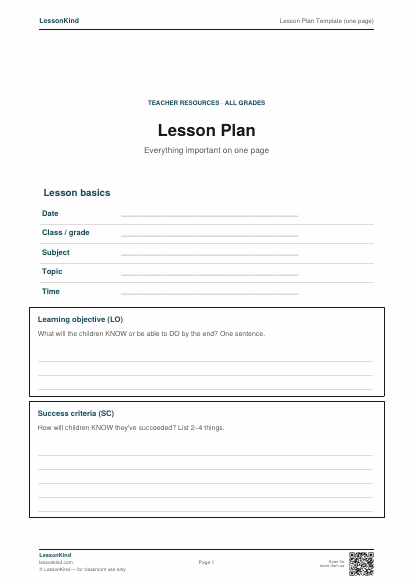
Lesson Plan Template (one page)
A one-page lesson plan template — objective, success criteria, hook, main task, assessment, plenary.
Light-Touch Tracking System — Setup Guide
How to set up a school assessment tracking system that's USEFUL and doesn't drown teachers in admin. Covers what to track, what to leave alone, paper vs digital, frequency, and the assessment data SLT actually need vs what they ask for.
Keep reading
Teacher wellbeing
Why your year-group plan is killing you
The way most primary schools plan — long-term plans, medium-term plans, weekly plans, daily plans, all in templates that nest inside each other — is a workload disaster that produces no teaching benefit. Here's the case for cutting it back.
7 min read
First-year teaching
Five Mistakes I Made as a New Elementary Teacher
If I could go back and shake my first-year teacher self by the shoulders, here's what I'd say.
7 min read
Teacher wellbeing
The Sunday Night Feeling
If you can't enjoy a Sunday afternoon because Monday is looming, you're not alone. Here's what's actually causing the dread, and the practical changes that help.
5 min read