First-year teaching · 7 min read
Five Mistakes I Made as a New Elementary Teacher
And what I'd tell my first-year self if I could
Published 2026-04-09
Every teacher remembers their first year. Mine was a mix of pride, exhaustion, and the slow realization that almost everything I'd been told would matter, didn't — and most of the things that actually mattered, no one had told me about.
If I could go back and shake my first-year self by the shoulders, here's what I'd say.
1. Lesson plans are not your job. Lesson DELIVERY is your job.
I spent so many evenings perfecting lesson plans. Color-coded objectives, three differentiated tasks, a beautifully laid-out PowerPoint. None of it survived contact with the children.
What worked, in the end, was a clear idea of what I wanted the children to be able to DO by the end of the lesson, three or four big questions to ask, and a simple task for them to attempt. Spend less time on the document. Spend more time picturing the lesson actually happening: where will children get stuck? What will I do when they do?
2. Behavior management isn't tricks. It's relationships and routine.
I tried every behavior chart, marble jar and "good choice" sticker scheme in the first six weeks. None of it worked for the kids who needed it most.
What worked: knowing every child's name on day one, and one thing they cared about by the end of week two. Greeting them at the door. Being relentlessly fair. Holding tight, predictable routines so the children always knew what came next. Not raising my voice — even when I really wanted to — because the moment I did, I lost the room.
The "tough" kids in my class became the easiest in the end. Not because of any one technique, but because they could feel that I liked them and would not give up.
3. The grown-ups in the building are the most important resource you have.
I spent my first term trying to look competent in front of my colleagues. I should have spent it asking for help.
The teaching assistant who'd been at the school 12 years. The mentor next door. The deputy head who happened to walk past my classroom. Every single one of them knew things I didn't. Asking "could I borrow you for two minutes — how would you handle this?" is a sign of professionalism, not weakness. It will save you years.
4. Marking everything is not the same as marking well.
I marked every book, every night. Tick, tick, tick, "well done!", tick. By February I was a husk of a person and the children's writing had not improved.
When I finally accepted that detailed feedback on every piece was unsustainable, I switched to: a brief verbal comment to two or three children DURING the lesson, "live marking" with a green pen as I walked around, and a deeper written response on one piece a week. Quality went up. So did my evenings.
5. You can take it home, but you cannot take it home all the time.
I cried in my car about a child for the first time in October. I cried in my car about a different child in March. I will probably do it again.
Caring about the children in your class is not a flaw — it's the entire point of the job. But there has to be a wall, however leaky, between school and the rest of your life. Friends who are not teachers. A hobby that has nothing to do with children. Sundays that are not lesson-planning marathons.
What new teachers need to hear
You will not be perfect this year. You will not be perfect next year. Every teacher you admire was once exactly where you are, doing the same dumb things, taking the same bruises. They got better. So will you. Be patient with yourself, and ask for help.
Free bundle for this topic
The Starter Pack
18 free resources spanning every subject — the universal new-teacher starter.
Practical resources for this
Take this further
Printable, classroom-ready resources for the topics in this article.
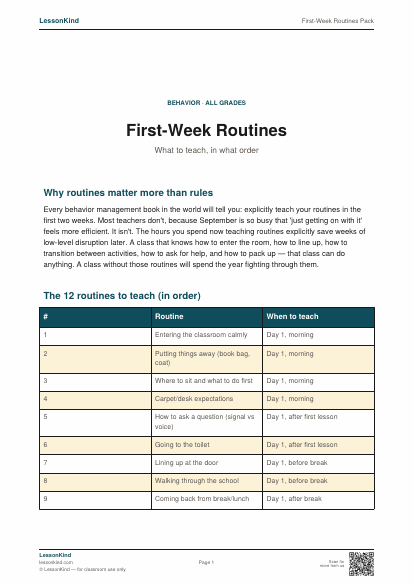
First-Week Routines Pack
The 12 routines you must establish in the first two weeks — entry, transitions, lining up, asking for help, finishing work, end of day. With explicit teaching scripts.
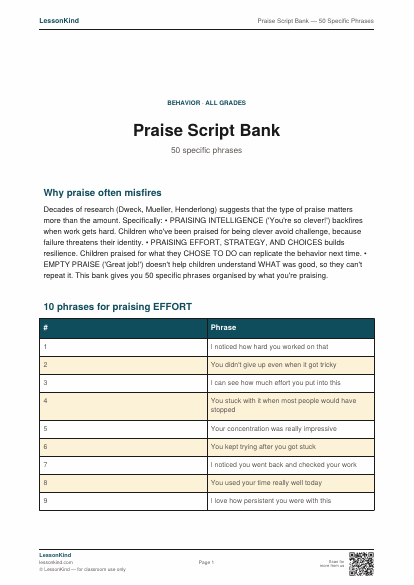
Praise Script Bank — 50 Specific Phrases
50 specific praise phrases you can use in the classroom — focused on effort, strategy, and behavior, not ability. Built around the research on what kinds of praise actually motivate children.
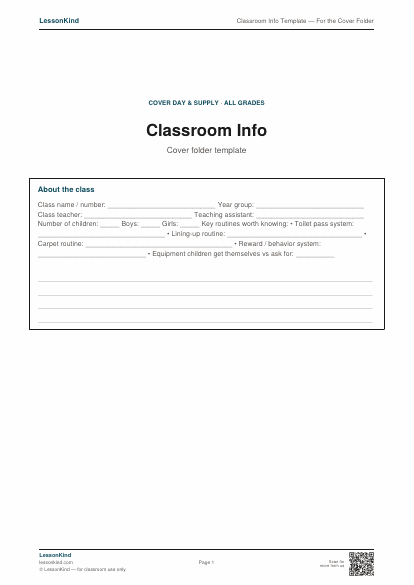
Classroom Info Template — For the Cover Folder
A printable template for the 'about your class' page that goes in the emergency cover folder. Class list, seating plan, medical flags, SEND notes — all in one page.
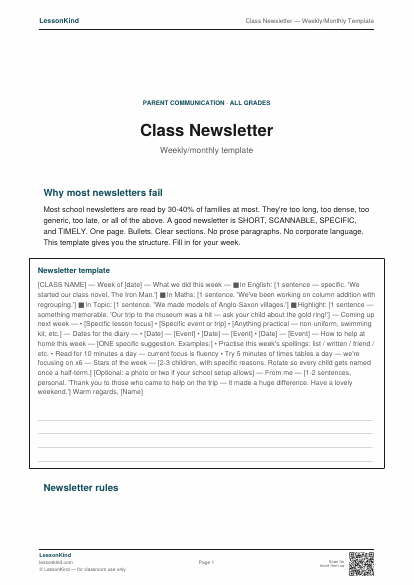
Class Newsletter — Weekly/Monthly Template
A simple, scannable class newsletter template — what we did, what's coming up, important dates, how to help. Designed to actually get read.
Going deeper
For new (and second-year) primary teachers
The books experienced primary teachers wish they'd read in their first year.
Practical foundations
Convenience links to Amazon. As an Amazon Associate we earn from qualifying purchases at no extra cost to you. Read our affiliate disclosure.
Keep reading
Behavior & classroom management
The First Two Weeks: The Behavior Foundation You Can't Build Later
Most teachers know the first two weeks matter. Few know how MUCH they matter, or what to do with them. The behavior of your class in June is largely determined by what you do — or fail to do — in September.
8 min read
Classroom culture
Why Your Routines Matter More Than Your Lesson Plans
First-year teachers spend hours on lesson plans and almost no time on routines. The teachers whose classrooms run beautifully have it the other way around.
6 min read
Classroom culture
The Most Important Week of the Year
Most teachers think the first week is for getting to know the children. The teachers whose classrooms run beautifully use it for something quite different.
6 min read
Teacher wellbeing
Why September Feels So Hard (And Why That's Normal)
Every teacher knows September is hard. Fewer know that October is harder, that November is the lowest point, and that the system more or less requires you to push through. Here's what to expect and how to survive it.
7 min read