Teacher wellbeing · 5 min read
The Sunday Night Feeling
Why teachers dread Mondays — and what actually helps
Published 2026-10-25
By 4pm on Sunday, something happens to a lot of teachers' nervous systems. The week ahead starts to loom. The marking pile in the bag becomes visible. The mental list of "I haven't planned Tuesday yet" starts looping. By Sunday evening, many teachers are anxious, grumpy, and wishing they could fast-forward to Friday.
If this is you, you're not weak. You're not in the wrong job. You're experiencing what behavioural scientists call "anticipatory dread" — a stress response to a known stressor that hasn't happened yet. Teachers experience this acutely because the workload is real, predictable, and partly out of their control.
But it doesn't have to be this bad. Here's what helps.
Why Sunday evening specifically?
The brain pattern is interesting. Through Saturday morning, most teachers feel fine — Friday's relief is still echoing. Saturday afternoon, slight unease. Sunday morning, fine again, often the best part of the weekend. Sunday late afternoon, anxiety arrives.
This is because the brain is doing automatic mental rehearsal of Monday's demands as the temporal distance shrinks. Friday-after-school: 64 hours away — brain ignores it. Sunday 5pm: 14 hours away — brain starts processing.
The anxiety is *information*. It's your brain noticing that Monday contains things you don't feel ready for.
The fix isn't suppressing the anxiety. It's reducing the actual weight of what Monday contains.
Five changes that help
**1. Plan Monday on Friday afternoon, not Sunday evening.**
Most teachers who dread Sundays have unfinished planning hanging over them. Spending Sunday evening doing it doesn't help — it just confirms that the weekend is already work.
The shift: leave school 30 minutes later on Friday, with Monday's plans done. The trade — you arrive home tired but free — is dramatically better than the Sunday-night version. By Saturday morning, your brain knows Monday is sorted. The anticipatory dread doesn't build.
**2. Don't take work home on Sundays at all.**
If you're going to work weekends, do it on Saturdays and have Sundays off. The Sunday-evening dread is exacerbated by the work physically being there. A weekend without your school bag is a different weekend.
This requires some discipline — Friday's "I'll do it on Sunday" has to become "I'll do it Saturday morning". But it preserves the recovery function of the weekend.
**3. Identify the specific Monday thing you're dreading and face it.**
Often, "I'm dreading Monday" is actually "I'm dreading the conversation with Mrs X about her son" or "I'm dreading the maths lesson I haven't really thought through". Specific things, not Monday in general.
Naming the specific thing reduces the diffuse anxiety. Then you can either prepare for it (write notes for the conversation, sketch the lesson) or accept that you'll handle it on the day.
**4. Build a Sunday evening that ISN'T about preparing for Monday.**
Many teachers have unconsciously made Sunday evening into "preparing for school". Unwinding has been replaced by anticipating. Reverse this deliberately: cook a proper meal, watch something undemanding, walk somewhere green, see a friend, take a long bath, read a novel.
The point is to give Sunday evening a positive identity that isn't "the night before school". Over a few weeks, your brain re-associates Sundays.
**5. Get the last 90 minutes of Sunday genuinely off.**
In the final 90 minutes before bed, do nothing school-related. Don't check emails. Don't open the planner. Don't think about Monday.
This is harder than it sounds. The instinct is to "just check if there's anything urgent". There rarely is, and even if there were, you'll see it at 7am. The 90-minute buffer is the difference between sleeping well and sleeping badly. Sleeping well makes Monday tolerable. Sleeping badly makes Monday awful.
When the dread is actually a signal
Some Sunday dread is just normal anticipation. Some is a warning sign.
**Normal:** mild unease, mostly resolved by getting into the rhythm of Monday morning, gone by Tuesday.
**Warning sign:** physical symptoms (nausea, sleeplessness, dread that doesn't lift on Monday), tearfulness, thoughts about leaving the profession that won't go away.
If the second pattern is happening every week, the issue is no longer about Sunday evening — it's about the job, the school, or your stage of career. That deserves a real conversation, with your line manager, with your union, with a counsellor, or with friends in the profession. Burnout is treatable but not by tougher Sunday routines.
The thing nobody admits
Most experienced teachers, even ones who love their jobs, have Sunday dread sometimes. This is not a sign of failure. It's a sign that teaching is genuinely demanding. Pretending you don't dread Mondays doesn't help — being honest about it, talking about it with colleagues, and protecting your weekends ruthlessly is what helps.
The teachers who stay in the profession 20 years aren't the ones who feel no Sunday dread. They're the ones who built habits that contain it.
Free bundle for this topic
The Starter Pack
18 of our best free resources — a way to spend less time prepping and more time recovering.
Practical resources for this
Take this further
Printable, classroom-ready resources for the topics in this article.
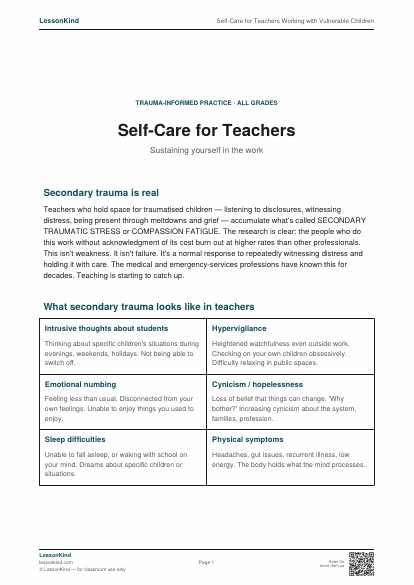
Self-Care for Teachers Working with Vulnerable Children
Teachers who work with traumatised children carry secondary trauma whether they realise it or not. What it looks like, what helps, and how to sustain yourself in the work.
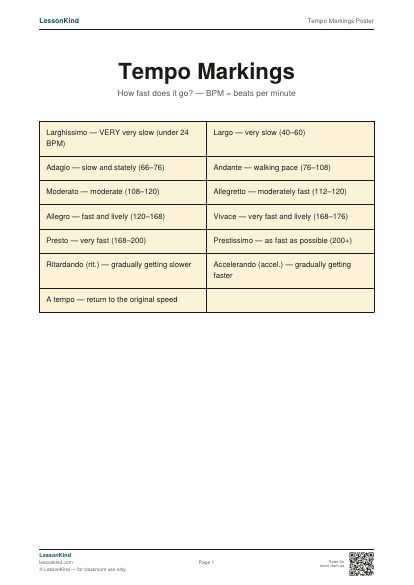
Tempo Markings Poster
Italian tempo terms with BPM ranges. Useful for music reading and ensemble work.
Self-Care for Teachers Working with Vulnerable Children
Teachers who work with traumatised children carry secondary trauma whether they realise it or not. What it looks like, what helps, and how to sustain yourself in the work.
Going deeper
Books on teacher wellbeing
Books we'd recommend on the topics raised in this article.
For the teacher
Convenience links to Amazon. As an Amazon Associate we earn from qualifying purchases at no extra cost to you. Read our affiliate disclosure.
Keep reading
First-year teaching
What They Don't Tell You in Teacher Training
Teacher training prepares you for lesson planning. It does not prepare you for what your first term as a class teacher actually feels like. Here's the honest version.
7 min read
First-year teaching
Five Mistakes I Made as a New Elementary Teacher
If I could go back and shake my first-year teacher self by the shoulders, here's what I'd say.
7 min read
Teacher wellbeing
Why September Feels So Hard (And Why That's Normal)
Every teacher knows September is hard. Fewer know that October is harder, that November is the lowest point, and that the system more or less requires you to push through. Here's what to expect and how to survive it.
7 min read