Classroom culture · 5 min read
How to Run a Morning Meeting in Primary School
The structure, the research, and the 15 minutes that can set up the whole day
Published 2026-05-21
A morning meeting is 15 minutes at the start of the school day, before academic work begins, structured around community-building, social skills, and positive tone-setting. The Responsive Classroom approach — which developed and researched the morning meeting model — has generated substantial evidence that well-implemented morning meetings improve attendance, reduce behavioural incidents, increase academic engagement, and improve social skills.
This is not because 15 minutes of conversation is magic. It is because 15 daily minutes of structured, warm, predictable community time builds the psychological safety that makes everything else in the school day easier.
The four-part structure
The classic morning meeting has four parts: greeting, sharing, activity, and morning message. Each serves a distinct function.
**Greeting** (2-3 min): every child is greeted by name. Not a whole-class good morning — each child hears their name said warmly by another person. This is the most under-appreciated element. For children who may not be greeted at home, this is the first time they have heard their name said warmly today. It matters.
**Sharing** (4-5 min): 2-3 children share something relevant to a prompt. The structure creates a listener role as well as a speaker role. Others ask one question or make one comment. The teacher facilitates, models active listening, and ensures every contributor feels heard.
**Activity** (4-5 min): a short energising or community game. The activity should involve movement or interaction — not a worksheet. It may connect to curriculum content or be purely social.
**Morning message** (2-3 min): a brief written message on the board, read together. Can preview the day, pose a question, or set a positive intention.
What makes morning meetings work
Consistency. Morning meetings that happen daily, at the same time, with the same structure, build the predictability that makes children feel safe. Irregular or optional meetings have far smaller effects.
Authenticity. A greeting that feels like a performance fails. The teacher's genuine warmth — and their genuine attention to each child in that moment — is what makes the greeting powerful.
The teacher's participation. The teacher sits in the circle with the children, not at the front. This signals that this is a community event, not a performance for the teacher's benefit.
Starting it in your class
Begin with the greeting only for the first two weeks. Add sharing in week three. Add activity in week four. The morning message can come whenever it feels right. Rushing to implement all four parts simultaneously produces a mechanical meeting rather than a genuine one.
Free bundle for this topic
Cover Day Survival Pack
9 resources for cover days and routines, including behavior systems and morning meeting scripts.
Practical resources for this
Take this further
Printable, classroom-ready resources for the topics in this article.
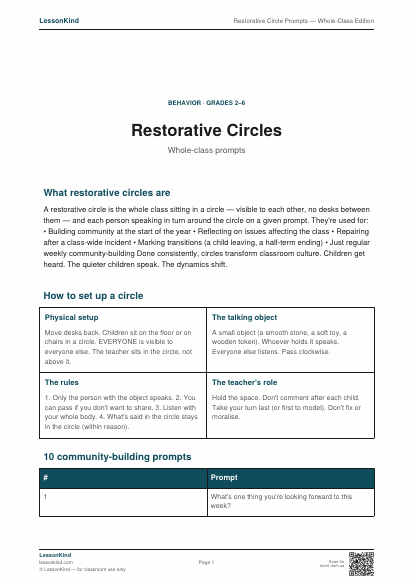
Going deeper
Books on morning meetings and circle time
Books we'd recommend on the topics raised in this article.
For teachers
Convenience links to Amazon. As an Amazon Associate we earn from qualifying purchases at no extra cost to you. Read our affiliate disclosure.
Keep reading
Classroom culture
Building Classroom Community: Practical Strategies That Actually Work
The quality of relationships in your classroom determines how much learning is possible. Here are the specific, practical strategies that build genuine community — not just a pleasant atmosphere.
6 min read
Classroom culture
The Most Important Week of the Year
Most teachers think the first week is for getting to know the children. The teachers whose classrooms run beautifully use it for something quite different.
6 min read