Math · 8 min read
How to teach times tables that actually stick
Spaced practice beats marathon Friday tests every time.
Published 2026-11-24
Most primary schools teach times tables badly. Not maliciously — just by doing what's intuitive rather than what works.
Here's the typical pattern. Friday morning, 20-minute test. The whole class doing 5×, 8×, 11× under pressure. Some kids ace it because they already knew it. Some kids fail it because they didn't. The teacher marks it. The next Friday, repeat.
After a year of this, the kids who knew their tables already still know them. The kids who didn't, mostly still don't. The Friday test was never the lesson. It was the assessment. And we used the assessment as the entire teaching strategy.
If you want children to actually know their times tables — instantly, automatically, when called on years later — there's a better way. It's based on three boring principles from cognitive science: spacing, retrieval, and interleaving.
The boring principles that work
**Spacing.** A child who practises the 7× table for 5 minutes a day for 5 days remembers more, longer, than a child who practises for 25 minutes once. The brain encodes information better when it's revisited just as it starts to fade. Cramming feels productive but is the worst way to learn. Five short sessions beat one marathon every time.
**Retrieval.** Looking AT the answer (8 × 7 = 56) is much weaker than trying to GENERATE the answer (8 × 7 = ?). Retrieval — the act of pulling information out — strengthens the memory. So worksheets where children copy out the table, while seemingly safe, are dramatically less powerful than worksheets where they have to recall.
**Interleaving.** A child who does 20 questions on the 8× table and gets them all right has not really tested their 8× table. They've tested their ability to do 20 of the same operation in a row. Mix it up — 8×, then 7×, then 8×, then 4×, then 8×, then 9× — and you're actually testing fluency. This feels harder. It IS harder. That's the point.
What this looks like in a classroom
A school I worked with replaced its Friday tests with a system they called 'daily 5'. Five mixed times-table questions, every day, first 90 seconds of maths. No marking. Children self-check against an answer board. No fanfare, no scores recorded.
Results after a term: the bottom third of the class doubled their accuracy. The top third stayed the same (they were already fluent). And classroom anxiety around tables collapsed.
The reason it worked: short bursts (spacing), recall not copying (retrieval), and mixed tables (interleaving). All three boxes ticked. Plus — crucially — no public failure. The Friday test had been creating a class of children who hated the test more than they hated the tables. Take the test away and you take the trauma away.
The 'master one then move on' trap
Most schools teach tables in order: 2×, then 5×, then 10×, then 3×, etc. The instruction is 'don't move on until they've mastered this one.' This is well-meant but wrong on two counts.
First, mastery of an isolated table is not the same as fluency in mixed contexts. A child who can recite the 6× table in order has not mastered it. Ask them '8 × 6' out of context and they'll often have to start at 1 × 6 and count up. That's not mastery. That's a memorised list, like a song.
Second, leaving the harder tables (7×, 8×, 12×) until last means they get less spacing time before the Year 4 Multiplication Tables Check. Children who've had 18 months of spaced practice on their 2× and 10× still struggle with their 7× because they've only had 4 months on it.
The fix: introduce all the tables earlier (Year 2 should know 2×, 5×, 10×; Year 3 should be touching every table at some level), then spend the time mixing and revisiting. Breadth first, depth through repetition.
Songs and tricks: yes or no?
Cautiously yes — with a hard limit.
Songs work for some children, especially younger ones, because the rhythm gives a retrieval scaffold. The 7× song that goes 'seven, fourteen, twenty-one, twenty-eight…' helps a child who is genuinely lost.
But songs do not produce fluency. A child singing the 7× song to themselves to find 7 × 6 is too slow for the Y4 MTC, which gives 6 seconds per question. Songs are scaffolding. Eventually the scaffolding has to come down.
The same with tricks. The 9× finger trick. The 11× double-the-digit trick. The doubling-and-doubling-again for 4×. They're useful entry points. But again — children who are still using these in Year 6 are not fluent. They're computing. Fluency is instant.
So: scaffolds yes, in early stages. But move children off them deliberately, not by leaving them until they outgrow them. Set the goal explicitly: 'Today we're not allowed to sing the song.' 'Today we're going to try to just KNOW these without working them out.'
What about the Multiplication Tables Check?
The Y4 MTC, introduced in 2020 in England, gives children 6 seconds per question, 25 questions, all of the tables to 12 × 12 mixed up randomly. It is genuinely a fluency test — there's no time to compute or sing.
Schools tend to react in one of two ways. Either they panic and drill the test format relentlessly from Year 3, which produces test-taking skills but not deeper fluency. Or they ignore it as 'just an assessment' and find their Year 4 children unprepared.
The middle path: build fluency steadily across Years 2-4 using the daily-5 spaced approach, and then in the half term before the MTC, introduce the test format itself for familiarity (not for cramming). Children should arrive at the MTC and find that the questions are easier than the practice they've been doing. That's the goal.
The takeaway
Friday tests don't teach times tables. Daily mixed retrieval does. Stop the marathon. Start the boring drips. Six months from now you'll have a class that actually knows their tables — including the children you'd written off.
It's not glamorous. It doesn't make for a flashy lesson observation. But it's what works. And once you see it work, you can't unsee it.
Free bundle for this topic
KS2 Maths Pack
10 favourite maths resources — times tables, fact families, mental maths, fractions.
Practical resources for this
Take this further
Printable, classroom-ready resources for the topics in this article.
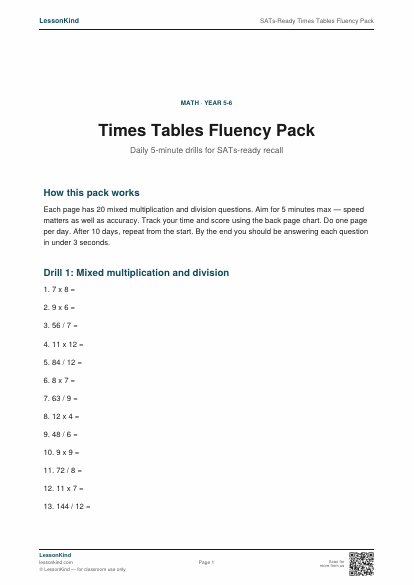
SATs-Ready Times Tables Fluency Pack
Daily 5-minute fluency drills covering all multiplication and related division facts to 12x12 — the foundation for SATs Arithmetic speed.
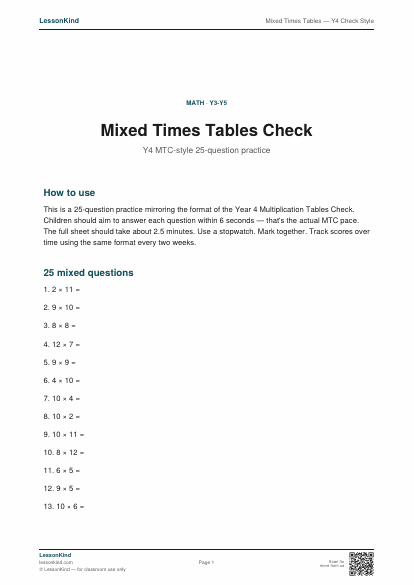
Mixed Times Tables — Y4 Check Style
25-question mixed multiplication check styled like the Year 4 Multiplication Tables Check (MTC). Six-second-per-question pace builds fluency for the real assessment.
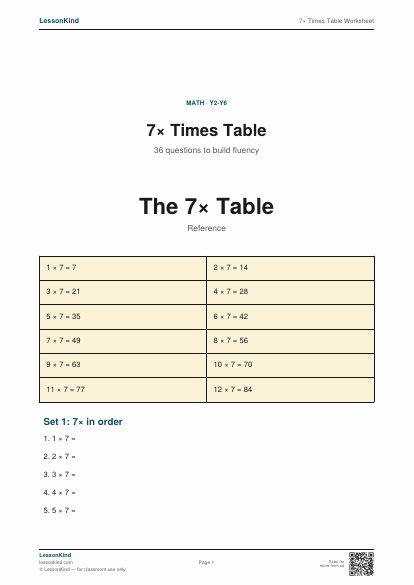
7× Times Table Worksheet
Ready-made printable practice for the 7× times table — 36 questions across multiplication, random-order, and related division facts. Print and go.
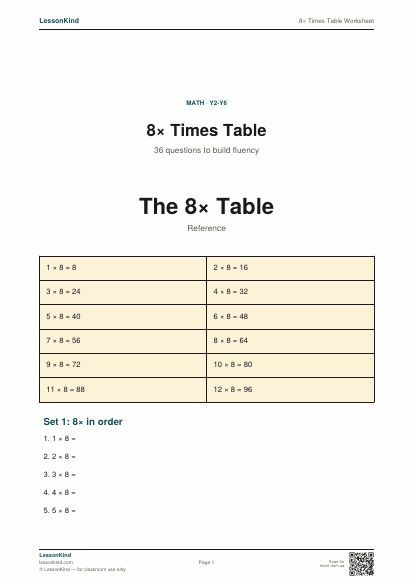
8× Times Table Worksheet
Ready-made printable practice for the 8× times table — 36 questions across multiplication, random-order, and related division facts. Print and go.
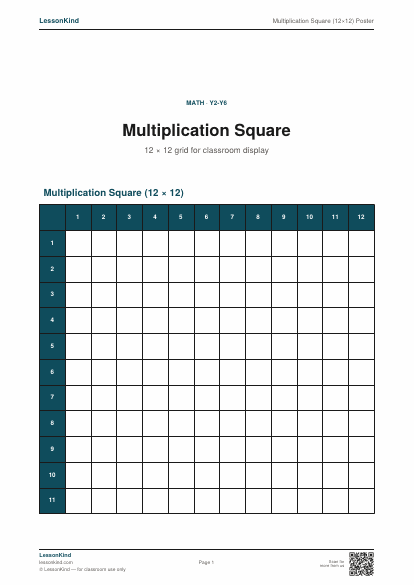
Multiplication Square (12×12) Poster
A clear, large-print 12×12 multiplication square for classroom display. The reference every primary maths classroom needs.
Going deeper
On fluency, retrieval and times tables
Books we'd recommend on the topics raised in this article.
Cognitive science of practice
-
M
Make It Stick: The Science of Successful Learning — Peter C. Brown, Henry L. Roediger, Mark A. McDaniel
The single best book on retrieval, spacing and interleaving - M Making Good Progress?: The Future of Assessment for Learning — Daisy Christodoulou
-
R
Rosenshine's Principles in Action — Tom Sherrington
Daily teaching application of the cognitive-science principles
Times tables specifically
Convenience links to Amazon. As an Amazon Associate we earn from qualifying purchases at no extra cost to you. Read our affiliate disclosure.
Keep reading
Math
Why kids hate maths (and what actually changes their mind)
When children say 'I hate maths,' they're rarely talking about numbers. They're talking about a feeling — confusion, embarrassment, the sense of being slow. The good news: that feeling is fixable, and the fix isn't more rote practice.
7 min read
Teaching strategy
Differentiating Math Without Burning Out
You don't need three separate lesson plans every day. Here's how to differentiate math meaningfully without doubling your prep.
6 min read