Math · 6 min read
Number Sense: What It Is and How to Develop It
The intuitive feel for numbers that separates children who get maths from those who don't
Published 2026-05-26
Some children seem to get numbers. They make estimates that are close, spot errors quickly, and navigate arithmetic by reasoning rather than remembering. Others apply procedures mechanically — and when the procedure fails, have nothing to fall back on.
The difference is usually number sense: an intuitive, flexible feel for what numbers mean and how they relate to each other.
What number sense actually involves
Number sense has several interrelated components:
**Magnitude and comparison.** Knowing that 0.7 is bigger than 0.07, that a fraction with a larger denominator is smaller, that -10 is further from zero than -5. This sounds obvious; it isn't for many children.
**Composition and decomposition.** Seeing numbers as built from other numbers: 48 is 40 + 8, or 50 - 2, or 6 × 8, or 4 × 12. This flexibility is what makes mental arithmetic possible.
**Estimation.** Knowing roughly what an answer should be before calculating it. Teachers who always ask 'what should this answer be roughly?' build estimation habits; teachers who focus only on exact answers don't.
**Relationships between operations.** Knowing that multiplication and division are inverses. That adding 9 is the same as adding 10 and subtracting 1. That doubling and halving are inverses. These relationships enable derived fact strategies.
How to develop it
Number talks. A brief (10-15 minute) whole-class discussion of a calculation: 'How many ways can you work out 38 + 47?' Different strategies are shared, compared, and discussed. No algorithm is privileged — all valid methods are valued. Number talks are well-researched and accessible; free resources are widely available.
Estimation first. Before any calculation, ask: is the answer bigger or smaller than X? Roughly how big will it be? This habit — which takes five seconds — builds magnitude sense and catches errors.
Rich tasks. Problems that can be approached in multiple ways, where the numbers are not pre-simplified, develop flexible thinking. 'Find all the ways to make 100 using exactly 10 numbers' is richer than 'what is 45 + 55?'
Mathematical talk. Children who explain their thinking aloud — 'I thought of 18 as 20 minus 2, so I added 20 to 35 and then took away 2' — develop stronger number sense than those who calculate silently and give an answer.
Free bundle for this topic
KS2 Maths Pack
10 favourite maths resources — times tables, fact families, mental maths, fractions.
Practical resources for this
Take this further
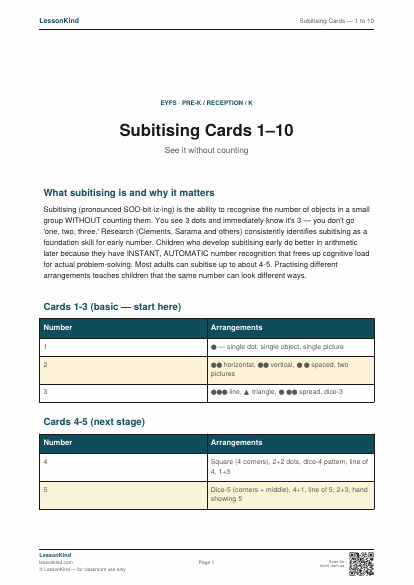
Printable, classroom-ready resources for the topics in this article.
Going deeper
Books on number sense and early maths
Books we'd recommend on the topics raised in this article.
For teachers
Convenience links to Amazon. As an Amazon Associate we earn from qualifying purchases at no extra cost to you. Read our affiliate disclosure.
Keep reading
Math
Maths Mastery in Primary: What It Is and What It Isn't
Mastery maths has become the dominant approach in UK primary maths since 2016. Here's what it actually means, where it came from, and the common misapplications that undermine it.
6 min read
EYFS & early years
Why Early Maths Experiences Matter More Than You Think
Mathematical understanding at age 5 is one of the strongest predictors of outcomes at 16 — stronger than reading. Here's what the research says about early maths, and what it means for EYFS practitioners.
6 min read