Reading & literacy · 5 min read
Spelling Isn't Just Memorisation
Why weekly spelling tests don't work — and what does
Published 2026-10-22
The weekly spelling test is one of education's most stubborn rituals. Every Monday: list of 10 words. Every Friday: dictation. Every Friday afternoon: 28 children with 10/10, two with 6/10, and a teacher feeling like spelling has been "covered".
Then on Monday, half the class misspells the same words in their writing.
What's going on?
What the weekly test actually measures
It measures short-term memorisation. Children memorise the visual pattern of the words for the test, then the memory degrades. By Wednesday, retention is around 50%. By the next Monday, it's 20%. The weekly cycle is essentially producing zero long-term improvement.
This isn't because children are lazy or because spelling tests are evil. It's because *isolated rote memorisation* is the wrong tool for what spelling actually requires.
What spelling actually requires
Strong spellers do four things, mostly without realising:
1. **They hear the sounds in words.** Confident phonemic awareness — the ability to break a spoken word into sounds — underlies almost all early spelling. 2. **They know the typical letter patterns for those sounds.** "ai" or "ay" or "a-e" all make the same sound, but each appears in different places in words. Strong spellers know the patterns. 3. **They notice when something looks wrong.** "I think it's 'recieve'... no, that doesn't look right, it must be 'receive'." Visual memory of correct spellings. 4. **They use morphology — the rules of how words are built.** "Sign" + "ature" = "signature". Strong spellers see word families.
A weekly test of 10 random words doesn't really build any of these. It builds memorisation of those specific 10 words.
What works instead
**1. Pattern-based teaching, not list-based.**
Instead of "this week's words are: laughter, brought, daughter, thought, naughty", reframe: "this week we're learning the 'ough' patterns. The sound can be 'or' (thought, brought), 'ow' (plough), 'uff' (rough), and 'oh' (though). Here are 30 examples grouped by sound."
Children build a *generalisation* — when they meet a new -ough word, they have a strategy.
**2. Sound-letter mapping practice.**
Make children explicitly map sounds to letters. "Stretch the word 'house'. What sounds do you hear? h-ow-s. Now what letters could make each sound?" This rebuilds the phonemic foundation, which is missing in many older children.
**3. Word-building from roots and suffixes.**
In KS2, teach prefixes (un-, dis-, in-, mis-) and suffixes (-tion, -ing, -ness) as building blocks. Once a child knows "act", they can spell "action", "react", "reaction", "actor", "actively" — all from the same root, with consistent rules.
**4. Look-cover-write-check, but used properly.**
LCWC is a fine technique, but most children do it badly. They look briefly, cover, then peek. Done properly, it builds visual memory. Done badly, it's just copying.
Real LCWC: study the word for 10 seconds (notice tricky bits, say it slowly). Cover completely. Write from memory. Check letter-by-letter. If wrong, repeat.
**5. Spelling in the context of writing.**
The biggest spelling improvements come from children noticing their own errors in their own writing. Train them: "Before you hand in, read through and circle any words you're not sure of." Then look those up. This is real-world spelling and it's far more effective than tests.
What about the weekly test?
If your school requires weekly spelling tests, you can still make them more useful:
- **Group words by pattern** (all -tion words, all words with silent letters, all -le words). - **Test old words alongside new ones.** Every test should include 5 words from this week and 5 from previous weeks. Children who only memorise short-term will fail this. - **Vary the test format.** One week dictation, one week dictated sentences, one week "spot the misspelling". - **Mark in writing too.** A child who gets 10/10 on the test but misspells the same words in their writing isn't really spelling. Award the spelling result based on writing usage, not just the test.
The KS2 spelling list problem
The statutory KS2 spelling lists (Y3-4 list, Y5-6 list) contain about 200 words children are meant to know. Most schools work through them in order, doing 10 words a week.
This is mathematically a 20-week cycle, which means a child sees each word about three times across two years.
That's not enough. Words need to be encountered repeatedly, in context, over a long period. The schools that get good results from these lists revisit words constantly — they're embedded in writing tasks, dictation, daily review, not just tested once and moved on.
What to tell parents
Parents often ask "How can we help with spelling at home?" The boring truth is:
- Read with them. Reading exposes children to thousands of correctly-spelled words. - Talk about words. Notice interesting spellings together. ("Why is 'knight' spelled with a k?") - Don't make them test out 10 words every Sunday. It doesn't help and it makes spelling feel like punishment. - When they ask "How do you spell X?", tell them — but then ask them to spell it back to you, and use it in a sentence.
That's it. The weekly home-test ritual isn't doing anyone any favours.
Free bundle for this topic
EYFS Essentials Pack
8 early-literacy essentials — provision, phonics-readiness, mark-making and storytime support.
Practical resources for this
Take this further
Printable, classroom-ready resources for the topics in this article.
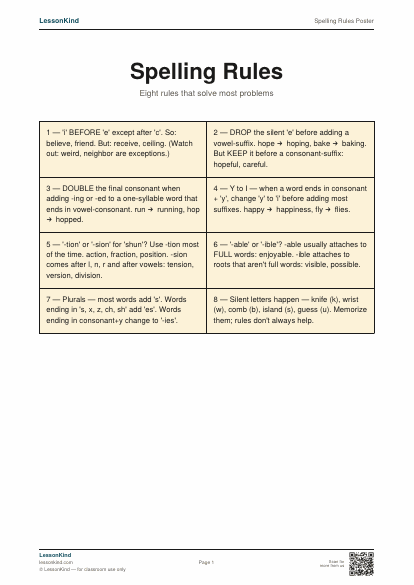
Spelling Rules Poster
Eight common spelling rules every elementary writer should know — i before e, doubling letters, and more.
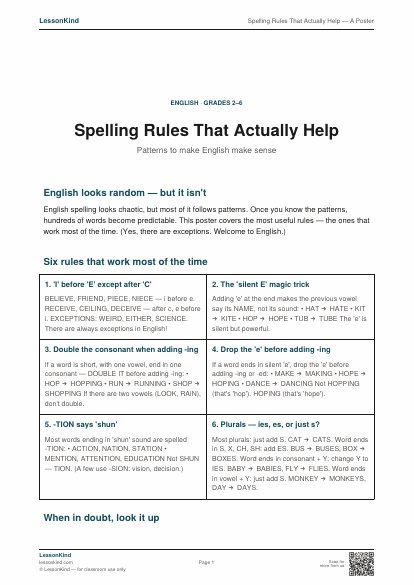
Spelling Rules That Actually Help — A Poster
The spelling rules that make English make sense — i before e, doubling consonants, dropping the e, and the magic of -tion. With clear examples.
Spelling Rules Poster
Eight common spelling rules every elementary writer should know — i before e, doubling letters, and more.
Going deeper
Books on teaching spelling
Books we'd recommend on the topics raised in this article.
Practitioner
Convenience links to Amazon. As an Amazon Associate we earn from qualifying purchases at no extra cost to you. Read our affiliate disclosure.
Keep reading
Reading & literacy
Phonics vs Whole Language: The Fight Is (Mostly) Over
The 'reading wars' tore at education for decades. Here's where the science of reading has actually landed — and what it means for your classroom.
8 min read
Reading & literacy
Phonics Screening: A Parent's Honest Guide
Every June, parents of UK Year 1 children worry about a 40-word test their child has to take. Here's what it's actually measuring, what the result means, and what to do about it — including the bit most schools don't tell you.
8 min read
Reading & literacy
Why Children Hate Writing (And What Actually Helps)
Most children love drawing and storytelling. Many start to hate writing somewhere around Year 3. Here's why, and what teachers can do about it.
6 min read