Reading & literacy · 6 min read
Why Children Hate Writing (And What Actually Helps)
The four reasons children stop writing — and the small shifts that bring them back
Published 2026-10-21
Watch a Reception class during a mark-making activity. Children are absorbed, inventive, drawing-and-writing fluently in their own way. Watch a Year 4 class on a writing task and you'll see hands up everywhere — "I don't know what to write". "Do I have to write?". "How long does it have to be?"
What happened?
Children don't naturally hate writing. Something happens to them between Reception and Year 4 that turns it from joy into chore. Understanding *what* happens points the way to fixing it.
The four reasons children stop writing
**1. The physical demand becomes punitive.**
Writing is hard. Holding a pencil, forming letters, spacing them, keeping them on a line — it's an exhausting motor task for children whose hand muscles aren't yet strong. By Year 3, children are expected to write in greater quantity, and the children who never quite mastered the physical act fall behind.
For children with poor handwriting, a 30-minute writing task can be physically painful. They're focused on hand-cramp, not ideas. When a teacher then says "I want more detail", they think: I can't physically write more. They start refusing.
**Fix:** Take handwriting seriously. Five minutes a day of explicit handwriting practice through KS2 (yes, even in Y6) saves thousands of hours of struggle. Look at hand position, pencil grip, letter formation. Don't assume they "got that in KS1".
**2. The cognitive load is hidden.**
When an adult writes, three things happen: planning what to say, choosing the words, and physically getting them onto paper. Adults don't notice these as separate tasks because they're automated.
Children are doing three new tasks at once, every single sentence. They run out of working memory.
**Fix:** Separate the tasks. Plan orally first. Have the children rehearse the sentence aloud before writing it. Use sentence starters. Use word banks. Anything that reduces the number of decisions per sentence.
**3. The rewards are abstract.**
When children draw, the reward is immediate — they see their picture, they're proud of it. When they speak, the reward is immediate — someone listens.
When they write, the reward is... a tick? A "well done"? Maybe a comment if the teacher has time? The gap between effort and reward is huge.
**Fix:** Build in immediate rewards for writing. Read aloud what they wrote. Display work where it's seen by other children. Have writing "performances" — they read their piece to the class. Make the audience real.
**4. The criticism feels personal.**
Most marking is corrective. Spelling errors circled, missing capitals marked, "needs full stops" written at the bottom. Children who hand in their best effort and get back a page of red marks learn quickly that writing produces criticism.
This is a marking-policy problem more than an individual-teacher problem. But it's lethal for motivation.
**Fix:** For most pieces, mark for *one thing* (say, varied sentence openers). Let everything else go. Children get praised for what they did, then know what to focus on next time. After ten weeks of focused marking, you've covered ten genuine improvements rather than confused them with everything-at-once.
What writing-confident classrooms look like
The classes where children are visibly enthusiastic about writing tend to share these features:
- **Writing is talked about as craft, not chore.** The teacher gets visibly excited about a great sentence, talks about what makes it good, has favourite authors. - **Children write for real audiences.** Letters to actual people. Stories read aloud. Newspapers that get printed and pinned up. - **Drafts are normal.** First drafts are messy and that's expected. Editing is its own lesson. - **Less is asked, but better is expected.** A confident teacher might ask for 100 words of really polished writing rather than a full page of mediocre output. - **Reading and writing are connected.** "Notice what this writer does. Try it in your piece." The children see writing as borrowing techniques from real authors.
The classroom shift that helps the most
If you do one thing this term, do this: **before any writing task, spend 10 minutes orally rehearsing.**
"We're going to write about your weekend. Turn to your partner. Tell them three sentences about your weekend. Now listen to your partner's. Now you're going to write yours down."
The children who can't write fluently can almost always *speak* fluently. By the time they sit down to write, they have the whole piece in their heads. The cognitive load drops dramatically. What was "I don't know what to write" becomes "I just need to remember what I said."
It's such a simple intervention, but the change in writing volume and quality across a class is sometimes startling.
When a child genuinely refuses
For the children who actively refuse to write — pencil down, head on the desk, arms folded — the issue is almost never laziness. It's usually:
- Anxiety about getting it wrong - Frustration with handwriting - Genuine difficulty getting ideas out - A history of being publicly criticised for writing
The fix is not pressure. The fix is reducing the demand temporarily — allow them to dictate, allow shorter pieces, build success — and then gradually build the volume back. Six weeks of voluntary, low-pressure writing usually rebuilds what eighteen months of pressure damaged.
Free bundle for this topic
EYFS Essentials Pack
8 early-literacy essentials — provision, phonics-readiness, mark-making and storytime support.
Practical resources for this
Take this further
Printable, classroom-ready resources for the topics in this article.
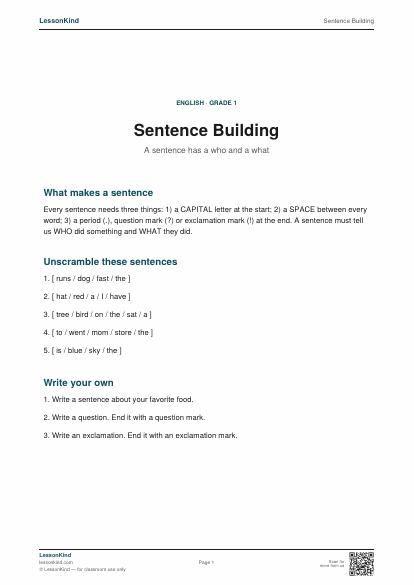
Sentence Building
Build complete sentences from word banks. Practice capital letters, spaces, and end punctuation.
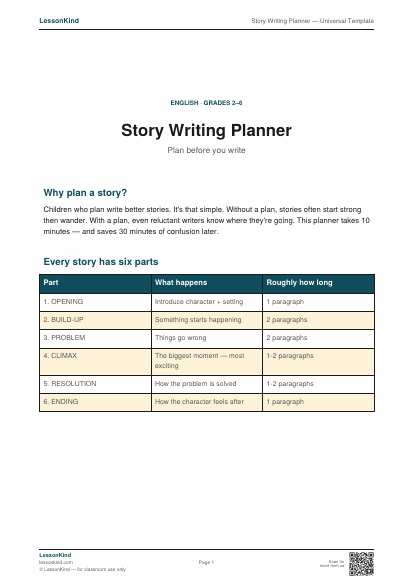
Story Writing Planner — Universal Template
A six-section story planner that works for any narrative — opening, build-up, problem, climax, resolution and ending. Print one per child before any story task.
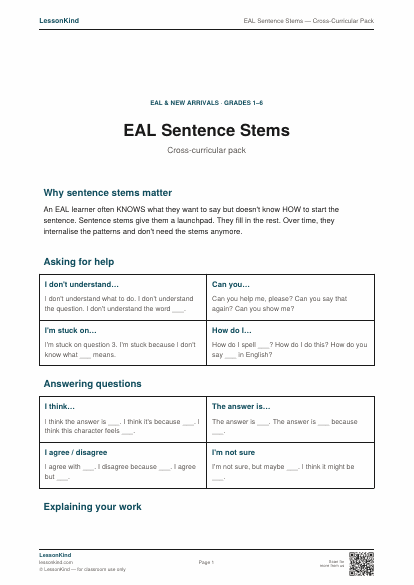
EAL Sentence Stems — Cross-Curricular Pack
Sentence starters for every part of the school day — answering questions, giving opinions, explaining work, asking for help. Print, laminate, give the child their own copy.
Going deeper
Books on teaching writing
Books we'd recommend on the topics raised in this article.
Practitioner
Convenience links to Amazon. As an Amazon Associate we earn from qualifying purchases at no extra cost to you. Read our affiliate disclosure.
Keep reading
Assessment & feedback
How to Give Feedback That Actually Changes the Work
Most marking has almost no effect on student work. Here's what does — and what to stop doing immediately.
7 min read
Assessment & feedback
Feedback That Changes the Work
Decades of research on feedback in education converge on one uncomfortable finding: most feedback given in classrooms produces little or no improvement. Here's what actually works.
7 min read
Teaching strategy
What I Wish I'd Known About Classroom Talk
We ask thousands of questions a year. Most of them produce shallow answers. Here's how to ask better ones — and what to do with the answers.
6 min read
Teaching strategy
Differentiating Math Without Burning Out
You don't need three separate lesson plans every day. Here's how to differentiate math meaningfully without doubling your prep.
6 min read