First-year teaching · 7 min read
Supply Teaching: How to Walk Into an Unknown Classroom and Have a Good Day
From the perspective of teachers who've done it well — and those who haven't
Published 2026-05-14
Supply teaching — or substitute teaching — is routinely underestimated as a professional skill. It requires almost everything a permanent teacher needs, deployed faster, with none of the relationship infrastructure.
You have no existing relationship with the class. You don't know their names, their dynamics, who the attention-seekers are, who the SEN pupils are, or what 'a normal lesson' looks like here. The children know you don't know these things — and some of them will test what that means.
Here's what works.
The first five minutes are everything
You don't have September. You have now.
Stand at the door before pupils enter. Greet them individually — "Good morning" — and direct them to their seats. Don't let them pile in unsupervised while you're looking at the work set.
Before they sit down, introduce yourself. Full name. Write it on the board. ("My name is Miss Khan. I'll be your teacher today.")
Then immediately — before a word of work — set the expectation for the day. Two sentences: "I don't know your class yet, which means today is an opportunity for me to learn that you're brilliant. Your teacher will hear exactly how today went."
The second sentence matters. It signals accountability without threatening. It's true. And the children know it's true.
Narrate routines you don't know
You don't know how this teacher usually does things. Say so. "I don't know your exact routine for this, so here's what we're going to do today." Most children respond well to honesty. They don't need you to pretend to know things you don't.
What you cannot be uncertain about: the expectation that they do the work. That must be absolute.
Find the class helpers
Every class has 2–3 pupils who know how the classroom works and want to demonstrate that they do. These are your allies. Give them a small responsibility immediately — "Can you help me hand out these books?" — and they become invested in the lesson going well.
Use names as quickly as possible
If there's a seating plan — use it. If there isn't, spend the first activity quietly getting names from as many pupils as possible and writing them down. Knowing someone's name changes the quality of every interaction you have with them.
If you can't learn names fast enough, address pupils by their seat position ("the person in the middle of row two") rather than "you" — "you" sounds dismissive and tends to escalate.
When behaviour deteriorates
Behaviour almost always deteriorates by the end of the day, especially on a Friday, especially if the relationship hasn't been built.
The key: don't escalate. Match any escalating behaviour with de-escalation — quieter, slower, more deliberate. Never raise your voice if you can avoid it, because it signals that you've lost control and invites children to test that further.
Give pupils an easy way to comply. "I'd like you to open your book to page 6" is easier to comply with than "stop talking". The more concrete the instruction, the easier it is for a child to choose compliance.
Use the class behaviour system, whatever it is. Don't invent your own and don't ignore poor behaviour hoping it'll resolve — it won't. Low-level persistence is the most effective tool: short, quiet, private reminders rather than public confrontations.
What to do if you have no work set
This happens. A teacher is ill suddenly, there's no work.
Have a set of go-to activities in your head or your bag: - For English: five-minute free writing on a stimulus you provide; improve these five sentences; write a letter to yourself from ten years in the future - For maths: times tables relay; write your own word problem; ordering numbers challenge - For any subject: "Write everything you know about [topic you just scanned from the classroom displays]" - For any year group: a structured read-aloud and discussion works for most classes
End well
The end of day is as important as the beginning. Clear up deliberately, with the class. Give a brief, specific acknowledgment of what went well: not "what a great class" but "table 3 worked really hard in the second lesson and I'm going to mention that."
Leave the classroom tidy. Leave a note for the class teacher — brief, factual, noting any incidents or unusually strong work. This is professional courtesy and often the thing that determines whether you get called back.
The honest truth about supply teaching
Supply teaching is exhausting precisely because it's all the hard parts of teaching with none of the sustaining relationship that makes the hard parts worthwhile. A regular teacher draws energy from knowing their class, watching them develop, and the moments of genuine connection that accumulate over months.
Supply teaching offers a different version of this: breadth over depth. You see more classrooms, more schools, more children. You develop an adaptive flexibility that many permanent teachers never need. And occasionally, you have a day with a class that's just brilliant — and that carries you too.
Free bundle for this topic
The Starter Pack
18 free resources spanning every subject — the universal new-teacher starter.
Practical resources for this
Take this further
Printable, classroom-ready resources for the topics in this article.
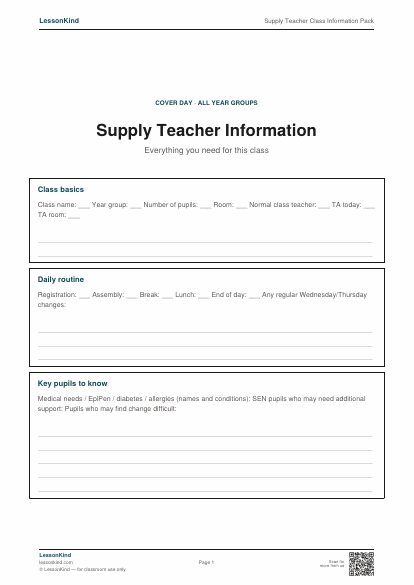
Supply Teacher Class Information Pack
One-page template for classroom teachers to leave for supply cover — class rules, daily routines, key pupils to know, and emergency contacts. Print and keep in the cover folder.
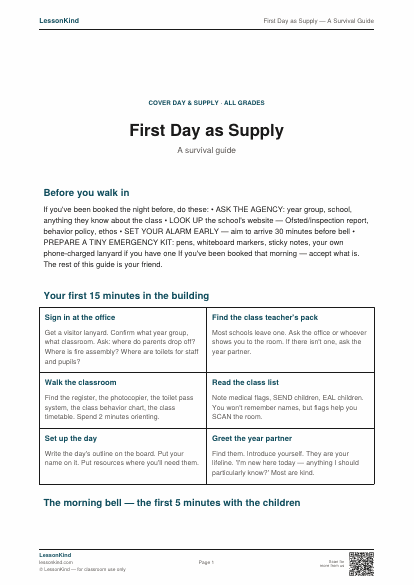
First Day as Supply — A Survival Guide
What to do in your first 15 minutes in an unfamiliar classroom. How to win the morning before the children arrive. How to manage the rest of the day. Field-tested supply teacher survival.
Going deeper
Books for supply and cover teachers
Books we'd recommend on the topics raised in this article.
For supply teachers
Convenience links to Amazon. As an Amazon Associate we earn from qualifying purchases at no extra cost to you. Read our affiliate disclosure.
Keep reading
First-year teaching
Five Mistakes I Made as a New Elementary Teacher
If I could go back and shake my first-year teacher self by the shoulders, here's what I'd say.
7 min read
Classroom culture
The Most Important Week of the Year
Most teachers think the first week is for getting to know the children. The teachers whose classrooms run beautifully use it for something quite different.
6 min read