Teacher wellbeing · 7 min read
Teacher Burnout: The Warning Signs and What Actually Helps
Beyond bubble baths — the structural causes of burnout and realistic approaches to recovery
Published 2026-05-22
Burnout is a state of chronic exhaustion, cynicism, and reduced professional efficacy caused by sustained workplace stress. It is more serious than being tired at the end of term. It is more serious than finding work hard. It is a clinical syndrome with measurable symptoms and, left unaddressed, significant health consequences.
Teaching has some of the highest burnout rates of any profession. The causes are well-documented: high emotional labour, ambiguous success criteria, insufficient autonomy, workload disconnected from educational outcomes, and a culture in which admitting difficulty is read as professional inadequacy.
The three components of burnout
Christina Maslach's research — the most cited framework — identifies three components:
**Exhaustion** — feeling depleted of emotional and physical resources. Not the normal tiredness of a busy term but a tiredness that sleep doesn't fix, that feels cumulative, that doesn't lift during holidays.
**Depersonalisation** — emotional detachment from the work and the people in it. Referring to children as 'them'. Finding it hard to care about individual pupils. Losing the warmth that characterised your early teaching. This is the most professionally distressing symptom and the one teachers are least likely to admit to.
**Reduced efficacy** — a pervasive sense that what you do doesn't matter, that your efforts don't produce results, that the good work you used to produce is now beyond you.
What doesn't help
Self-care advice that focuses on individual coping strategies (exercise, meditation, time management) has weak evidence when the causes of burnout are structural. A teacher whose workload is unreasonable will not be fixed by a yoga class. A teacher whose school culture is toxic will not recover by going to bed earlier.
This is not to say individual strategies are useless — they can build resilience and maintain wellbeing during difficult periods. But they address symptoms, not causes.
What actually helps
**Addressing workload at source.** The most significant predictor of teacher burnout is workload volume and its perceived meaningfulness. Workload reduction strategies that focus on eliminating tasks that don't improve outcomes (certain marking policies, excessive data entry, unnecessary planning formats) are more effective than workload management strategies.
**Autonomy.** Teachers with more control over how they teach their class show lower burnout rates. This is partly about policy (less prescription) and partly about culture (leaders who trust teachers' professional judgement).
**Genuine collegial support.** Not enforced wellbeing activities, but authentic peer relationships where difficulty can be named honestly. Schools where teachers say 'I'm struggling with this class' and receive practical help rather than performance concern have lower burnout rates.
**Talking to someone outside work.** This may mean a GP (burnout has physiological components), a therapist, or the Education Support Partnership helpline (0800 562 561 — free, confidential, for education workers).
**Permission to do less.** The perfectionistic standards that good teachers set themselves are often the direct cause of their exhaustion. Sometimes the most important professional decision is to decide which things are good enough and stop trying to make them excellent.
Free bundle for this topic
The Starter Pack
18 of our best free resources — a way to spend less time prepping and more time recovering.
Practical resources for this
Take this further
Printable, classroom-ready resources for the topics in this article.
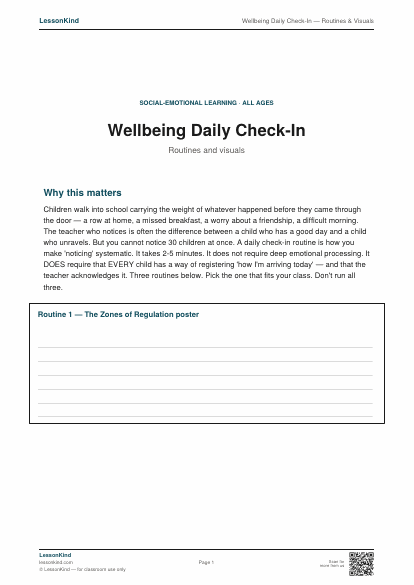
Wellbeing Daily Check-In — Routines & Visuals
Three classroom routines for daily wellbeing check-ins — Zones of Regulation poster, How am I arriving today wheel, and a class wellbeing tracker. Print, mount, use every morning.
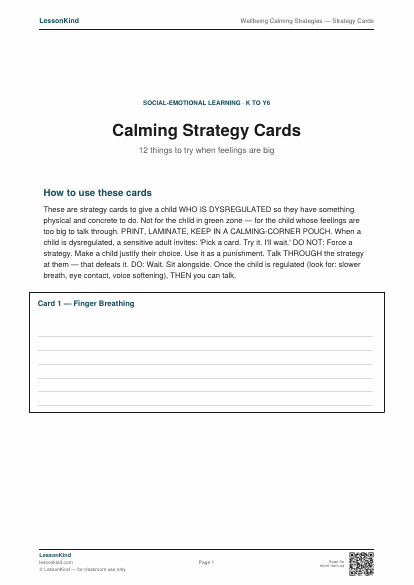
Wellbeing Calming Strategies — Strategy Cards
12 calming strategy cards for children — finger breathing, 5-4-3-2-1 grounding, slow drink of water, hand-press, bubble breathing, animal walks, and more. Print, laminate, give one to a child who needs to regulate.
Keep reading
Teacher wellbeing
When a Child Gets Under Your Skin
Almost every teacher has a child they find genuinely difficult to warm to. Acknowledging this is not a failure — it's the beginning of doing something about it.
6 min read
Teacher wellbeing
When a Child Gets Under Your Skin
Almost every teacher has a child they find genuinely difficult to warm to. Acknowledging this is not a failure — it's the beginning of doing something about it.
6 min read