EAL New Arrival — First Day Checklist
What to do in the first hour, first morning and first afternoon when a child with no English joins your class. Practical, kind, ready to print.
Preview
Page count: 6. Print-ready PDF — letter / A4 friendly. Click image to see all pages.
Learning objective
Provide a structured response for the day a child with little or no English first arrives.
About this resource
- Subject: EAL & New Arrivals
- Type: Checklist
- Grade levels: Kindergarten (ages 4-6, ≈ Reception / Y1), Grade 1 (ages 6-7, ≈ Year 2), Grade 2 (ages 7-8, ≈ Year 3), Grade 3 (ages 8-9, ≈ Year 4), Grade 4 (ages 9-10, ≈ Year 5), Grade 5 (ages 10-11, ≈ Year 6), Grade 6 (ages 11-12, ≈ Year 7)
- Pages: 6
- Date added: 2026-08-10
- Credit: Qualified primary teacher
EAL — recommended reading
Books on welcoming, supporting and teaching new arrivals.
Practitioner foundations
-
S
Scaffolding Language, Scaffolding Learning — Pauline Gibbons
The book most-quoted by EAL specialists - A Adding English: A Guide to Teaching in Multilingual Classrooms — Liz Coelho
- E English as an Additional Language: Approaches to Teaching Linguistic Minority Students — Constant Leung, Charlene Solomon
Disclosure: Links above go to Amazon. LessonKind may earn a small commission if you buy via these links — at no extra cost to you. We only link to books and items we already recommend in our resources. We are not paid by Amazon to recommend specific titles.
Part of these collections
Curated bundles where this resource appears alongside related ones.
Read more about this
Articles that go deeper on the topic this resource covers.
EAL & inclusion · 9 min read
Teaching a Child Who Doesn't Speak Any English Yet
When a new arrival is sat at the back of your class with no English and no warning, here's what to do in the first hour, the first week and the first term.
EAL & inclusion · 6 min read
The Silent Period — Why Your EAL Child Isn't Speaking
When a new EAL arrival barely speaks for weeks, teachers worry. The silent period is well-documented in the research, almost universal, and often a sign of cognitive work happening below the surface.
EAL & inclusion · 6 min read
A New EAL Pupil's First Week: What Actually Helps
When a child who speaks little or no English joins your class, the first week shapes everything that follows. Here's what experienced teachers do — and what they avoid.
EAL & inclusion · 6 min read
A New EAL Pupil's First Week: What Actually Helps
When a child who speaks little or no English joins your class, the first week shapes everything that follows. Here's what experienced teachers do — and what they avoid.
You might also like
Selected based on subject, grade, and type — with a free option always included.
EAL Quick Reference — One Page for Mainstream Teachers
A one-page reference card summarising the most important things mainstream teachers need to know when supporting EAL learners. Print and stick on your desk.
EAL Initial Language Assessment Form
A printable form for the first formal EAL assessment — based on the DfE Proficiency in English scale. Use in week 2-4 once child has settled.
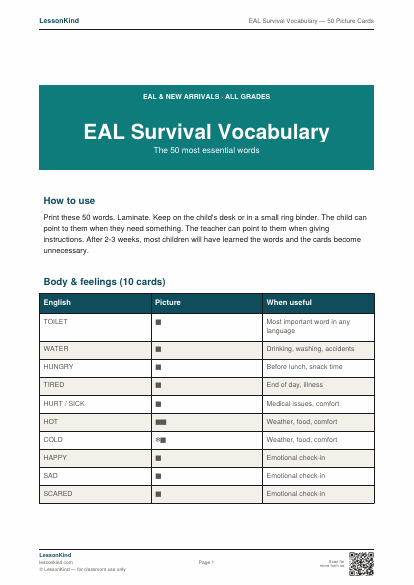
EAL Survival Vocabulary — 50 Picture Cards
The 50 most essential English words for a new arrival — toilet, water, hungry, hurt, friend, help. Picture cards to laminate and use daily.
EAL Classroom Communication Board
A single-sheet visual board children can point to when they don't have the English to say what they need. Print A3, laminate, mount on the wall.
EAL Math Vocabulary — Picture Cards
40 essential math words for EAL learners — add, subtract, equals, more, less, half. Each with a visual cue and example sentence.
EAL Sentence Stems — Cross-Curricular Pack
Sentence starters for every part of the school day — answering questions, giving opinions, explaining work, asking for help. Print, laminate, give the child their own copy.